

Real estate investment often depends on timing, structure, financing, tax planning, and the ability to complete transactions efficiently. For investors who want to acquire property through a corporate entity rather than personally, a shelf company can provide an already incorporated structure that may reduce the time required to establish the company itself.
A shelf company – also known as a ready-made company – is generally incorporated in advance and maintained without active trading until ownership is transferred to a buyer. For property investors, it can potentially serve as a corporate vehicle for acquiring, holding, leasing, developing, or managing real estate. However, buying a shelf company does not automatically provide financing, tax advantages, property ownership rights, or regulatory approval. The structure must be appropriate for the jurisdiction and intended investment.
What Is a Shelf Company in Real Estate Investment?
A shelf company is an existing legal entity that was incorporated earlier and subsequently kept dormant or inactive until a buyer acquired it. Instead of creating a completely new company before purchasing property, an investor can take ownership of an existing corporate entity.
Investors considering this structure can review the range of ready-made companies available worldwide before deciding which jurisdiction and corporate form may suit their proposed investment.
Once ownership has been legally transferred and all required company information has been updated, the shelf company may potentially be used as a property-holding vehicle. Whether this is possible – and whether it is commercially sensible – depends on local company law, property law, tax rules, financing requirements, and restrictions applicable to foreign or corporate property owners.
Why Use a Company to Hold Real Estate?
Holding real estate through a corporate structure can separate the property investment from an investor’s other personal or commercial activities. A company can also make it easier to establish a defined ownership structure where multiple shareholders or investors participate in the project.
Depending on local law, corporate ownership may also support succession planning, joint ventures, portfolio management, property development, or the separation of different properties into individual investment vehicles.
However, incorporating property into a company does not automatically make the investment more tax-efficient. Corporation tax, capital gains, property transfer taxes, stamp duties, VAT, withholding taxes, annual property taxes, and taxes on distributions can all affect the final position.
Benefits of Using a Shelf Company for Property Investment
Faster Corporate Setup
One of the clearest advantages is that the legal entity already exists. Investors do not need to wait for the initial company incorporation process before beginning the next stages of their investment.
This can be particularly useful where a property opportunity has a defined completion timetable. The investor still needs to complete KYC, ownership transfer, banking, tax registration, and any property-specific requirements, but the company incorporation itself has already taken place.
Existing Incorporation Date
A shelf company retains its original incorporation date after ownership changes. This may be useful where an investor has a genuine commercial reason for requiring an existing entity.
It is important, however, to distinguish company age from business history. A company incorporated several years ago but kept dormant does not automatically have several years of property investment experience, revenue, credit history, or completed transactions.
Separate Property-Holding Structure
Using a shelf company can provide a distinct legal vehicle through which the real estate asset is held.
This may be useful for investors who want to separate individual investments, establish a property-specific special purpose vehicle, bring different investors into a particular project, or distinguish real estate assets from another operating business.
Potentially Easier Portfolio Organisation
Investors building a larger portfolio may use separate corporate entities for different assets or projects, subject to professional legal and tax advice.
This can make ownership structures clearer and may help investors organise different partners, financing arrangements, liabilities, and investment strategies.
Investors looking at established markets may, for example, consider a UK shelf company where a UK corporate structure is appropriate for their intended activities. The company must still comply with applicable UK corporate, property, tax, and beneficial ownership requirements.
Shelf Company vs New Company for Real Estate
| Factor | Shelf Company | New Company |
|---|---|---|
| Incorporation | Already completed | Created from scratch |
| Incorporation date | Existing | Current |
| Trading history | Usually none if dormant | None |
| Due diligence | Extensive checks required | Generally simpler |
| Initial cost | Usually higher | Usually lower |
The better structure depends on the transaction. If there is no commercial benefit from acquiring an existing entity, incorporating a new company may be simpler and more cost-effective.
Also read: How to Buy a Shelf Company
Process for Using a Shelf Company for Real Estate Investment
Using a shelf company for property investment requires more than purchasing an existing entity. The company must be verified, transferred correctly, prepared for its intended activity, and compliant with property regulations in the relevant jurisdiction.
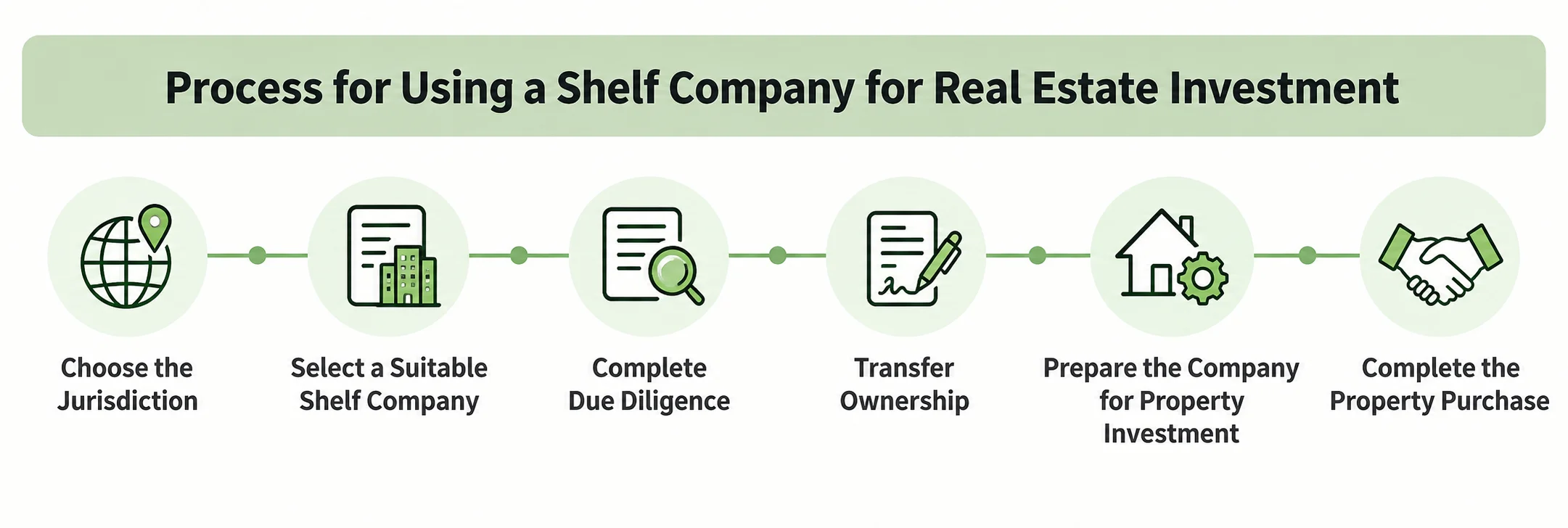
Choose the Jurisdiction
Start by determining where the property will be located and whether corporate ownership is permitted.
Different countries – and sometimes different regions within the same country – impose different rules on foreign investors, corporate property ownership, beneficial ownership disclosure, land registration, taxation, and financing.
Select a Suitable Shelf Company
Choose an entity with the appropriate legal form, incorporation jurisdiction, corporate status, and history.
The objective should not simply be to purchase the oldest available company. The company should have a clean and verifiable corporate history and be appropriate for the intended property activity.
For investors targeting the American market, available USA shelf companies can provide an existing US corporate entity, although property ownership, taxation, financing, and foreign-investment rules must be reviewed separately.
Complete Due Diligence
Before acquiring the company, verify its complete history.
Checks should generally cover:
- Incorporation and registry status
- Previous shareholders and directors
- Annual filings and accounts
- Existing debts or liabilities
- Registered charges
- Tax position
- Litigation or legal disputes
- Dormant or trading history
A company should never be selected for a property transaction based only on its incorporation certificate or age.
Transfer Ownership
Once due diligence and KYC requirements have been completed, ownership can be transferred to the investor.
Depending on the jurisdiction, this may involve share transfer documents, shareholder resolutions, director appointments, beneficial ownership updates, registered office changes, company registry filings, and delivery of statutory records.
Prepare the Company for Property Investment
After acquisition, the company may need to update its registered activities, tax registrations, accounting arrangements, insurance, banking arrangements, and other corporate information before entering into a property transaction.
Investors should also confirm that the company’s constitutional documents and business activities allow the proposed real estate activity.
Complete the Property Purchase
The company can proceed with the property transaction once the corporate structure is properly established and all relevant legal, banking, financing, tax, and property requirements have been satisfied.
The property title should be registered correctly in accordance with local law, and the beneficial ownership and source of funds should be disclosed wherever required.
Key Risks Investors Should Consider
Hidden Corporate Liabilities
The main company-specific concern is inheriting problems that existed before the acquisition.
Outstanding filing penalties, unpaid fees, tax issues, registered charges, contractual obligations, or other liabilities could affect the entity. This is why independent due diligence is particularly important before using an existing company to hold a valuable real estate asset.
Banking and Financing Scrutiny
Purchasing an older company does not guarantee a mortgage, bank account, or investment finance.
Financial institutions generally assess the current beneficial owners, source of funds, business purpose, property, income, collateral, and overall risk profile. Banks may also ask why an older dormant company has recently changed ownership.
An incorporation date should therefore never be presented as evidence of trading activity that did not occur.
Tax Consequences
Corporate property ownership can create a very different tax position from personal ownership.
Taxes can arise when purchasing the property, receiving rental income, disposing of the property, distributing profits, or transferring shares in the company. Cross-border structures can introduce additional tax-residency and withholding considerations.
Specialist tax advice should therefore be obtained before the structure is finalised rather than after the property has already been acquired.
Property Ownership Restrictions
Not every jurisdiction treats corporate and foreign property buyers equally.
Certain types of land may be restricted, additional approvals may be necessary, and some jurisdictions impose special taxes or reporting obligations on companies owning residential or investment property.
The fact that a company is legally incorporated in a jurisdiction does not by itself mean that it can purchase every category of property there.
Due Diligence Before Putting Property Into a Shelf Company
The higher the value of the intended property investment, the more important the corporate due diligence becomes. Investors should obtain up-to-date registry records and verify that the entity has been maintained correctly throughout its existence.
The seller should also be able to provide the corporate documentation required to establish ownership and history. Any unexplained transaction, previous trading activity, missing filing, liability, charge, or ownership discrepancy should be investigated before completion.
Ready Made Companies Worldwide also provides detailed information on this process in Important Questions to Ask Before Buying a Shelf Company.
Can International Investors Use Shelf Companies for Property?
Potentially, yes. A shelf company can be particularly relevant to international investors who require a corporate presence in the country where they intend to invest.
However, purchasing a local company does not automatically remove restrictions imposed on foreign beneficial owners. Authorities, banks, lawyers, estate agents, and other regulated professionals may still need to identify the individuals who ultimately own or control the company.
Cross-border investors should therefore examine company law, property ownership rules, beneficial ownership reporting, tax residency, double-tax agreements, financing restrictions, and repatriation of rental or sale proceeds before proceeding.
When Can a Shelf Company Make Sense for Real Estate?
A shelf company can be worth considering when an investor genuinely requires an existing legal entity and the structure has been reviewed for the proposed property transaction.
It may be relevant when:
- A transaction requires a corporate purchasing vehicle
- Investors need to establish a local legal entity quickly
- Several investors will hold the project through one company
- A property portfolio requires a separate holding structure
- An existing corporate entity provides a genuine transactional benefit
The decision should be based on legal, commercial, tax, and investment considerations rather than simply the age printed on the company’s incorporation certificate.
Final Thoughts
Using a shelf company for real estate investment can provide an already incorporated corporate vehicle and may support faster preparation for a property transaction. However, the company itself is only one part of the structure. Investors must verify its history, complete ownership changes, satisfy KYC and beneficial ownership requirements, arrange banking and taxation, and confirm that the company can legally acquire the intended property.
Ready Made Companies Worldwide can help investors identify suitable ready-made companies across multiple jurisdictions and coordinate the ownership transfer process. Contact Us to discuss your proposed investment, preferred jurisdiction, and company requirements so that you can begin with an appropriate corporate structure.