
Buying an existing company can be a practical option when you need an incorporated business entity without starting the incorporation process from scratch. However, understanding how to buy a shelf company involves much more than selecting an available company and paying the purchase price. Buyers need to check the company’s history, complete compliance requirements, transfer ownership correctly and prepare the entity for its intended business activities.
A shelf company, sometimes called a ready-made company, is generally incorporated in advance and maintained without active trading until it is purchased. Importantly, purchasing a shelf company does not automatically give you trading history, customers, revenue, creditworthiness, contracts or a business bank account. The value lies in acquiring an existing legal entity, potentially with an earlier incorporation date, for a genuine commercial purpose.
What Is a Shelf Company?
A shelf company is an existing corporate entity established in advance and kept available for a future purchaser. Rather than incorporating an entirely new company, the buyer acquires an existing entity and completes the necessary ownership and management changes. Depending on the company and jurisdiction, the entity may already have
- A registration number
- Certificate of incorporation
- Constitutional documents
- An existing incorporation date
- Issued share capital
- Statutory records
- Registered office arrangements
- Previous dormant filings
Some shelf companies may have been incorporated relatively recently, while others have existed for several years. Older entities are commonly referred to as aged shelf companies.
An important distinction is that company age does not automatically equal trading experience. For example, a company incorporated in 2021 and kept dormant until 2026 has existed for five years, but it does not therefore have five years of active trading history.
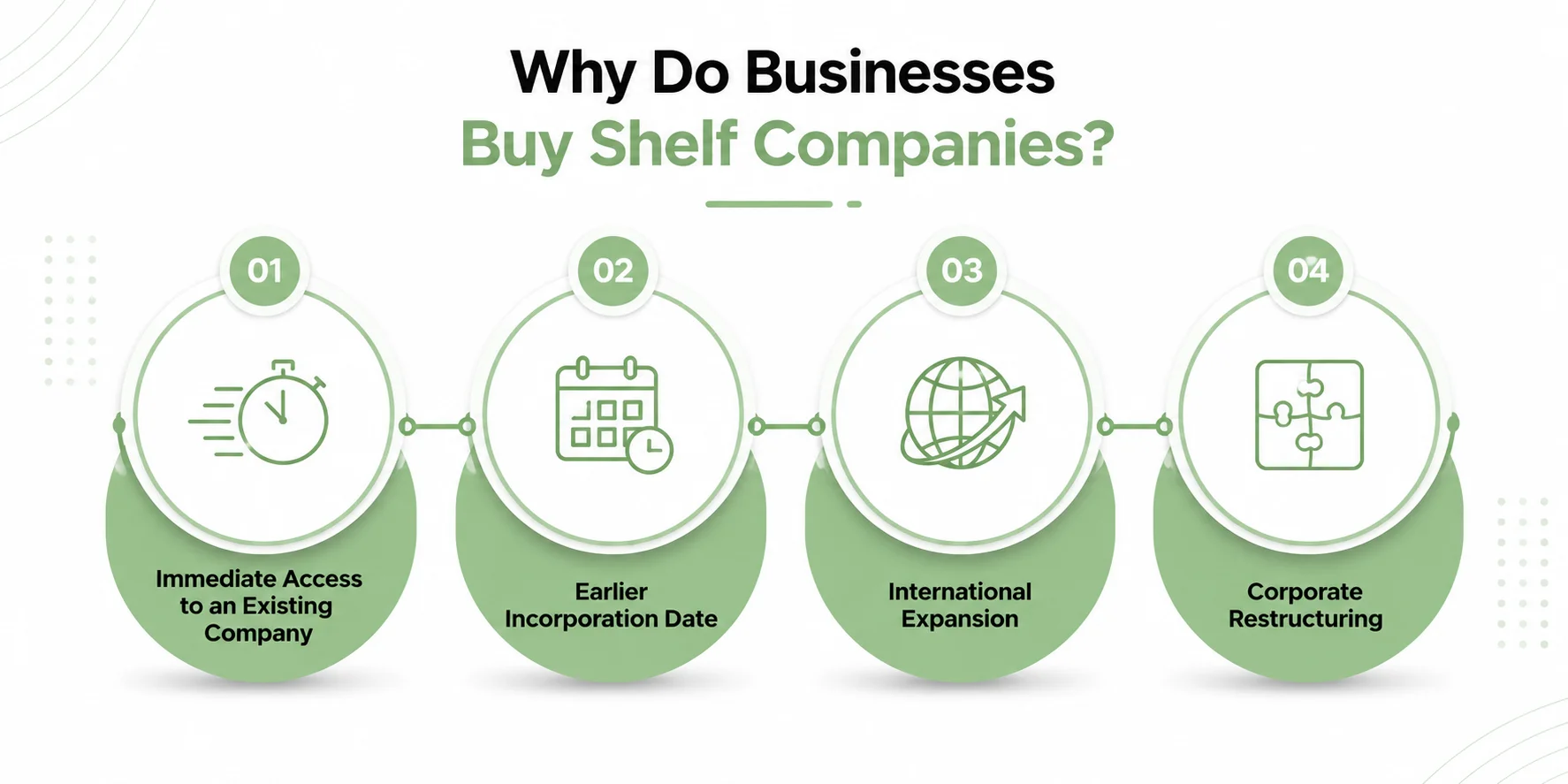
Why Do Businesses Buy Shelf Companies?
Although forming a new company is relatively straightforward in many jurisdictions, there are circumstances in which purchasing an existing entity can serve a legitimate business purpose.
-
Immediate Access to an Existing Company
The company has already been incorporated, so the transaction focuses on transferring and updating an existing legal entity rather than creating one from the beginning. This may suit businesses dealing with time-sensitive corporate transactions, international expansion or restructuring.
-
Earlier Incorporation Date
Some businesses have a genuine commercial reason for requiring an entity with an earlier incorporation date. An aged shelf company can provide this characteristic, although buyers should never represent the company’s age as evidence of trading history that does not exist.
-
International Expansion
An international organisation may use a ready-made company when establishing operations in another jurisdiction. The entity might ultimately become
- A subsidiary
- A regional company
- Part of a corporate group
- A vehicle for local operations
Businesses expanding internationally can also explore jurisdiction-specific options, including shelf companies in Australia.
-
Corporate Restructuring
Existing groups may also require additional companies when reorganising operations or creating new subsidiaries. Where complex ownership, cross-border taxation or regulatory requirements are involved, appropriate legal and tax advice should be obtained.
How to Buy a Shelf Company – The Complete Process?
The exact procedure varies according to the provider, company and jurisdiction, but a properly managed purchase will normally involve the following stages.
Step 1 – Define Your Requirements
Before asking which companies are available, determine exactly what your business requires. Consider
- Jurisdiction
- Preferred incorporation date
- Intended activities
- Company type
- Ownership structure
- Number of directors
- Number of shareholders
- Registered office requirements
- Intended trading date
- Licensing requirements
Choosing the oldest company available simply because of its age is rarely a good strategy. The company should match a specific business objective.
Step 2 – Enquire About Available Shelf Companies
Once your requirements are clear, contact a specialist provider to identify suitable companies. The information available may include
- Company name
- Registration number
- Incorporation date
- Jurisdiction
- Company status
- Share structure
- Filing history
- Purchase price
- Included services
At this point, compare companies according to suitability and corporate history rather than age alone.
Step 3 – Review the Company’s History
Due diligence is one of the most important stages when learning how to buy a shelf company. For a UK company, its Companies House record can provide useful information about its corporate history. Review areas such as
- Incorporation details
- Filing history
- Accounts
- Confirmation statements
- Previous officers
- Registered office history
- Company name changes
- PSC information
- Charges
- Any unusual filing activity
Before proceeding, buyers should understand what to check before buying a shelf company, including its filing history, dormancy status and previous corporate changes.
Step 4 – Confirm What Is Included
Before paying for the company, establish exactly what is included within the purchase. Depending on the provider and jurisdiction, the package may include
- Certificate of incorporation
- Constitutional documents
- Share documentation
- Relevant statutory records
- Transfer documentation
- Registered office services for a defined period
Other services may cost extra, including company name changes, ongoing registered office facilities, accounting support and company secretarial services. A business bank account should not be assumed to be included or guaranteed. Banks conduct their own customer due diligence and decide independently whether to accept an applicant.
Step 5 – Understand the Cost
Shelf company prices vary considerably. The price can depend on
- Company age
- Jurisdiction
- Corporate structure
- Maintenance history
- Included services
- Transfer complexity
- Registered office arrangements
Aged companies generally cost more because they have been maintained over a longer period. In the UK, forming a completely new company directly through Companies House is considerably cheaper than purchasing most aged shelf companies. Companies House increased its digital incorporation fee to £100 from 1 February 2026.
Therefore, businesses should make sure the additional cost of purchasing an existing entity provides a genuine commercial benefit.
Step 6 – Complete KYC and Identity Checks
A reputable provider will normally conduct customer due diligence before transferring a shelf company. Depending on the circumstances, buyers may need to provide
- Passport or photographic identification
- Proof of address
- Director details
- Shareholder information
- Beneficial ownership information
- Details about intended activities
- Source-of-funds information where required
- Corporate documentation if another company is purchasing the entity
These checks are an important part of a compliant transaction.
Step 7 – Agree the New Ownership Structure
Before completing the transaction, establish how the company will look after acquisition. Confirm
- New shareholder or shareholders
- Shareholdings
- New directors
- PSCs
- Registered office
- Proposed company name
- Share structure
Establishing these details before preparing the final documentation can prevent unnecessary changes later.
Step 8 – Transfer the Shares
For a typical private company limited by shares, ownership is transferred through the relevant share-transfer procedure. Depending on the circumstances, this can involve
- Stock transfer documentation
- Updating the register of members
- Cancelling old share certificates
- Issuing new share certificates
- Recording the new ownership
- Considering applicable Stamp Duty requirements
The specific requirements depend on the transaction, so professional advice may be appropriate.
Step 9 – Update Directors and PSCs
Following the acquisition, director information should accurately reflect the company’s new management. The company’s PSC position should also be reviewed. For UK companies, incoming directors and relevant PSCs must comply with applicable Companies House identity-verification requirements. Accurate beneficial ownership information is an ongoing compliance responsibility, not merely paperwork associated with purchasing the company.
Step 10 – Update the Company’s Details
Once ownership has been transferred, other company information can be updated where necessary. Common changes include
- Registered office
- Company name
- Registered email
- SIC code
- Directors
- PSC information
- Shareholder information
- Share structure
Different changes may require different filings. Buyers should ensure that both the public register and the company’s own records accurately reflect its new position.
Step 11 – Update Corporate Records
The company’s internal records should also be updated as part of the transaction. Relevant documentation may include
- Register of members
- Share certificates
- Stock transfer forms
- Board or shareholder resolutions
- Constitutional documents
- Other statutory records
Updating Companies House does not necessarily replace the requirement to maintain accurate internal company records.
Step 12 – Complete the Handover
Once the necessary ownership and corporate changes have been completed, the provider can hand control of the company to the purchaser.
Shelf Company vs New Company
| Factor | Shelf Company | New Company |
| Incorporation | Already completed | Created from scratch |
| Incorporation date | Existing | Current |
| Trading history | Usually none if dormant | None |
| Corporate history | Must be reviewed | Starts fresh |
| Due diligence | Important | Usually simpler |
| Initial cost | Generally higher | Generally lower |
| Ownership | Transferred | Created for founders |
| Compliance dates | Existing | Begin with new entity |
| Best for | Specific commercial needs | Standard startups |
Neither structure is automatically better. A shelf company makes sense when acquiring an existing legal entity provides a genuine benefit. If there is no specific reason for doing so, new incorporation may be simpler and less expensive.
Why Buy Through Ready Made Companies Worldwide?
Purchasing a shelf company is not simply about selecting an incorporation date. The company needs to be appropriate for its intended use and transferred through a properly managed process. Ready Made Companies Worldwide helps entrepreneurs, investors and international businesses identify suitable ready-made companies across multiple jurisdictions.
Depending on your requirements, support can include selecting an appropriate company, coordinating the transfer process and helping ensure the company’s corporate details are updated correctly. Businesses can also contact RMC to discuss their requirements before choosing an entity.
Conclusion
Understanding how to buy a shelf company means looking beyond the purchase itself. A well-managed transaction moves from defining your requirements and reviewing available companies through due diligence, KYC, ownership transfer, corporate updates and final handover. After acquisition, additional work may still be required before the business becomes fully operational, including banking, taxation, accounting, insurance and licensing.
Most importantly, choose a shelf company because it meets a genuine business requirement, not simply because it is older. A clean history, appropriate structure, accurate records and proper compliance provide a much stronger foundation for the business than incorporation age alone. If you need help selecting the right shelf company for your requirements, Contact Us to discuss your options with our team.