

Starting or expanding a business often involves registration procedures, compliance checks, documentation, and administrative preparation before the company can operate. For entrepreneurs who have a genuine commercial reason to acquire an existing corporate entity, buying a shelf company can provide an alternative to incorporating a completely new business.
A shelf company is an already incorporated legal entity that has typically been maintained without active trading until a purchaser acquires it. It can offer an existing incorporation date and an established corporate structure, but buyers should understand its limitations. A shelf company does not automatically provide trading history, customers, revenue, financing, creditworthiness, contracts, or guaranteed banking access.
What Is a Shelf Company?
A shelf company – also known as a ready-made company – is a corporate entity incorporated in advance and kept available for a future purchaser. Instead of registering a completely new company, the buyer acquires the existing entity and completes the required changes to its ownership, management, and corporate records.
Depending on the jurisdiction and individual company, an existing shelf company may already have a registration number, certificate of incorporation, constitutional documents, share structure, registered office arrangements, statutory records, and previous dormant filings.
Businesses looking for an existing corporate entity can review available options through Ready Made Companies Worldwide, including companies established across different international jurisdictions.
Shelf Company vs Aged Shelf Company
The terms are closely related but are not always identical.
A standard shelf company may have been incorporated relatively recently. An aged shelf company has normally existed for a longer period while remaining dormant or inactive. Its principal distinguishing feature is therefore its earlier incorporation date.
That distinction is important because an older incorporation date should never be presented as evidence that the company has actively traded for the same period. A company may have legally existed for several years without having conducted business.
Also read – What Is an Aged Shelf Company and Is It Worth Buying?.
Why Buy a Shelf Company?
There is no single reason that makes a shelf company suitable for every entrepreneur. Its value depends on what the buyer is trying to achieve and whether an existing entity provides a meaningful advantage over incorporating a new one.
Faster Access to an Existing Corporate Entity
The company has already been incorporated, meaning the purchaser does not need to begin by creating the legal entity from scratch.
The transaction instead concentrates on verifying the company and transferring its ownership and control. This can be useful when a business has a time-sensitive expansion, restructuring, investment, or commercial requirement.
However, being already incorporated does not necessarily mean the company can immediately undertake every intended activity. Banking, tax registrations, licences, insurance, regulatory approvals, and other operational requirements may still need to be completed.
Existing Incorporation Date
One of the clearest reasons businesses consider aged shelf companies is their existing incorporation date.
An earlier incorporation date can be relevant where the age of the legal entity has a genuine commercial purpose. It may also be useful when structuring a group or acquiring an existing corporate vehicle rather than establishing another newly incorporated company.
The incorporation date must nevertheless be represented accurately. Corporate age should never be confused with revenue, trading experience, financial performance, or operational history.
International Business Expansion
International businesses may use ready-made companies when entering another jurisdiction. Instead of creating a new entity as part of an expansion project, the organisation may acquire an existing company and incorporate it into its wider corporate structure.
The acquired company could potentially operate as a:
- Local operating company
- Subsidiary
- Regional entity
- Investment vehicle
- Member of an international corporate group
Ready Made Companies Worldwide provides jurisdiction-specific options, including UK shelf companies for businesses considering an established corporate entity in the United Kingdom.
Corporate Restructuring
Shelf companies can also have a role in legitimate corporate restructuring.
A business group may require another legal entity when separating business activities, establishing a new subsidiary, reorganising ownership, preparing an investment structure, or entering another market.
The suitability of the arrangement should be considered alongside applicable legal, accounting, regulatory, and tax requirements.
Convenience
Purchasing a company that already exists can reduce some of the initial incorporation administration.
Certain corporate documents and records have already been created because the entity already legally exists. After acquisition, however, those records need to be reviewed and updated accurately to reflect the new directors, shareholders, beneficial owners, registered office, and other relevant information.
What Does Buying a Shelf Company Actually Give You?
It is important to distinguish between acquiring a company and acquiring an operating business.
A shelf company generally gives the purchaser ownership of an existing legal corporate entity. Depending on the company and jurisdiction, the handover may include incorporation documents, constitutional documents, share documentation, statutory records, and transfer documents.
It does not automatically provide
- Customers or suppliers
- Revenue or profits
- Genuine trading history
- Business contracts
- Employees
- Intellectual property
- Loans or finance
- Guaranteed creditworthiness
- Guaranteed banking approval
This distinction is particularly important when evaluating an aged company. The value of an earlier incorporation date should not be exaggerated into commercial achievements that the company never had.
Shelf Company vs New Company
Both structures can be appropriate depending on the circumstances.
| Factor | Shelf Company | New Company |
|---|---|---|
| Incorporation | Already completed | Newly incorporated |
| Incorporation date | Existing date | Current date |
| Corporate history | Requires review | Starts fresh |
| Initial cost | Usually higher | Usually lower |
| Best suited to | Specific existing-entity needs | Standard new ventures |
A new company may be the simpler choice when the entrepreneur only needs a standard corporate entity and has no particular reason to acquire an existing one.
A shelf company becomes more relevant when the existing legal entity or incorporation date serves a clear commercial objective.
Who Might Consider Buying a Shelf Company?
Shelf companies can potentially suit different types of purchasers.
International Entrepreneurs
An international entrepreneur entering another jurisdiction may prefer an existing corporate entity where it fits the proposed market-entry structure.
Established Companies
An established organisation expanding internationally may acquire a shelf company and use it as a subsidiary or another entity within its corporate group.
Investors
Investors may consider shelf companies for holding investments or other legitimate transactions where an existing corporate vehicle is appropriate. Legal and tax advice is particularly important where investment assets or cross-border structures are involved.
Businesses Facing Time-Sensitive Opportunities
A company may encounter an opportunity where having an incorporated entity available sooner is commercially useful.
Acquiring an existing entity can remove the initial incorporation stage, although buyers should not assume that this removes subsequent KYC, banking, tax, licensing, or regulatory procedures.
What Should You Check Before Buying?
The decision to buy a shelf company should never be based only on its age or price.
Due diligence helps determine whether the entity has the clean corporate history and documentation that the purchaser expects.
Verify Registration and Status
Confirm that the company genuinely exists through the relevant official corporate registry.
Review its registration number, incorporation date, legal status, registered office, and other publicly available information.
Examine Filing History
Review the available filing history carefully.
Depending on the jurisdiction, this can reveal previous accounts, annual or confirmation filings, officers, ownership information, registered office changes, company name changes, charges, and other corporate events.
Confirm Dormancy
Where a company is being sold specifically as dormant, confirm what that status means under the relevant jurisdiction and whether the records support the seller’s representation.
A company being several years old does not itself prove that it remained inactive throughout that period.
Check Liabilities and Previous Activity
Investigate whether there are known debts, charges, legal disputes, outstanding taxes, regulatory problems, or unexplained previous activities associated with the company.
Review Corporate Documents
The documentation supplied should correspond with the company and transaction.
Relevant documents can include certificates of incorporation, constitutional documents, statutory books, share certificates, transfer documents, and certificates of good standing where applicable.
Steps to Buy a Shelf Company
Although procedures differ between jurisdictions, a properly managed acquisition will generally follow a structured process.
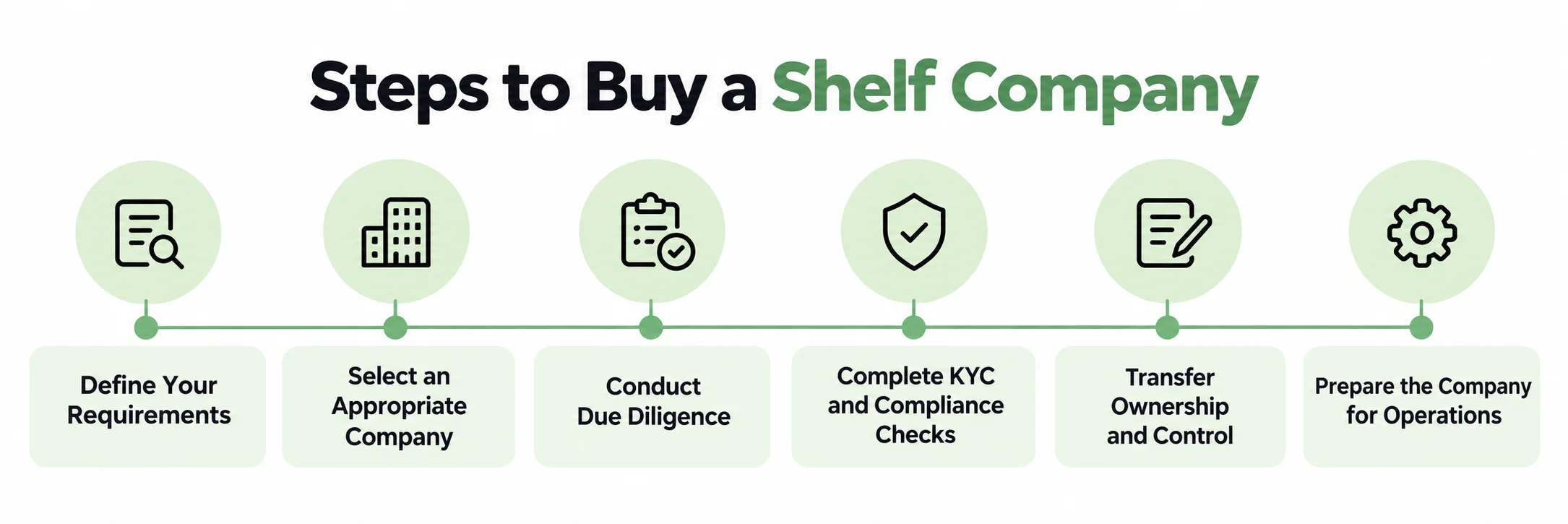
1. Define Your Requirements
Determine your preferred jurisdiction, company age, entity type, ownership structure, business activities, and intended use.
2. Select an Appropriate Company
Compare available companies based on suitability rather than choosing the oldest entity automatically.
3. Conduct Due Diligence
Review the company’s registration, filings, corporate history, documentation, dormancy, and other relevant information.
4. Complete KYC and Compliance Checks
Provide the required identification, address, beneficial ownership, corporate, and source-of-funds information where applicable.
5. Transfer Ownership and Control
Complete the relevant share transfer, director, shareholder, beneficial ownership, and other corporate changes required by the jurisdiction.
6. Prepare the Company for Operations
After handover, arrange any necessary banking, tax registrations, accounting, licences, insurance, registered office arrangements, or regulatory approvals.
A detailed breakdown of the acquisition procedure is available in How to Buy a Shelf Company – Step-by-Step Guide from Enquiry to Handover.
Due Diligence Is More Important Than Company Age
An old incorporation date can be attractive, but it should never replace proper verification.
A younger shelf company with transparent records and a clean corporate history may be more appropriate than an older entity with incomplete documentation or unexplained activity.
Buyers should therefore prioritise
- Clean and understandable corporate history
- Accurate statutory records
- Up-to-date filings
- Clear ownership
- Appropriate company structure
- Transparent documentation
The company must ultimately be suitable for the purchaser’s intended activities, not merely old enough to look established.
Banking, Tax and Compliance After Purchase
Purchasing the company is not necessarily the final stage.
Banks conduct their own due diligence and decide independently whether to accept a business as a customer. Buying an older company therefore should not be treated as a guarantee of bank account approval, lending, credit facilities, or financing.
Similarly, tax registration, VAT registration, business licences, accounting arrangements, insurance, and sector-specific approvals may still be required depending on the jurisdiction and proposed activities.
For example, the site’s UK shelf-company information confirms that corporate bank accounts remain subject to the bank’s own KYC and compliance procedures.
Why Jurisdiction Matters
Shelf-company rules and procedures vary considerably between countries.
The appropriate jurisdiction depends on factors including the intended business activities, customer location, tax position, ownership structure, regulatory requirements, banking needs, and where the company will actually operate.
Ready Made Companies Worldwide offers companies across multiple jurisdictions. Businesses considering U.S. operations, for example, can review USA shelf company options, while individual state options such as Delaware are also available.
Professional legal and tax advice may be appropriate before choosing a jurisdiction, particularly for international ownership or investment structures.
Why Buy Through Ready Made Companies Worldwide?
Buying a shelf company involves more than selecting a company name and incorporation date. The entity must match the buyer’s requirements, its history should be understood, and ownership must be transferred through the appropriate process.
Ready Made Companies Worldwide provides access to ready-made and shelf companies across numerous international jurisdictions and supports buyers through the company selection and ownership-transfer process. Its current acquisition process covers company selection, enquiry, quotation, and taking ownership.
Working with an experienced provider can also make it easier to identify the documents and corporate changes that need to be addressed before the entity is handed over.
Conclusion
Understanding why buy a shelf company begins with understanding what the company actually provides. A shelf company gives you an already incorporated corporate entity and, where relevant, an earlier incorporation date. It does not automatically give you genuine trading history, financial performance, banking approval, customers, contracts, or commercial credibility.
For the right purchaser, an existing entity can support international expansion, corporate restructuring, investment planning, or another time-sensitive commercial requirement. The decision should nevertheless be based on the company’s suitability, history, documentation, compliance position, and intended use rather than age alone.
If you are considering purchasing an existing company, Contact Us to discuss available shelf-company options and the ownership-transfer process with Ready Made Companies Worldwide.