

Buying a shelf company can be a smart way to accelerate your business plans, gain immediate credibility, and avoid the lengthy process associated with starting a company from scratch. However, not every shelf company is as clean or reliable as it appears. Hidden liabilities, incomplete records, questionable ownership, and fraudulent sellers can turn what looks like a convenient opportunity into an expensive mistake. Proper due diligence is therefore essential before committing to a purchase. This guide covers the 11 critical questions every buyer should ask to verify the company, assess the seller, understand the risks, and make a more informed purchase decision.
What is a Shelf Company? A Quick Overview
Buying a shelf company can be a smart business move. You get instant credibility. You skip months of paperwork. You’re ready to operate immediately. Before diving into questions, let’s clarify what you’re buying.
A shelf company is
- A legally registered business entity
- Formed months or years ago
- Never conducted any business operations
- Kept in good standing with the state
- Ready to transfer to a new owner immediately
Alternative names you might hear
- Shelf corporation
- Aged corporation
- Ready-made company
- Off-the-shelf company
- Dormant company
- Blank check company
All these terms mean the same thing.
How it works – Professional incorporation services create companies and metaphorically “shelf” them. These companies age over time. When entrepreneurs need quick incorporation, they buy these aged companies instead of forming new ones from scratch. Think of it like buying a vintage bottle of wine instead of watching a new one age for years.
Why are shelf companies popular?
The benefits are compelling
- Skip 4-8 weeks of incorporation paperwork
- Appear established to clients and lenders immediately
- Bid on contracts requiring business history
- Secure loans more easily
- Gain credibility on day one
- Operate immediately
But you must understand the risks to make an informed decision.
The 11 Critical Questions to Ask Before Buying a Shelf Company
Question 1 – Is This Company Truly Clean and Dormant?
This is your most important question, and it deserves careful attention.
A company is “clean” when it meets specific criteria. Look for these characteristics –
- No prior business operations or activities
- No existing debts or liabilities
- No previous owners or shareholders
- No tradelines or credit history
- No EIN issued to it
- No bank accounts ever opened
- No tax returns filed
Why this matters
A company with hidden baggage becomes your problem. It affects your credibility with lenders and partners. It impacts your liability exposure. It sets the foundation for either legitimate operations or legal headaches you didn’t expect.
According to ShelfCorpGiant.com, the most common scam involves sellers offering shelf corporations with fraudulent credit lines. They claim the company has “established credit” ready for you to use immediately. This is completely false and illegal.
Red flags to watch for
- Seller claims the company has “established credit.”
- The company comes with “pre-approved loans.”
- Tax returns or financial statements are included
- Existing credit lines or bank accounts are mentioned
- The seller seems reluctant to provide the company history
What you need to do
Request written verification that this company has never been used. Ask for confirmation that it has no assets, liabilities, tradelines, or EINs. Request the Certificate of Good Standing from the state. Get the Certified Articles of Incorporation. Request complete documentation showing the company has never filed taxes.
Also Read – opened bank accounts.
Questions to ask your vendor
- “Can you provide written verification that this company has never been used?”
- “Does it have no assets, liabilities, tradelines, or EIN?”
- “Can you provide a Certificate of Good Standing and proof of no prior business activity?”
Question 2 – What is the Company’s Age and Formation State?
Company age and shelf company location affect how lenders and partners perceive your business.
Why company age matters
Banks treat a 5-year-old company differently from a 6-month-old one. Many government contracts require 2-3 years of business history before bidding is allowed. Older companies appear more established and professional. Better financing terms come with a longer business history.
Minimum age requirements depend on your goals
- For financing – 2+ years minimum preferred
- For government contracts – 3-5 years typically required
- For general credibility – 1+ year is acceptable
- For investors – 5+ years preferred
The state of formation matters significantly
Not all states are created equal. Some offer better protection and privacy for business owners.
StateComparison
| State | Privacy | Income Tax | LLC Protection | Best For | Annual Cost |
|---|---|---|---|---|---|
| Wyoming | Excellent | None | Strongest in the US | Asset protection, privacy | Low |
| Delaware | Good | None | Strong | Venture capital, growth | Moderate |
| Nevada | Excellent | None | Strong | Asset protection | Low-Moderate |
| Montana | Good | None | Moderate | General business | Low |
| Texas | Moderate | None | Strong | General business | Moderate |
Wyoming is preferred in 2025-2026
because it offers
- No state income tax
- Strongest LLC asset protection statutes in the country
- No public listing of members or managers
- Strong privacy protections for owners
- Low annual fees
- Less regulatory scrutiny than in Nevada
Delaware is ideal if you plan to
- Raise institutional capital from investors
- Go public eventually
- Need a venture investor appeal
- Rely on sophisticated corporate law precedents
Nevada draws regulatory scrutiny from some lenders. If financing is important to your business, consider Wyoming or Delaware instead. Delaware shelf companies are ideal if you plan to raise institutional capital from investors, go public eventually, need venture investor appeal, or rely on sophisticated corporate law precedents.
Questions to ask the vendor
- “Why was this company formed in this specific state?”
- “Does it align with my business goals?”
- “What are the annual maintenance fees?”
- “If I need to operate in another state, can I file as a foreign corporation?”
Question 3 – Are All Taxes and Fees Current?
A company in good standing is essential. This means
- All state filing fees have been paid
- Annual reports were filed on time
- Legal compliance is current
- No lapsed registration
- No unpaid taxes or penalties
Why this matters
A lapsed company cannot legally operate. It cannot open bank accounts. It cannot get financing. It cannot change ownership properly. It may require expensive restoration.
According to FORIS, companies that let registrations lapse face serious challenges. Even after paying back fees, the company’s credibility is damaged. Lenders view it with suspicion.
What to check
- Request Certificate of Good Standing directly from your state
- Verify all annual reports were filed on time
- Confirm no unpaid state taxes exist
- Check for any administrative penalties
- Review filing history for gaps or inconsistencies
Expected annual costs
- Wyoming LLC – $50-100/year
- Delaware Corporation – $300-500/year
- Nevada LLC – $100-200/year
- Registered agent fees – $50-200/year
Ask your vendor
- “Can you provide a Certificate of Good Standing issued within the last 30 days?”
- “Has this company ever lapsed or had a late filing?”
- “Are all state fees current through the next renewal date?”
- “What are the annual renewal costs going forward?”
Question 4 – Does the Vendor Actually Own the Shelf Corporation?
This is a major fraud vector that catches many unsuspecting entrepreneurs.
The scam – Criminal sellers offer companies that they don’t legally own. After you pay
- You cannot legally transfer ownership
- You have no recourse to get your money back
- You face litigation to reclaim the company
- This happens to thousands of entrepreneurs annually
Why does this happen?
- Easy to claim ownership without verification
- Difficult for buyers to verify initially
- The victim has limited legal recourse
- Scammers operate from multiple locations
- Many are offshore-based
How to protect yourself
Request proof of ownership directly from the vendor. Check state records yourself independently. Verify the seller’s history with past clients. Use a title company or attorney for verification. Demand written guarantee of clean title transfer.
The vendor should provide
- Documentation showing they’re the registered agent
- Proof of current ownership
- Documentation of all previous transfers
- Written guarantee of clean title transfer
- Statement confirming no liens exist against the company
Critical questions to ask
- “Provide written proof that you legally own this company.”
- “Has this company ever had a lien placed against it?”
- “Can you provide references from previous buyers?”
- “Will you guarantee clean title transfer in writing?”
Question 5 – What Are the BOI Reporting Requirements?
This is critical and often overlooked by buyers.
Important change – In 2024, the Corporate Transparency Act changed the requirements. Most businesses now must report beneficial ownership information to FinCEN. This is mandatory, and compliance is serious.
What is BOI?
BOI stands for Beneficial Ownership Information. It identifies who actually owns and controls a company. FinCEN, the Financial Crimes Enforcement Network, now requires –
- Filing of BOI reports for most US entities
- Identification of all beneficial owners
- Updating reports when ownership changes
- Filing within specific timeframes
Why this matters for shelf companies
When you purchase a shelf corporation, you become the beneficial owner. You must
- File a BOI report within 30 days
- File before opening bank accounts
- Keep information current and updated
- Follow FinCEN filing requirements
Penalties for non-compliance are serious
- Civil penalties – Up to $591 per day of violation
- Criminal penalties – Up to $10,000 and 2 years imprisonment
- Potential record flagging affecting future business
Red flag warning – If a vendor doesn’t mention BOI compliance, they’re not current on 2025 regulations. This is a serious warning sign.
Ask your vendor
- “Will you provide guidance on BOI reporting?”
- “Can you explain the timelines for my BOI filing?”
- “Do you offer assistance with FinCEN submission?”
- “What’s your knowledge of the Corporate Transparency Act?”
Question 6 – Are There Hidden Liabilities or Past Litigation?
Hidden problems can cost you thousands and create legal nightmares.
What should you look for
- Previous lawsuits against the company
- Judgment liens on the company
- Tax issues or unpaid debts
- Regulatory violations or complaints
- Inheritance of legal problems
According to Manimama Law Firm, existing limited liability companies with prior activity can have “unpleasant inherited burdens that skyrocket costs unexpectedly.”
Conduct a thorough legal audit
Work with an attorney to verify everything. Request these documents from the vendor
- Certificate of incorporation
- Complete shareholder registry
- Tax clearance certificates
- Proof of no litigation or court records
- State compliance records
- Complete filing history
- Documentation of any administrative complaints
Questions to ask
- “Has this company ever been involved in litigation?”
- “Are there any liens or judgments against it?”
- “Has it ever been cited for regulatory violations?”
- “Provide a certified statement that it has no liabilities.”
Watch for these warning signs
- The vendor is unwilling to provide the litigation history
- Gaps exist in the filing history
- Previous administrative complaints appear
- The vendor gives vague responses about the company history
- Records seem incomplete or inconsistent
Question 7 – Is the Vendor Reputable and Accessible?
Your vendor is critical to your success.
What a bad vendor means
- Poor quality company
- Inadequate or missing documentation
- No post-purchase support
- Potential fraud or scams
What a good vendor means
- Clean, verified company
- Complete documentation
- Responsive support available
- Protection for your investment
Evaluate vendors based on these criteria
Accessibility
- Phone number available (test it)
- Email support is responsive
- Physical office address (not just virtual)
- Clear hours of operation
Track record
- Years in business (5+ years preferred)
- Verifiable customer reviews
- Documented case studies
- Industry recognition
Transparency
- Clear, honest pricing
- Written guarantees provided
- Process fully explained
- No hidden fees
Post-purchase support
- Customization services available (name changes, director updates)
- Bank account opening assistance
- Documentation updates
- Compliance guidance provided
How to evaluate vendors
Make a test call to assess responsiveness. Check reviews and testimonials. Verify the physical address. Request references from 2-3 previous buyers. Review their written guarantee. Check business history using Google, BBB, and industry databases.
Red flags include
- Virtual office only with no physical address
- Difficult to reach by phone
- Limited or no customer reviews
- Pressure to decide quickly
- Vague or evasive answers
- No written guarantees offered
Questions to ask
- “How long have you been in business?”
- “Can you provide customer references?”
- “What’s included in your guarantee?”
- “What post-purchase support do you offer?”
- “Are your fees fixed or are there hidden costs?”
Question 8 – What’s Included in Your Purchase Package?
Know exactly what you’re getting for your investment.
Essential documentation that should be included
- Certificate of Good Standing from your state
- Certified Articles of Incorporation or Organization
- By-laws or Operating Agreement
- Stock Certificate (for corporations)
- Corporate Seal and Electronic Kit
- EIN (Employer Identification Number) or guidance
- Bank Resolutions (if applicable)
- Complete filing history documentation
Customization services often available
Many vendors offer additional services. Confirm these are included or available
- Name change to your business name
- Director and officer updates
- Registered agent change
- Address updates
- Bylaws modifications as needed
Bank account support matters
The vendor should provide
- Guidance on which banks accept shelf companies
- Bank verification letters
- Documentation packages for bank opening
- Follow-up support if issues arise
Post-transfer support is essential
Ask about
- Compliance filing reminders
- Annual report assistance
- Tax documentation guidance
- Regulatory updates
Ask your vendor
- “What’s included in the purchase price?”
- “Are there fees for name changes or updates?”
- “Will you assist with bank account opening?”
- “What post-purchase support is included?”
- “How are additional services priced?”
Question 9 – What Are the Common Scams to Avoid?
Understanding common scams is your best defense against fraud.
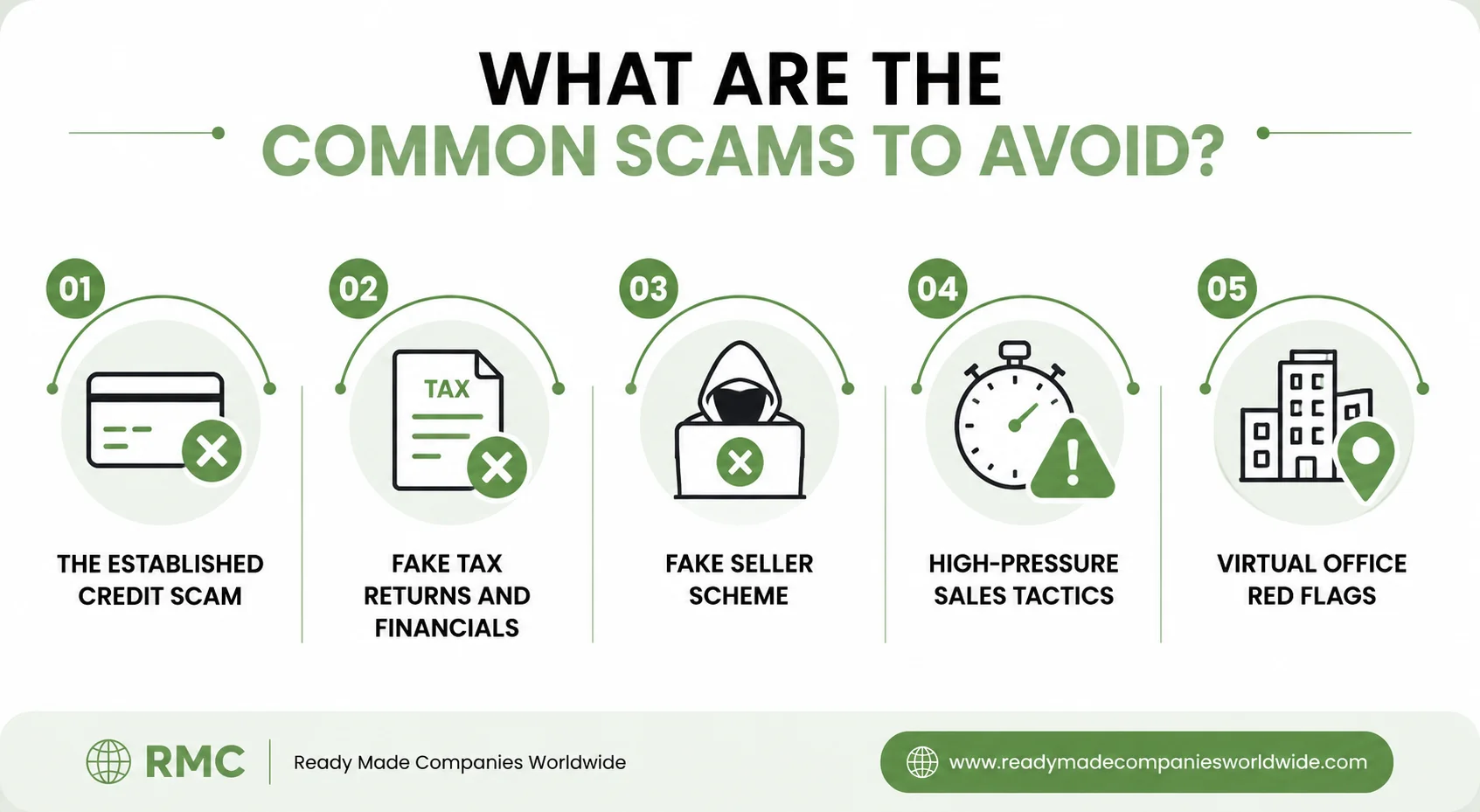
Scam 1 – The Established Credit Scam
How it works – Sellers claim the company has “established credit” with access to $50,000+ credit lines immediately. They charge $2,000-$5,000+ premium for this “aged” company with credit.
The reality
- Shelf companies have zero credit by definition
- They’ve never conducted business or borrowed
- They have no credit history
- Pre-approval letters are often fake
- Loans offered are hard money loans (10%+ interest)
- You still need down payments, they didn’t mention
ShelfCorpGiant.com warns – “If it looks too good to be true, it’s probably a scam.”
Protect yourself by understanding that shelf companies have no credit. Never pay extra for “established credit.” Get pre-approvals directly from the lender. Understand all loan terms before committing.
Scam 2 – Fake Tax Returns and Financials
How it works – Sellers include fake tax returns showing false revenue and profits. This makes the company appear operational. You might use these on loan applications, which is illegal.
The consequences are serious
- Loan fraud charges
- Criminal prosecution
- Loss of your investment
- Permanent criminal record
Never accept any company with tax returns. Confirm the company has never filed taxes. Never use false financials on applications. Work with legitimate lenders who understand shelf companies.
Scam 3 – Fake Seller Scheme
How it works – The “seller” doesn’t actually own the company. You pay but cannot transfer ownership. Your money is gone. You face legal battles for the title.
This is the most dangerous scam. Verify ownership before any payment.
Scam 4 – High-Pressure Sales Tactics
Watch for these warning signs –
- “This company is about to be sold to someone else.”
- “This deal expires today.”
- “Limited availability”
- “Don’t waste time verifying, just buy.”
- Reluctance to answer questions
Legitimate vendors don’t pressure you. Take your time. No legitimate vendor rushes you. Ignore artificial urgency. Ask all questions before payment. Get everything in writing.
Scam 5 – Virtual Office Red Flags
The problem – Multiple companies share the same virtual address. Some haven’t paid bills. Lenders flag addresses with defaults. Your company appears suspicious.
Protect yourself by asking for a real, verifiable office address. Confirm the vendor uses an actual office. Choose companies with individual addresses. Plan to use your own address as the registered office.
Question 10 – How Will You Use the Company Legally and Ethically?
This question protects you and your company.
Legitimate uses of shelf companies
- Skip incorporation paperwork and delays
- Gain credibility with customers and partners
- Bid on contracts requiring business history
- Secure business loans and credit lines
- Hold assets or intellectual property
- Create subsidiary structures
- Operate as a holding company
What’s legal
- Buying a shelf company (perfectly legal)
- Using the company age for credibility
- Disclosing shelf status to lenders
- Operating the company legitimately after purchase
- Using history for contract bids with disclosure
What’s illegal and constitutes fraud
- Misrepresenting company history on loan applications
- Hiding the recent acquisition from lenders
- Using false financial statements
- Claiming to be older than you actually are
- Defaulting intentionally on fraudulently obtained loans
Honest disclosure matters
When applying for loans or contracts, be transparent –
- “I recently acquired this company.”
- “It’s been registered since [date] but under new ownership.”
- “Full financial history available.”
- Never misrepresent activities before your ownership
Consider these questions
- “How will I represent this company to lenders?”
- “Am I required to disclose it’s a recently acquired shelf company?”
- “What documents should I have ready for disclosure?”
- “Should I consult a lawyer before applying for major financing?”
Question 11 – What is the Cost and ROI?
Understanding the full financial picture is essential.
Shelf Company Pricing in 2025-2026
- Recent companies (6 months old) – $500-$1,000
- Newer-aged companies (1-2 years) – $1,000-$2,000
- Established companies (3-5 years) – $2,000-$5,000
- Vintage companies (5-10+ years) – $5,000-$15,000+
Factors affecting price
- Company age (older costs more)
- State of incorporation
- Vendor reputation
- Included documentation
- Additional services offered
Compare – Shelf Company vs. New Incorporation
| Aspect | Shelf Company | New Incorporation |
|---|---|---|
| Cost | $500-$5,000 | $100-$2,000 |
| Setup time | 1-3 days | 4-8 weeks |
| Bank account | Usually easier | Takes longer |
| Loan qualification | Better approval | More difficult |
| Credibility | Instant | Builds over time |
Determining ROI depends on several factors
What’s the time value to you? Eight weeks equals how much lost business opportunity? How much would better loan terms save you? How much revenue from accessible contracts? What’s instant credibility worth to you?
If you save 8 weeks (valued at $500/week), a $2,000 shelf company pays for itself in 4 weeks of operations. If better financing saves 2% on a $50,000 loan, you save $1,000 annually.
Ask your vendor
- “What’s included in the price?”
- “Are there additional customization fees?”
- “What’s the total cost of ownership, including annual fees?”
- “Can you provide a breakdown of all costs?”
- “What payment options are available?”
Due Diligence Checklist – Before You Buy
Company Verification
- Verify the incorporation date directly with the state authority
- Confirm the company is in current Good Standing
- Order Certificate of Good Standing within 30 days
- Check state records for judgments or liens
- Review the complete legal filing history for gaps
- Confirm absolutely no prior business activity
- Request a statement showing no creditors or liabilities
- Verify the state of formation matches your needs
- Confirm annual renewal dates and costs
- Understand ongoing compliance requirements
Vendor Verification
- Verify the vendor’s legal business registration
- Check vendor’s track record (5+ years preferred)
- Read customer reviews and testimonials
- Call the phone number to test responsiveness
- Confirm physical office address
- Request and contact 2-3 customer references
- Verify vendor’s knowledge of BOI and CTA regulations
- Confirm the vendor’s written guarantee
- Understand the refund policy, if any
- Get everything in writing
Documentation Request
- Certified Certificate of Good Standing
- Certified Articles of Incorporation/Organization
- Complete By-laws or Operating Agreement
- Stock Certificates, if applicable
- Corporate Seal and Electronic Kit
- EIN documentation or application help
- Bank Resolutions, if applicable
- Complete filing history documentation
- Proof of no prior business activity
- Written guarantee of a clean title
Legal and Compliance
- Consult with an attorney if a high-value purchase
- Conduct a title search
- Review the complete state filing history yourself
- Search court records for litigation
- Verify tax clearance status
- Understand BOI reporting requirements and deadlines
- Plan BOI filing strategy
- Understand ongoing compliance obligations
- Know your state’s annual reporting requirements
- Know your registered office address requirements
Financial and Operational
- Understand the total cost of ownership, including annual fees
- Plan the bank account opening process
- Know which banks accept shelf companies
- Prepare documentation package for banks
- Plan disclosure strategy for lenders
- Understand how you’ll represent the company age
- Know your business structure needs
- Plan any name change before purchase
- Understand director/officer requirements
- Know your registered office address
The Benefits – Why Shelf Companies Make Sense
Quick Market Entry
New incorporation takes 4-8 weeks. A shelf company gets set up in 1-3 days. When markets move fast, this advantage is significant. You can launch operations while competitors are still in the process of incorporating.
Improved Bank Account Opening
Banks see an aged company with a registration history and an established corporate structure. They perceive lower risk. You get faster account opening in days instead of weeks. Operations can begin immediately.
Access to Contracts
Government and large contracts often require 2-3+ years of operation. A shelf company shows that history on day one. You gain access to opportunities not available to brand new companies. This opens revenue possibilities immediately.
Instant Credibility
People perceive older companies as more stable. Partners are more willing to work with you. Investors are more confident. Clients view you as established. Perceived legitimacy comes immediately without years of waiting.
Better Financing Access
New companies get rejected for loans. Aged companies get approvals. You get better loan approval rates, lower interest rates, larger credit lines available, and a faster approval process. This improves your cash flow situation.
Simplified Operations
You get a ready-made corporate structure with all foundational documents. Registered status is established. No incorporation delays. Start operating, not incorporating.
The Risks – What Can Go Wrong
Hidden Liabilities
Inherited debt or legal problems create unexpected costs and legal liability. Conduct a thorough legal audit before purchase to mitigate this risk.
Lender Scrutiny
Some lenders remain suspicious of shelf companies. Nevada companies draw particular concern. Choose Wyoming or Delaware if financing is important to your business.
Compliance Obligations
Ongoing annual requirements exist and cost money. Budget for –
- Annual state filings
- Registered agent fees
- Annual reports
- Compliance tracking ($100-300+ annually)
Fraud Risk
Unscrupulous vendors operate. Protect yourself by verifying everything independently before any payment.
Perceived Legitimacy Concerns
In some jurisdictions, shelf companies face skepticism. Your solution is the transparent disclosure of recent ownership to all business partners.
Conclusion
Buying a shelf company can save valuable time, provide an established corporate identity, and help you start operating sooner, but these advantages only matter when the company has a clean and verifiable history. Before completing a purchase, confirm its ownership, good-standing status, liabilities, compliance records, and supporting documentation. Working with a reputable provider and carrying out proper due diligence can significantly reduce the risks associated with acquiring an aged company.
If you are ready to explore clean and properly maintained shelf companies, contact us to discuss your requirements and find a suitable option for your business.