

Choosing between a Delaware and Wyoming shelf company is an important decision for entrepreneurs looking for a faster route into the US business market. Both states have established reputations for business-friendly company laws, but they serve different commercial priorities. Delaware is widely associated with established corporate law, sophisticated business structures and companies planning for investment or expansion, while Wyoming attracts entrepreneurs looking for comparatively low state maintenance costs and a straightforward LLC environment. The right jurisdiction depends on your business model, ownership structure, operating location, funding plans and ongoing compliance requirements.
What Is a US Shelf Company?
A shelf company is a legal entity that was incorporated previously and then kept inactive or dormant until it is sold to a new owner. Instead of incorporating a completely new business, an entrepreneur acquires the ownership of an existing legal entity.
At Ready Made Companies Worldwide, businesses and international entrepreneurs can explore established companies in different jurisdictions when a ready-made structure is appropriate for their plans.
A genuine shelf company should generally have remained inactive before transfer. Buyers should verify its status, incorporation documents and compliance history rather than assuming that an older incorporation date automatically means the company is more valuable.
Most importantly, buying a shelf company does not automatically give the purchaser an established credit rating, banking relationship, revenue, contracts or genuine trading history. These are separate matters that normally have to be developed or approved independently.
Delaware Shelf Companies – An Overview
Delaware is one of the most recognised corporate jurisdictions in the United States. Its established corporate-law system and extensive body of business case law have made it particularly familiar to businesses, lawyers and investors.
A Delaware shelf company allows an entrepreneur to acquire an entity that has already been incorporated in the state. Depending on availability and the intended business model, this may include an LLC or corporation.
Every Delaware entity must maintain a registered agent with a physical address in Delaware. The registered agent receives legal service of process and performs other functions required under state law.
For entrepreneurs specifically considering this jurisdiction, our Delaware Shelf Companies service provides further information about acquiring and transferring a ready-made Delaware entity.
Wyoming Shelf Companies – An Overview
Wyoming is another well-known US jurisdiction for business formation, particularly for LLC structures. It is frequently considered by smaller companies, international entrepreneurs and privately held businesses looking for relatively straightforward state-level maintenance.
Wyoming requires registered business entities to submit annual reports. For LLCs and other specified profit entities, the annual licence tax is currently calculated at $60 or 0.0002 of assets located and employed in Wyoming, whichever amount is greater.
The annual report is generally due on the first day of the anniversary month of the entity’s formation.
These relatively modest state maintenance requirements can make Wyoming worth considering where the business does not specifically need Delaware’s corporate framework.
Delaware vs Wyoming Shelf Company – Key Differences
| Factor | Delaware | Wyoming |
|---|---|---|
| Corporate environment | Highly developed corporate-law framework | Business-friendly framework particularly popular for LLCs |
| Typical appeal | Investment-focused businesses, corporations and complex structures | Smaller companies, privately held businesses and LLCs |
| Registered agent | Required | Required |
| Annual state requirement | Depends on entity type | Annual report and applicable licence tax |
| LLC state-level annual charge | $400 annual tax under current Delaware Division guidance | Minimum $60 annual licence tax, subject to Wyoming asset calculation |
Delaware’s current Division of Corporations guidance states that domestic and foreign LLCs, LPs and GPs formed or registered in Delaware must pay a $400 annual tax, due by June 1 for LLCs, LPs and GPs.
Also read – Buying a Shelf Company
Why Choose a Delaware Shelf Company?
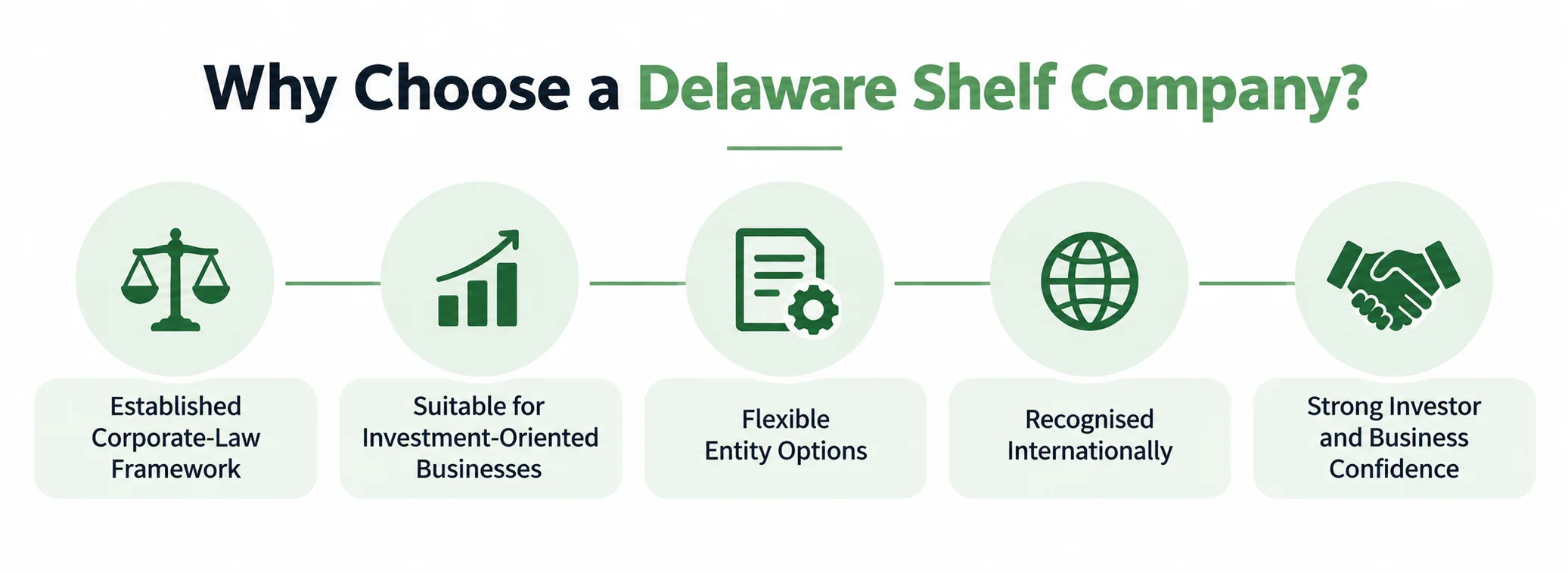
1. Established Corporate-Law Framework
One of Delaware’s biggest distinguishing features is its mature corporate legal environment. Businesses dealing with sophisticated investment arrangements, multiple shareholders or more complex governance structures may consider this especially relevant.
For a shelf-company buyer, however, Delaware’s reputation should not be confused with automatic credibility. The company must still build genuine commercial relationships and meet applicable regulatory obligations after transfer.
2. Suitable for Investment-Oriented Businesses
Delaware is frequently considered by businesses that expect external investment or anticipate a more complex ownership structure.
A startup that expects future equity investment may therefore assess Delaware differently from a small owner-managed consultancy that simply wants a US entity.
3. Flexible Entity Options
Delaware supports multiple business entity structures, including LLCs and corporations. The appropriate structure depends on factors including ownership, taxation, investment plans and management requirements.
The shelf company selected should therefore match the intended structure rather than simply being chosen because of its age.
4. Familiarity in International Business
Delaware entities are familiar to many international lawyers, professional advisers and corporate service providers. This can be useful for international entrepreneurs establishing a US presence.
It does not, however, eliminate requirements relating to banking, taxation, licensing or registration in states where the company actually conducts business.
Why Choose a Wyoming Shelf Company?
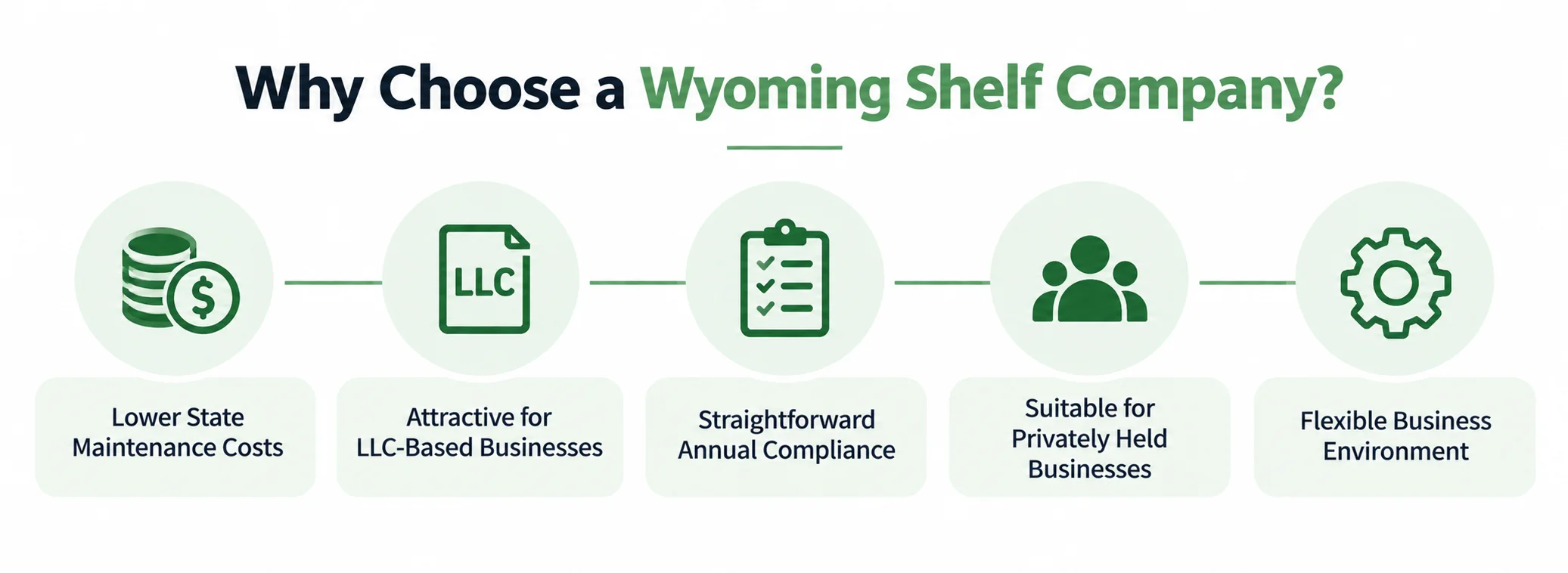
1. Lower State Maintenance Costs in Many Cases
Cost is one of the major differences entrepreneurs may notice.
Wyoming’s annual licence tax for relevant entities starts at $60, although businesses with sufficient assets located and employed in Wyoming may pay more under the state’s asset-based calculation.
This can make Wyoming attractive for smaller businesses where controlling recurring state costs is an important consideration.
2. Attractive for LLC-Based Businesses
Wyoming has developed a strong reputation as an LLC jurisdiction. Entrepreneurs operating consulting, online, holding or privately owned businesses may therefore consider Wyoming when the structure suits their actual commercial and tax requirements.
3. Straightforward Annual Compliance
Wyoming requires an annual report and applicable licence tax to keep an entity in good standing. The state provides an online annual-report filing system for active registered entities.
Straightforward administration can be particularly relevant to international entrepreneurs who want to minimise unnecessary complexity.
4. Suitable for Privately Held Businesses
A privately owned business that does not expect institutional investment may have different priorities from a venture-backed startup.
In such situations, Wyoming’s cost structure and LLC framework may deserve greater consideration.
What About Federal Beneficial Ownership Reporting in 2026?
This area has changed significantly and older online guides may now contain outdated information.
As of August 2026, FinCEN’s final rule exempts companies created in the United States from federal Beneficial Ownership Information reporting requirements under the Corporate Transparency Act. Certain foreign entities registered to do business in the United States remain within the revised reporting framework.
This means a domestic Delaware or Wyoming company is currently exempt from federal BOI reporting to FinCEN under these rules.
However, the exemption should not be interpreted as removing other obligations. State filings, federal and state tax requirements, registered-agent requirements, licences, banking checks and other regulatory obligations may still apply.
Does a Shelf Company’s Age Give You Better Business Credit?
Not automatically.
An older incorporation date shows when the legal entity was created. It does not prove that the company has generated revenue, maintained credit accounts, traded successfully or established a banking history.
Banks, lenders, suppliers and other institutions can conduct their own due diligence and assess the current owners, business activity, financial position and supporting documents.
For this reason, purchasing a shelf company solely because it is several years old can be a mistake.
Before acquiring any existing entity, conduct appropriate checks on its background and documentation.
Which State Works for Different Business Requirements?
Startups Planning to Raise Investment
Businesses expecting sophisticated equity investment may consider Delaware because of its established corporate-law environment and familiarity in investment transactions.
Small Online Businesses
An owner-managed online business may consider Wyoming where its LLC framework and lower minimum annual state costs better match the company’s requirements.
International Entrepreneurs
Both jurisdictions can be considered by non-US entrepreneurs. The correct choice depends on where the business will actually operate, the entity type, banking plans, tax treatment and whether additional state registrations will be necessary.
Holding Structures
Either jurisdiction may potentially be considered for holding structures, but the tax and legal consequences depend on the assets being held, the owners’ residence and the wider corporate structure.
Professional advice is particularly important for cross-border arrangements.
How to Choose Between Delaware and Wyoming
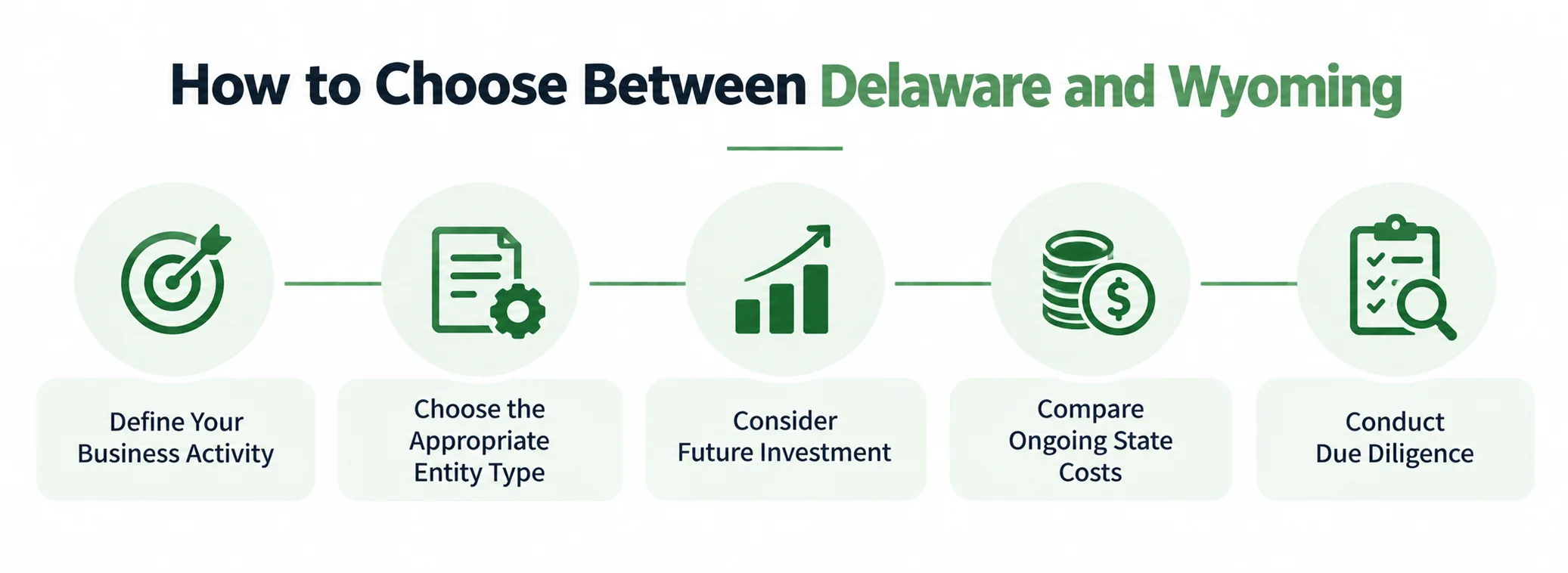
Step 1 – Define Your Business Activity
Identify exactly what the company will do. An investment-focused technology startup has different requirements from a consulting company or an e-commerce business.
Step 2 – Choose the Appropriate Entity Type
Determine whether an LLC or corporation better matches the intended ownership, tax and investment structure.
Step 3 – Consider Future Investment
If outside investors are part of your future plans, consider how the selected state and entity structure will support those transactions.
Step 4 – Compare Ongoing State Costs
Look beyond the initial shelf-company purchase price. Consider annual taxes, reports, registered-agent fees and other recurring compliance expenses.
Step 5 – Determine Where You Will Actually Operate
Incorporating in Delaware or Wyoming does not necessarily mean your obligations are limited to that state.
If the company conducts business in another US state, it may need to register there as a foreign entity and comply with that state’s tax, licensing and reporting requirements.
Step 6 – Conduct Due Diligence
Verify the shelf company’s status, incorporation date, filings and available records before ownership is transferred.
Step 7 – Complete the Ownership Transfer
Once appropriate checks have been completed, the ownership and relevant company records can be transferred to the buyer.
Step 8 – Complete Post-Purchase Requirements
After acquisition, address matters such as tax registrations, EIN requirements where applicable, banking, licences, registered-agent arrangements and ongoing compliance.
Delaware or Wyoming – Making the Right Choice
Delaware and Wyoming both provide established frameworks for US businesses, but their advantages apply in different circumstances.
Delaware may be particularly relevant where a business values its developed corporate-law environment, expects more sophisticated ownership arrangements or plans to pursue external investment.
Wyoming may be considered where an LLC-based, privately held business places greater emphasis on comparatively low state maintenance costs and straightforward annual administration.
Neither jurisdiction should be selected solely because it is frequently described online as the “best” state for business. Where the company actually operates, how it earns revenue, who owns it, its tax position and future funding plans are more important considerations.
Conclusion
The Delaware vs Wyoming shelf company decision ultimately depends on what you need from your US business structure. Delaware offers an established corporate-law environment that can suit companies with sophisticated ownership and investment requirements, while Wyoming can be attractive for privately held and LLC-based businesses seeking comparatively low state maintenance costs. Whichever jurisdiction you consider, verify the company’s history, assess ongoing obligations and make sure the entity supports your genuine business objectives. For assistance with selecting and acquiring an appropriate ready-made company, Contact Us to discuss your requirements.