
Starting a business begins with one of the most important decisions an entrepreneur will make: whether to purchase a shelf company or incorporate a brand-new company. Both options provide a legitimate legal entity through which you can operate, but they differ in terms of setup, flexibility, history, costs, and suitability for different business goals.
Many business owners assume that a shelf company is always the faster or better option, while others believe incorporating a new company is the only sensible choice. In reality, neither option is universally better. The right decision depends on your timeline, commercial objectives, jurisdiction, and future plans.
If you’re comparing shelf company vs new company formation, understanding the advantages, limitations, and practical implications of each option will help you make an informed decision. Whether you’re launching a startup, expanding internationally, bidding for contracts, or entering a new market, this guide explains how both approaches work and when each may be the right solution for your business.
What Is a Shelf Company?
A shelf company, sometimes called a ready-made company, is a company that has already been legally incorporated but has remained dormant. It has not traded, generated income, or conducted business activities before being offered for sale.
Instead of forming a new company from scratch, you purchase an existing legal entity and transfer ownership into your name. Following the transfer, you can update various company details, including
- Directors
- Shareholders
- Registered office
- Company name (where permitted)
- Business activities
- Share structure
After the required filings and compliance procedures are completed, the company can begin trading under its new ownership. Ready-made companies are available in many jurisdictions, making them particularly useful for businesses requiring an established legal entity within a specific country.
What Is a New Company Formation?
New company formation involves incorporating a completely new legal entity through the relevant government authority in your chosen jurisdiction. In the UK, this is completed through Companies House, while other countries have their own corporate registries.
Because the company is created specifically for you, every aspect can be tailored from the outset, including
- Company name
- Directors
- Shareholders
- Share capital
- Articles of association
- Business activities
- Ownership structure
Unlike a shelf company, a newly incorporated company has no previous history because it comes into existence at the point of incorporation.
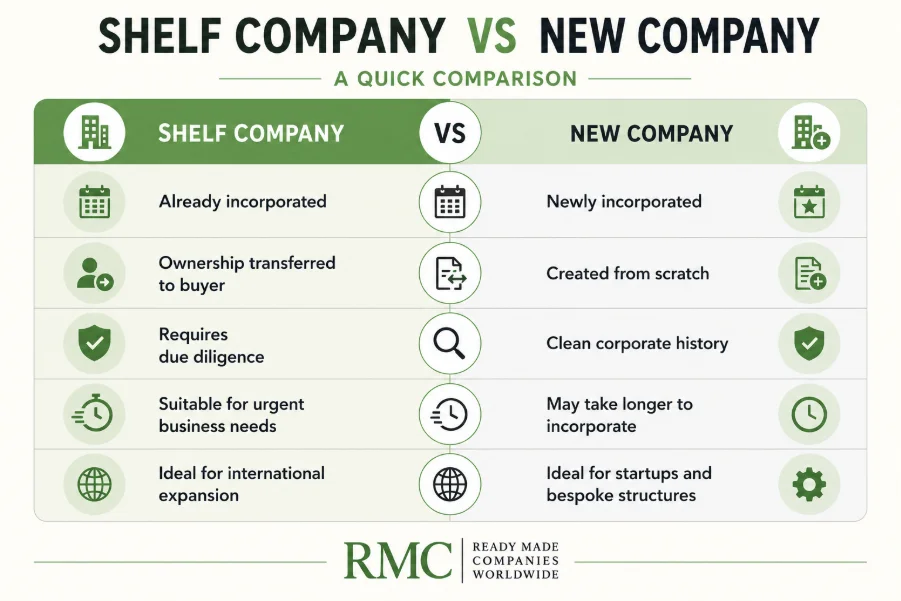
Shelf Company vs New Company Formation – The Key Differences
Although both options result in a legally recognised company, there are several important differences.
-
Company History
A shelf company already has an incorporation date that predates its purchase. While it should remain dormant until sold, it technically has an established legal history. A newly incorporated company begins its existence on the day it is registered and has no previous corporate record.
-
Speed
One of the most common reasons businesses purchase shelf companies is to obtain an existing legal entity without waiting for incorporation. However, entrepreneurs should understand that buying a shelf company does not eliminate every setup requirement.
You may still need to
- Complete identity verification
- Update company records
- Open a business bank account
- Register for taxes
- Complete regulatory registrations
- Transfer ownership documentation
Likewise, modern online company formation in many jurisdictions can often be completed relatively quickly, although operational readiness will still depend on banking, compliance, licensing, and tax registrations.
-
Flexibility
A newly formed company offers maximum flexibility because every aspect is created according to your requirements from day one. A shelf company can also be customised after purchase, but this usually involves making changes to an existing corporate structure. Depending on your future investment plans, those amendments may require additional documentation and professional advice.
-
Corporate Record
A shelf company already possesses
- Incorporation date
- Filing history
- Corporate registration
Provided it has remained dormant, its record should be clean. A new company has no historical filings because it has only recently been incorporated.
Advantages of Buying a Shelf Company
For certain businesses, a shelf company can offer practical benefits.
-
Established Incorporation Date
An earlier incorporation date may be useful where an established legal entity is commercially advantageous. Some businesses prefer dealing with companies that have existed for longer, although company age alone should never be confused with trading experience or financial strength. Many organisations will still review public records before entering into contracts.
-
Faster Access to a Legal Entity
If timing is critical, purchasing a shelf company may allow you to obtain an existing corporate vehicle without completing the incorporation process yourself.
This may benefit businesses that need to
- Enter contracts quickly
- Meet commercial deadlines
- Expand internationally
- Begin operations in a specific jurisdiction
However, becoming fully operational still requires completion of banking, compliance and regulatory requirements.
-
International Expansion
Many international businesses use ready-made companies when establishing operations overseas. Rather than beginning incorporation from scratch in every country, they may purchase a dormant company already incorporated within their target jurisdiction. This can simplify certain aspects of international expansion while still requiring compliance with local laws and regulations.
-
Suitable for Time-Sensitive Opportunities
Businesses may consider shelf companies when responding to
- Tender opportunities
- Investment deadlines
- Commercial acquisitions
- Partnership agreements
- Market expansion projects
In these situations, having an existing legal entity available can be advantageous, provided all due diligence has been completed.
Advantages of Forming a New Company
For many entrepreneurs, starting with a clean corporate structure remains the preferred option.
-
Complete Control From Day One
Every decision is made by the founders. You choose
- Company name
- Share structure
- Directors
- Articles
- Ownership arrangements
There is no need to amend an existing corporate framework.
-
Clean Corporate History
A newly incorporated company has no previous directors, shareholders or filing history. This simplicity can make future investment, due diligence and corporate governance more straightforward.
-
Greater Flexibility for Investors
Businesses intending to raise external investment often benefit from creating a bespoke corporate structure from the outset. Investor requirements regarding
- Share classes
- Voting rights
- Employee share schemes
- Option pools
can all be incorporated during formation rather than amended later.
-
Reduced Due Diligence
Even dormant shelf companies require investigation before purchase. Buyers should always confirm there are no
- Outstanding liabilities
- Previous trading activities
- Legal disputes
- Tax issues
- Regulatory concerns
A newly incorporated company removes much of this historical investigation because no prior corporate activity exists.
Shelf Company vs New Company Formation: Cost Comparison
Cost is often an important factor when deciding between a shelf company and forming a new company. However, the purchase price alone should not determine your decision. A new company generally involves incorporation fees and any professional service charges if you choose to use a company formation agent.
A shelf company typically costs more because you are purchasing an already incorporated legal entity. The price may reflect factors such as the company’s age, jurisdiction, maintenance costs, and any additional transfer services provided by the supplier.
Regardless of which option you choose, you should also budget for ongoing costs such as
- Business bank account setup
- Tax registrations
- Registered office services (where required)
- Accounting and compliance
- Annual filing obligations
- Business licences or permits
Rather than focusing solely on the initial purchase price, consider the total cost of establishing and operating your business over the long term.
Legal and Compliance Considerations in 2026
Whether you buy a shelf company or incorporate a new one, the company must comply with all applicable legal and regulatory requirements in its jurisdiction.
For example, in the UK this may include
- Completing Companies House identity verification requirements where applicable
- Maintaining accurate statutory registers
- Filing confirmation statements and annual accounts
- Meeting tax registration obligations
- Complying with anti-money laundering (AML) checks
- Keeping People with Significant Control (PSC) information up to date
Purchasing a shelf company does not exempt new owners from these responsibilities. Once ownership has been transferred, the company becomes subject to the same ongoing obligations as any newly incorporated business.
Before purchasing a shelf company, it is also essential to verify that
- The company has remained dormant.
- There are no outstanding debts or liabilities.
- Previous filings are complete and accurate.
- No legal disputes or regulatory issues exist.
- Ownership can be transferred without restrictions.
Professional legal and accounting advice can help identify any potential risks before completing the purchase.
Who Should Choose a Shelf Company?
A shelf company may be suitable for businesses that
- Need a legal entity within a short timeframe.
- Are expanding into a new jurisdiction.
- Require an existing company for commercial reasons.
- Need a company before a specific business deadline.
- Have completed appropriate due diligence.
Although a shelf company can save time in certain situations, buyers should ensure the company is appropriate for their intended activities before proceeding.
Who Should Form a New Company?
A newly incorporated company is often the better choice for businesses that
- Are launching a startup from scratch.
- Want complete control over the company structure.
- Expect external investment.
- Require customised shareholdings or governance arrangements.
- Prefer a completely clean corporate history.
For many entrepreneurs, creating a company specifically for their business objectives provides greater long-term flexibility.
Shelf Company vs New Company Formation
| Feature | Shelf Company | New Company |
| Incorporation date | Existing | New |
| Corporate history | Existing (should be dormant) | None |
| Initial setup | Ownership transfer required | New incorporation |
| Share structure | Can be amended | Created from the beginning |
| Due diligence | Essential | Minimal |
| Suitable for urgent requirements | Yes | Depends on incorporation timeline |
| Suitable for complex investment structures | May require amendments | Usually more flexible |
Questions to Ask Before Making Your Decision
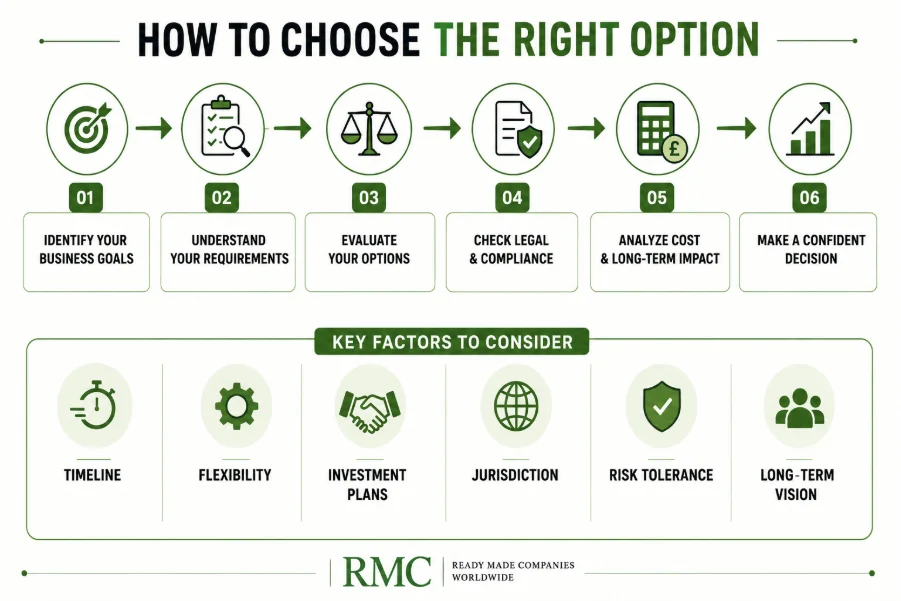
Before deciding between a shelf company and a new company, consider the following questions
- How quickly do I need the company?
- Will I seek investment in the future?
- Do I require a specific incorporation date?
- Am I expanding into another country?
- Have I completed sufficient due diligence?
- Do I need a bespoke ownership structure?
- Which option best supports my long-term business objectives?
Answering these questions can help determine which solution aligns best with your commercial plans.
Conclusion
Choosing between a shelf company and a new company formation depends on your business goals rather than simply which option is faster. A shelf company can be an excellent solution for businesses that need an existing legal entity quickly or are expanding into a new jurisdiction. However, it requires careful due diligence to ensure the company has a clean history and is suitable for your intended activities. A newly incorporated company offers a completely fresh start, allowing you to build the ownership structure, governance, and share arrangements around your business from day one.
For startups seeking investment or businesses requiring a customised corporate structure, this is often the preferred option. Ultimately, there is no one-size-fits-all answer. By considering your timeline, growth plans, compliance requirements, and long-term objectives with the experts support, you can choose the option that best supports your business success.