
Buying a shelf company is a legitimate way to acquire an already incorporated business entity, but the transaction must satisfy modern anti-money laundering requirements. Company service providers, banks, accountants, lawyers, and other regulated organisations may need to establish who the buyer is, who ultimately owns or controls the company, where funds originate, and what the company will actually do. For buyers, understanding AML requirements before starting the acquisition can make the ownership transfer smoother while reducing the risk of delays, rejected applications, or compliance concerns.
What Is a Shelf Company?
A shelf company is an existing legal entity that was incorporated before being acquired by its eventual owner. It may also be described as a ready-made, aged, or off-the-shelf company.
A genuine dormant shelf company may have an earlier incorporation date while having little or no previous commercial activity. Once purchased, its shares, directors, beneficial ownership, registered details, and other corporate information can be updated in accordance with the rules of its jurisdiction.
Businesses considering existing companies in different jurisdictions can explore Ready Made Companies Worldwide and compare available structures according to their commercial requirements.
Importantly, a shelf company should not be confused with an anonymous company. The fact that an entity already exists does not remove requirements to identify the people who ultimately own or control it.
Why Are Shelf Companies Relevant to AML Compliance?
Shelf companies are legitimate corporate structures, but company structures can be misused when ownership is concealed or transactions lack a genuine commercial purpose.
The Financial Action Task Force – FATF – has strengthened international standards concerning beneficial ownership. Its guidance emphasises the importance of authorities being able to access adequate, accurate, and up-to-date information about the true owners of companies.
For buyers, this means that transparency is increasingly central to legitimate company ownership.
A reputable shelf-company transaction should make it possible to establish
- Who is buying the company
- Who will own the shares
- Who ultimately controls the company
- Who the directors are
- Where acquisition funds originate
- What business the company intends to conduct
- Which countries the business will operate in
Attempts to conceal these details can create significant compliance concerns.
What Is Anti-Money Laundering – AML?
Anti-money laundering refers to laws, regulations, controls, and procedures designed to prevent criminals from disguising illegally obtained funds as legitimate assets or business income.
AML frameworks can also address related financial-crime risks, including terrorist financing and proliferation financing.
For businesses operating in regulated sectors, AML responsibilities can include
- Assessing financial-crime risk
- Identifying customers
- Verifying customer identities
- Identifying beneficial owners
- Understanding the purpose of business relationships
- Monitoring relevant activity
- Maintaining records
- Conducting enhanced checks where risk is higher
- Reporting suspicious activity where legally required
The exact requirements depend on the jurisdiction, regulated business, transaction, and risk profile.
Also read – Shelf Company Due Diligence.
What Is KYC and How Does It Apply to Shelf Companies?
KYC – Know Your Customer – is closely connected to AML compliance.
When purchasing a shelf company, buyers should expect the provider to request documents and information that establish their identity and circumstances.
This may include
- Full legal name
- Passport or government-issued identification
- Date of birth
- Residential address
- Proof of address
- Nationality
- Occupation or business activities
- Contact information
If the purchaser is another company, additional information may be required to establish its ownership and control structure.
HMRC’s current AML guidance describes customer due diligence as checks that regulated businesses perform on customers and, where applicable, their beneficial owners. The level of due diligence depends on the risk associated with the customer, relationship, product, or transaction.
For buyers, therefore, a provider asking detailed KYC questions should not automatically be regarded as creating unnecessary bureaucracy. Appropriate checks are part of legitimate corporate-service compliance.
Understanding Beneficial Ownership
Beneficial ownership is one of the most important concepts in AML compliance.
The legal shareholder shown on a company’s records may not always be the person who ultimately owns or controls the entity.
AML checks therefore seek to identify the natural person or persons ultimately behind a corporate structure.
Consider a shelf company purchased by Holding Company A, which is owned by Holding Company B, which is ultimately controlled by an individual.
Simply identifying Holding Company A may not provide a complete picture. Depending on the applicable rules, the ownership chain may need to be traced until the relevant ultimate beneficial owner is identified.
FATF’s strengthened beneficial-ownership standards are designed to improve the availability of accurate information about the people who ultimately own or control legal entities.
Why Source of Funds Matters
Shelf-company buyers may also be asked about the source of the money used for the transaction.
Source of funds generally concerns where the money for a particular transaction originates.
Depending on the circumstances, evidence might include
- Employment income
- Business income
- Company funds
- Investment proceeds
- Property-sale proceeds
- Savings
- Dividends
- Inheritance
- Loan documentation
The type and depth of evidence requested can vary according to risk.
A provider may need additional information where the transaction is unusually large, complex, inconsistent with the customer’s known circumstances, or connected with a higher-risk situation.
Buyers should therefore be prepared to explain how an acquisition is being funded rather than assuming that payment alone is sufficient.
Source of Funds vs Source of Wealth
Although the terms are sometimes used together, they address different questions.
Source of funds asks where the money being used for a particular transaction came from.
Source of wealth considers how an individual accumulated their overall wealth.
For example, a buyer might pay for a shelf company from a particular savings account. The savings account can explain the immediate source of funds, while employment, business ownership, investments, or property transactions may explain the broader source of wealth.
Not every shelf-company transaction requires the same level of information. Requirements should reflect applicable regulation and risk.
Customer Due Diligence – What Buyers Should Expect
Customer due diligence – CDD – is the process used to understand and verify a customer and, where relevant, beneficial owners.
For a shelf-company purchase, due diligence on the buyer can involve
- Identifying the customer
- Verifying the customer’s identity
- Identifying beneficial owners
- Understanding the ownership structure
- Establishing the purpose of the acquisition
- Understanding the intended nature of the business relationship
- Assessing relevant AML risks
These checks can take place before the company is transferred.
HMRC’s 2026 guidance states that CDD involves verifying customers, identifying and verifying beneficial owners where applicable, and obtaining information about the purpose and intended nature of a transaction or business relationship.
When Is Enhanced Due Diligence Required?
Not every customer presents the same risk.
Where a transaction, customer, ownership structure, or geographic connection presents higher risk, enhanced due diligence – EDD – may be necessary.
Depending on the applicable regime and circumstances, additional scrutiny may arise from factors such as
- Complex ownership structures
- High-risk jurisdictions
- Politically exposed persons
- Unusual payment arrangements
- Transactions without an obvious commercial purpose
- Difficulty identifying beneficial owners
- Inconsistent source-of-funds information
- Unusually complex corporate structures
- Higher-risk business activities
Enhanced due diligence does not necessarily mean wrongdoing has occurred. It means additional information or verification is required because the identified risk is higher.
AML and Shelf Company Due Diligence Work Both Ways
AML checks should not only focus on the buyer. The buyer should also investigate the company being acquired.
An older company can have a longer corporate history, and that history needs to be understood before ownership changes.
Review
- Previous shareholders
- Previous directors
- Beneficial ownership
- Filing history
- Previous trading activity
- Accounting records
- Tax status
- Outstanding liabilities
- Charges
- Legal disputes
- Previous banking relationships
- Regulatory history
A company advertised as dormant should have records consistent with that description.
The presence of previous commercial activity does not automatically make a company unsuitable, but it changes the risk profile and normally requires deeper investigation.
Red Flags Buyers Should Take Seriously
Certain circumstances should prompt additional questions before purchasing a shelf company.
Potential warning signs can include
- Unclear previous ownership
- Missing corporate records
- Unexplained changes of directors
- Previously undisclosed trading
- Unresolved debts
- Unexplained payments or transactions
- Inconsistent company information
- Unclear beneficial ownership
- Seller resistance to due diligence
- Requests to use third parties without explanation
- Claims that KYC can be avoided
- Guaranteed anonymous ownership
- Unexplained bank-account activity
One red flag does not necessarily prove financial crime. It indicates that the issue should be understood and resolved before proceeding.
Shelf Companies with Existing Bank Accounts
Buyers should exercise particular care where a shelf company is marketed with an existing bank account.
The presence of a bank account does not guarantee that the account can simply continue after the ownership changes.
A bank may need to identify and verify the new
- Directors
- Shareholders
- Beneficial owners
- Authorised signatories
It can also request information concerning the business model, expected turnover, customers, suppliers, countries of operation, source of funds, and expected transactions.
HMRC’s current risk guidance specifically recognises that ready-made companies and access to financial services can present financial-crime risks where corporate structures are misused to conceal identities or connections.
Banking should therefore be treated as a separate compliance process rather than an automatic benefit of buying an aged company.
Does Company Age Reduce AML Checks?
No, An older incorporation date does not exempt a company or its new owners from modern AML requirements.
A company incorporated ten years ago can still be subject to current identity, beneficial ownership, banking, and compliance checks when ownership changes.
Company age should therefore never be used as a reason to expect reduced scrutiny.
The new owners should expect regulated organisations to assess the company’s current ownership and intended activities rather than relying exclusively on its incorporation date.
AML Requirements for UK Shelf Companies in 2026
The UK provides a useful example of how corporate transparency and AML requirements increasingly interact.
Trust or Company Service Providers – TCSPs – include businesses providing company formation services and selling off-the-shelf firms. HMRC’s 2026 guidance confirms that TCSPs fall within the UK’s AML framework and must assess money laundering, terrorist-financing, and proliferation-financing risks.
Companies House has also introduced the Authorised Corporate Service Provider – ACSP – framework. An agent that verifies identities for Companies House must register as an ACSP and be supervised by a UK AML supervisory body.
Buyers interested in established British entities can review available UK Shelf Companies while recognising that purchasing an existing entity does not remove KYC, beneficial-ownership, identity-verification, or ongoing compliance obligations.
AML Compliance for International Shelf Companies
AML requirements are not identical in every jurisdiction.
A buyer acquiring a company in the UK, EU, United States, Asia, or an offshore jurisdiction can encounter different
- Beneficial ownership rules
- Corporate registries
- KYC standards
- Reporting obligations
- AML supervisory systems
- Record-keeping requirements
- Sanctions controls
- Banking procedures
International buyers can also encounter more than one compliance framework.
For example, the company may be incorporated in one country, managed from another, banked in a third, and conduct business with customers across several additional jurisdictions.
This makes transparency particularly important for cross-border structures.
How to Prepare for AML Checks When Buying a Shelf Company
Preparing documentation before starting the purchase can make the process more efficient.
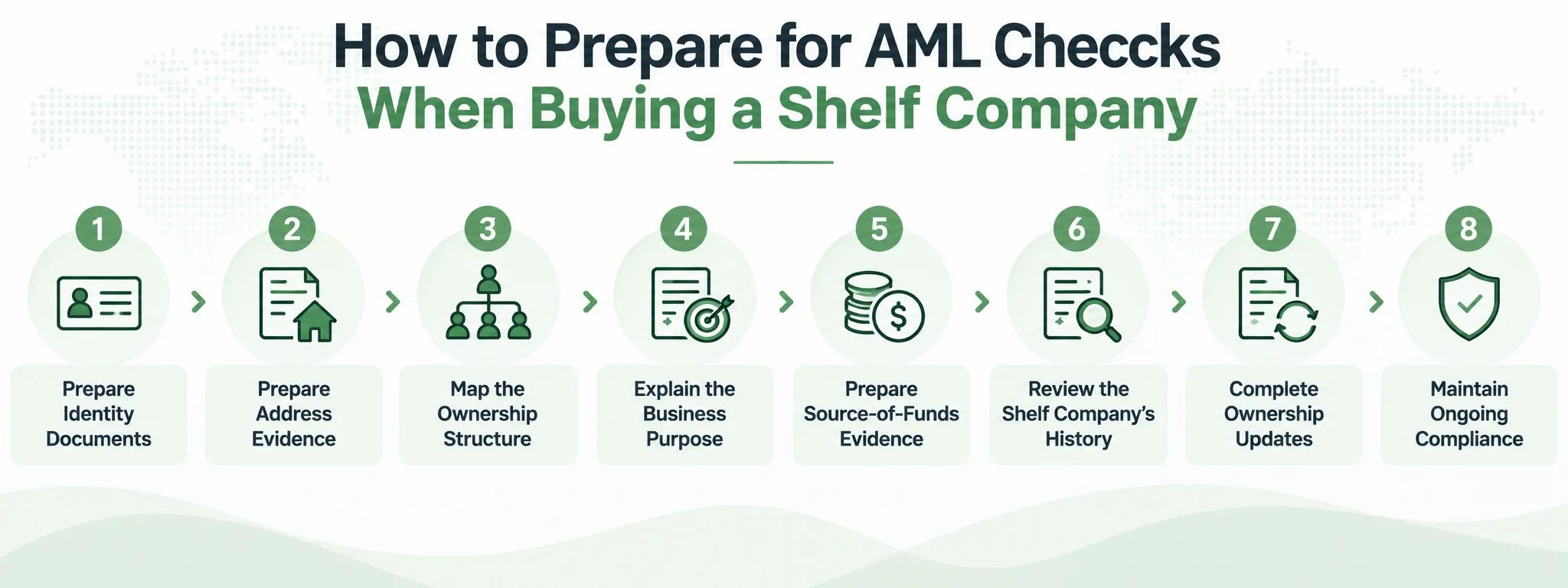
Step 1 – Prepare Identity Documents
Ensure that valid identification is available for the relevant buyer, directors, shareholders, and beneficial owners.
Step 2 – Prepare Address Evidence
Have current documents available to verify residential addresses where required.
Step 3 – Map the Ownership Structure
If companies, trusts, or other entities form part of the structure, prepare a clear ownership chart showing the relevant individuals behind it.
Step 4 – Explain the Business Purpose
Be ready to describe why the shelf company is being purchased and what activities it will conduct.
Step 5 – Prepare Source-of-Funds Evidence
Keep appropriate evidence showing how the acquisition is being financed where this is requested.
Step 6 – Review the Shelf Company’s History
Verify the entity’s ownership, filings, previous activity, liabilities, and other relevant corporate information.
Step 7 – Complete Ownership Updates
Ensure that directors, shareholders, beneficial owners, and other corporate records are updated correctly following acquisition.
Step 8 – Maintain Ongoing Compliance
AML and corporate compliance should not end when the shares are transferred. Keep company, ownership, accounting, tax, and regulatory records accurate as the business develops.
Conclusion
Shelf companies can provide a legitimate and practical route to acquiring an already incorporated business entity, but they do not provide a way around modern anti-money laundering requirements. Buyers should expect appropriate identity checks, beneficial-ownership verification, questions about business purpose and potentially source of funds, while also conducting their own due diligence on the company’s previous ownership, activities, liabilities, and records. AML requirements vary across jurisdictions, so international acquisitions should be assessed according to the rules applying to the company, provider, owners, and financial relationships involved. If you are considering acquiring a ready-made company and need help identifying an appropriate structure, Contact Us to discuss your requirements.