
Singapore remains one of Asia’s most established business centres, making a Singapore private limited company an attractive structure for entrepreneurs and international businesses expanding into Southeast Asia. Buying a pre-registered Pte Ltd can provide an existing corporate entity without incorporating a completely new company, but the purchase still requires careful due diligence, proper share transfers, updated corporate records, local officers, tax compliance, and potentially separate banking or licensing arrangements.
In 2026, buyers should focus less on company age alone and more on whether the entity has a clean history and satisfies current Singapore regulatory requirements. A pre-registered company does not automatically provide trading history, creditworthiness, banking facilities, customers, or tax advantages.
What Is a Singapore Shelf Company?
A Singapore shelf company is an existing company that has been incorporated in advance and maintained until a buyer acquires it. In most cases, the structure of interest to international entrepreneurs is a private company limited by shares – commonly identified by Pte Ltd in its name.
A genuine shelf company will normally have an incorporation date, Unique Entity Number – UEN, constitutional documents, issued shares, corporate records, and a registered office. Depending on its history, it may also have previous annual filings.
Businesses comparing existing companies across international markets can check Ready Made Companies Worldwide before determining whether Singapore is the appropriate jurisdiction for their operations.
The most important point is that a pre-registered company should not be confused with an established trading business. If a company was incorporated in 2023 but remained dormant until 2026, it may have a three-year corporate age but not three years of customers, revenue, contracts, or operating history.
Why Consider a Singapore Pte Ltd?
Singapore’s corporate framework is administered by the Accounting and Corporate Regulatory Authority – ACRA. A private limited company provides a separate legal structure through which shareholders can conduct legitimate commercial activities.
Singapore can be particularly relevant to businesses targeting Southeast Asian and wider Asia-Pacific markets.
Potential users can include
- International trading companies
- Technology businesses
- Professional services firms
- Regional subsidiaries
- E-commerce businesses
- International corporate groups
- Businesses establishing Southeast Asian operations
However, choosing Singapore should be based on genuine commercial requirements rather than simply its international reputation.
Singapore Shelf Company vs New Company Formation
The principal difference is that a shelf company already exists.
When forming a new company, the incorporation process starts with choosing and reserving the company name and then registering the entity through ACRA’s Bizfile system. ACRA states that the registration fee for a local company is S$300, and most straightforward registrations are approved shortly after payment, although complex applications can take longer.
A shelf company instead involves acquiring an existing entity and changing the ownership and, where required, management arrangements.
| Factor | Singapore Shelf Company | New Singapore Company |
|---|---|---|
| Incorporation | Already completed | New registration required |
| Incorporation date | Existing | Current |
| UEN | Already issued | Issued after registration |
| Corporate records | Existing | Created at formation |
| Shareholders | Transferred or changed | Selected during formation |
| Directors | Existing appointments may require changes | Appointed during formation |
| Due diligence | Essential | Less historical due diligence |
| Trading history | Not automatic | None |
| Bank account | Not guaranteed | Not guaranteed |
Because Singapore’s new-company registration process can itself be efficient, purchasing a shelf company generally makes the most sense when an existing incorporation date or immediately available legal entity provides a genuine commercial benefit.
Requirements a Singapore Pte Ltd Must Meet
Purchasing an existing company does not remove its continuing statutory obligations.
Resident Director
Every Singapore company must have at least one director who meets the local residency rules. ACRA states that directors must be at least 18, meet applicable eligibility requirements, and that at least one director must satisfy the Singapore residency requirement.
International buyers therefore need to address the board structure as part of the acquisition.
Using a nominee director does not eliminate directors’ legal responsibilities. ACRA expressly states that all directors remain responsible under the legislation regardless of whether they are described as active, nominee, or sleeping directors.
Company Secretary
A Singapore company must also have a company secretary.
ACRA states that the secretary must be appointed within six months of successful registration and must satisfy local residency requirements. The secretary must be a natural person, and where the company has only one director, that person cannot simultaneously serve as the company secretary.
When purchasing a shelf company, confirm who currently acts as secretary and what arrangements will apply after completion.
Registered Office
The company must maintain a registered office in Singapore.
ACRA explains that the registered office is the official address where communications and notices can be delivered and where relevant company records and registers are kept.
This requirement continues after the shelf company changes ownership.
How to Buy a Singapore Shelf Company in 2026
A properly managed acquisition should involve more than selecting an available company and making payment.
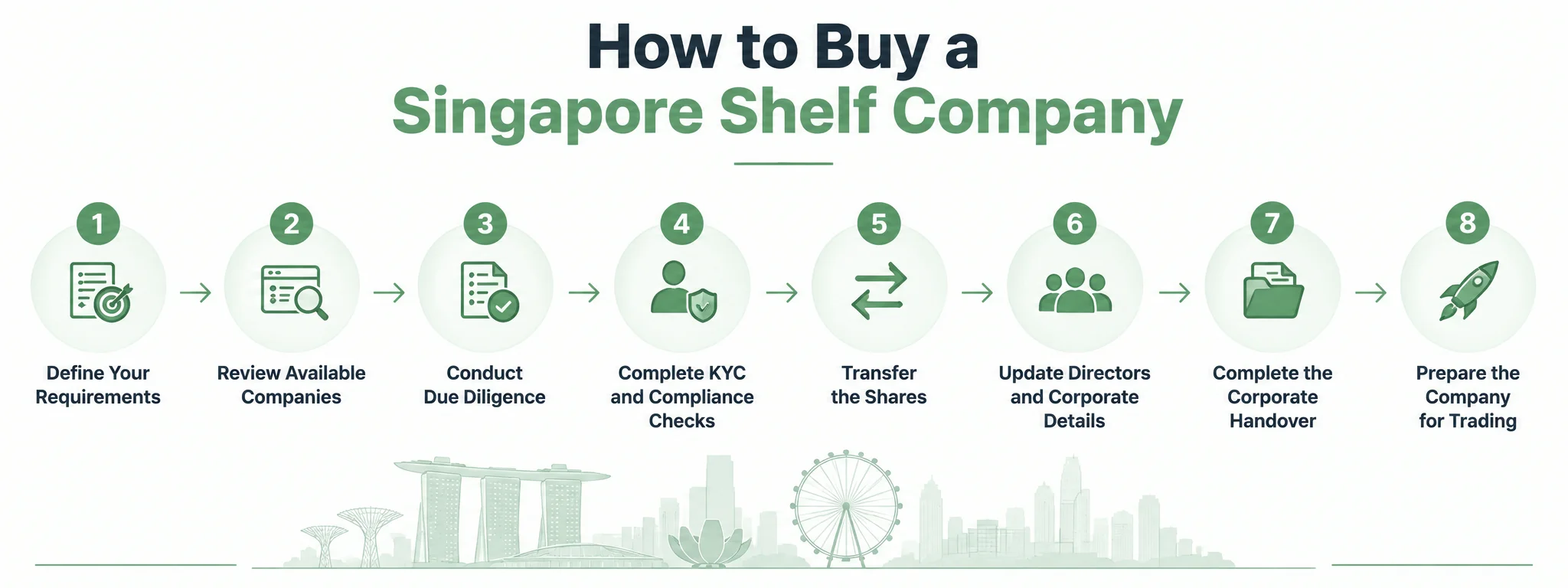
Step 1 – Define Your Requirements
Start by establishing why you need a Singapore company.
Consider
- Intended business activity
- Required company age
- Shareholder structure
- Directors
- Singapore resident director requirement
- Registered office
- Company secretary
- Banking requirements
- Tax implications
- Licensing requirements
- Intended operating date
If an older incorporation date provides no meaningful benefit, forming a new company may be the simpler option.
Step 2 – Review Available Companies
Once your requirements are clear, review the available pre-registered entities.
Businesses looking specifically at Asian corporate options can review Asian Shelf Companies.
Availability is important here – RMCW’s current Asia page states that no Asian shelf companies are presently available and that assistance with setting up a new Asian company can instead be provided. Availability should therefore be confirmed directly before assuming that a Singapore Pte Ltd can be purchased immediately.
When an entity is available, request details including
- Company name
- Incorporation date
- UEN
- Share capital
- Current shareholders
- Current directors
- Registered office
- Company secretary
- Filing history
- Trading status
Step 3 – Conduct Due Diligence
Never purchase a shelf company solely because it has an attractive incorporation date.
Verify whether it has genuinely remained dormant and whether all required corporate records have been properly maintained. Check
- Certificate and date of incorporation
- Current ACRA status
- Business Profile
- Constitution
- Shareholders
- Directors
- Share capital
- Previous ownership
- Annual filings
- Accounting records
- Tax position
- Existing contracts
- Debts and liabilities
- Charges or legal issues
- Previous commercial activity
If the company has previously traded, the transaction requires significantly deeper investigation.
Also read – Important Questions to Ask Before Buying a Shelf Company.
Step 4 – Complete KYC and Compliance Checks
A reputable provider should verify the purchaser and relevant beneficial owners before transferring the company.
Buyers should expect to provide documentation such as
- Passport or identification
- Residential address evidence
- Shareholder information
- Director information
- Beneficial ownership details
- Source-of-funds information where required
- Intended business activity
Singapore’s corporate transparency requirements should also be considered. ACRA’s 2026 incorporation guidance includes requirements concerning the Register of Registrable Controllers and registers relating to nominee directors and nominee shareholders for companies that are not exempt.
A shelf company should never be purchased as a means of concealing its genuine ownership.
Step 5 – Transfer the Shares
Ownership of a private company can generally be changed by transferring its shares.
ACRA states that existing shareholders can transfer shares provided the shares are fully paid and the transfer complies with the company’s constitution. A proper instrument of transfer is required to record the transfer of legal title.
The transaction should clearly identify
- Seller
- Buyer
- Number of shares
- Class of shares
- Transfer date
- Consideration where applicable
- Resulting ownership
The company’s corporate records must then accurately reflect the new shareholder structure.
Step 6 – Update Directors and Corporate Details
The buyer may also need to change directors and other company information.
ACRA states that changes to company officers must be filed through Bizfile within 14 days of the change.
Depending on the transaction, updates may involve
- Directors
- Shareholders
- Beneficial owners or controllers
- Registered office
- Company secretary
- Contact information
- Business activity
- Company name
Do not assume that acquiring the shares automatically updates every regulatory record.
Step 7 – Complete the Corporate Handover
Once the ownership and management changes have been properly completed, the buyer should receive or obtain access to the company’s complete records.
The handover may include
- Incorporation information
- UEN
- Business Profile
- Constitution
- Share records
- Director records
- Corporate resolutions
- Accounting records where applicable
- Previous filings
- Tax documentation
- Registered office information
Review everything against the due diligence information provided before completion.
Step 8 – Prepare the Company for Trading
Ownership transfer does not necessarily mean that the business is immediately operational.
Depending on its activities, the new owner may still need to arrange
- Business banking
- Tax administration
- GST registration where applicable
- Accounting
- Employment arrangements
- Insurance
- Sector-specific licences
- Commercial contracts
- Payment processing
Licensing requirements should be checked before commencing regulated activities.
Singapore Corporate Tax in 2026
Singapore’s headline corporate income tax rate remains 17% of chargeable income for both local and foreign companies.
However, the headline rate should not be treated as the company’s effective tax rate in every situation. Singapore provides qualifying companies with tax exemption schemes, while Budget 2026 also introduced a corporate income tax rebate and cash-grant measures for YA 2026 subject to the applicable conditions.
A shelf company’s age should not be used to assume eligibility for a particular tax concession. Tax treatment depends on the company’s circumstances and applicable IRAS rules.
International owners should also consider whether management, activities, income, or operations create tax obligations outside Singapore.
Does a Singapore Shelf Company Include a Bank Account?
Not necessarily.
Purchasing the shares of an existing Singapore company does not guarantee that a business bank account is included or that a bank will accept the new owner.
Banks and payment providers conduct independent onboarding and risk assessments. They can request information concerning
- New beneficial owners
- Directors
- Source of funds
- Source of wealth
- Business model
- Customers
- Suppliers
- Expected transactions
- Countries of operation
- Tax residency
Even where an existing account is associated with a company, the bank may need to review the ownership change before allowing the new owners to operate it.
Banking should therefore be treated as a separate workstream from the company acquisition.
Does an Older Singapore Company Provide Better Credibility?
An older incorporation date can sometimes have commercial value, but buyers should avoid overstating what it represents.
Consider a company incorporated in 2022 and maintained dormant until 2026. It is four years old as a legal entity, but it does not automatically have –
- Four years of revenue
- Four years of trading
- Established customers
- Supplier relationships
- Business credit
- Financing history
- Successful contracts
A buyer should describe its history accurately.
A clean dormant company can provide an established incorporation date. It cannot legitimately provide trading achievements that never occurred.
Conclusion
A Singapore shelf company can provide an established Pte Ltd structure for businesses seeking a corporate presence in one of Asia’s major commercial centres, but purchasing an existing entity does not remove Singapore’s director, company secretary, registered office, tax, corporate filing, beneficial ownership, banking, or licensing requirements. Buyers should verify the company’s complete history, distinguish incorporation age from genuine trading history, complete the share transfer correctly, and ensure all corporate records reflect the new ownership before commencing operations. Current availability should also be confirmed because existing Singapore entities may not always be in stock. If you are considering establishing or acquiring a company for your Singapore expansion, Contact Us to discuss the most appropriate option.