
Buying an existing US company can be an attractive option for international entrepreneurs who want to establish a business presence without going through the entire incorporation process. However, choosing between an LLC and a corporation is an important decision that can affect taxation, ownership flexibility, compliance responsibilities, and future business growth. When comparing LLC vs corporation structures, foreign buyers need to consider more than the company’s registration date. The right shelf company should support their intended business activities, investment plans, and long-term objectives while meeting applicable US legal and tax requirements.
What Is a Shelf LLC or Shelf Corporation?
A shelf company is a business entity that has already been legally registered but has generally remained inactive until purchased by a new owner.
In the United States, shelf companies may be available as Limited Liability Companies (LLCs) or corporations. Both structures can provide an existing legal entity with an earlier incorporation date.
The main difference lies in how each business is organised, managed, taxed, and owned.
A shelf LLC typically provides flexible management and ownership arrangements. Its owners are called members, and its internal operations are usually governed by an operating agreement.
A shelf corporation has a more formal structure involving shareholders, directors, and corporate officers. Ownership is generally represented through shares.
Foreign buyers can consider available US shelf companies in Delaware when evaluating suitable acquisition opportunities.
LLC vs Corporation – Key Differences
Understanding the structural differences helps foreign investors choose a company that supports their commercial objectives.
| Feature | LLC | Corporation |
|---|---|---|
| Ownership | Members | Shareholders |
| Management | Member-managed or manager-managed | Directors and officers |
| Taxation | Flexible federal tax classification | Generally corporate taxation |
| Compliance | Often fewer corporate formalities | More formal governance |
| Best Suited For | Small businesses and flexible ownership | Investment and expansion plans |
Both structures can provide limited liability protection, although that protection is not absolute and depends on applicable law and proper business practices.
The most suitable option depends on how the company will operate after ownership is transferred.
Why Foreign Buyers Choose a Shelf LLC
An LLC is often attractive to international entrepreneurs because it combines limited liability protection with flexible internal management.
Flexible Ownership and Management
Most US states allow foreign individuals and businesses to own LLCs without requiring members to be US citizens or residents.
An LLC can also have one or multiple members, making it suitable for individual entrepreneurs, international partnerships, and foreign-owned subsidiaries.
Flexible Tax Classification
One important advantage of an LLC is its federal tax classification flexibility.
Depending on ownership and elections, an LLC may be treated as:
- A disregarded entity for federal income tax purposes.
- A partnership when it has multiple members.
- A corporation if an appropriate tax election is made.
However, foreign ownership can introduce additional reporting requirements. For example, certain wholly foreign-owned single-member LLCs must file Form 5472 with a pro forma Form 1120 when they have reportable transactions.
An LLC does not automatically provide tax-free income or eliminate US tax obligations.
Also read – How to Buy a Shelf Company – Step-by-Step Guide.
Why Foreign Buyers Choose a Shelf Corporation
Corporations can be particularly suitable for businesses that need a structured ownership framework or intend to raise external investment.
Suitable for Investors and Shareholders
A corporation can issue shares, establish different ownership interests, and accommodate changes in shareholders.
This structure may be preferable for businesses planning to:
- Raise capital from external investors.
- Establish a US subsidiary.
- Introduce additional shareholders.
- Expand through acquisitions.
- Develop a long-term investment structure.
Established Corporate Governance
Corporations operate through a formal governance framework involving directors, officers, and shareholders.
Although this generally involves additional administrative responsibilities, it can provide clarity when managing larger businesses or multiple investors.
Foreign buyers should also understand the difference between C corporations and S corporations.
A C corporation can generally have foreign shareholders, while S corporations cannot have non-resident alien shareholders. Consequently, C corporations are usually the relevant corporate option for foreign individuals who do not meet S corporation eligibility requirements.
Tax Considerations for Foreign Buyers
Taxation is one of the most important factors when comparing an LLC vs corporation.
LLC Taxation
An LLC’s federal tax treatment depends on its classification, ownership, and activities.
Foreign owners may have US filing obligations even when their LLC has limited operations.
The owner’s country of residence, applicable tax treaties, and whether the business generates US-connected income can also affect the overall tax position.
Corporation Taxation
A US C corporation generally pays federal corporate income tax on taxable profits.
When profits are distributed as dividends, shareholders may face additional taxation, including applicable withholding taxes for foreign investors.
This potential two-level taxation should be considered alongside the corporation’s advantages for investment and ownership arrangements.
Neither structure should be selected solely on assumptions about lower taxation. Professional cross-border tax advice is particularly important.
Which Structure Is Better for Different Business Needs?
There is no universally superior structure for every foreign investor.
For individual entrepreneurs: An LLC may be suitable where flexible management and straightforward ownership are priorities.
For international partnerships: A multi-member LLC may provide an adaptable ownership arrangement, subject to partnership tax and reporting requirements.
For investor-backed businesses: A C corporation may be preferable where issuing shares and attracting institutional investment are important.
For foreign subsidiaries: Either structure may work, depending on the parent company’s tax position, governance requirements, and commercial objectives.
For long-term expansion: Corporations may offer advantages where multiple shareholders, structured financing, or complex ownership arrangements are anticipated.
How to Choose Between an LLC and Corporation Shelf Company
Foreign buyers should follow a structured assessment before acquiring an existing US entity.
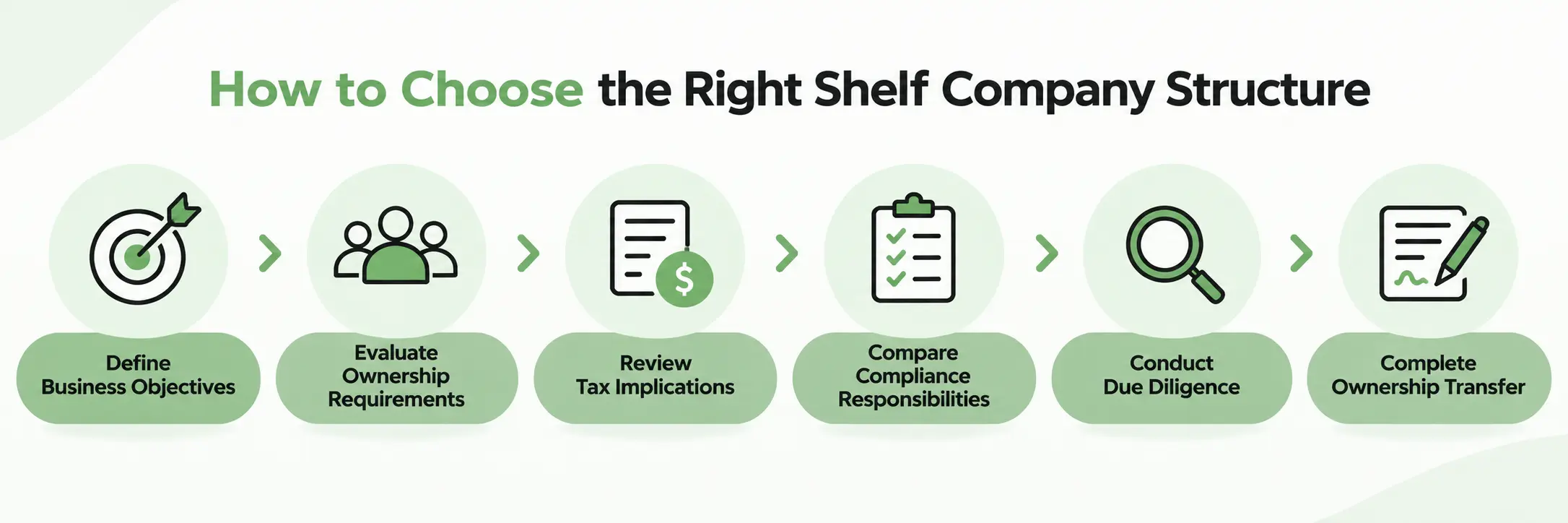
Step 1 – Define Your Business Objectives
Identify your intended business activities, target customers, investment requirements, and long-term plans.
Step 2 – Evaluate Ownership Requirements
Determine whether the business will have one owner, multiple partners, or external shareholders.
Step 3 – Review Tax Implications
Assess federal and state tax obligations, foreign ownership reporting, and potential taxation in your country of residence.
Step 4 – Compare Compliance Responsibilities
Review annual filings, registered agent requirements, corporate governance, and ongoing maintenance costs.
Step 5 – Conduct Shelf Company Due Diligence
Verify the company’s registration status, previous activities, financial records, tax filings, and potential liabilities.
Step 6 – Complete Ownership Transfer
Finalise the appropriate membership interest or share transfer, update company records, and complete required regulatory procedures.
Following these steps helps ensure that the selected company structure matches your commercial requirements.
What Foreign Buyers Should Check Before Purchasing
Purchasing an existing company does not automatically guarantee banking approval, operational readiness, or financial credibility.
Before completing an acquisition, confirm:
- Corporate status – Verify that the company is legally registered and in good standing.
- Previous activities – Establish whether the company has genuinely remained dormant.
- Outstanding liabilities – Check for debts, legal disputes, or unpaid obligations.
- Ownership documentation – Review membership interests, shares, and transfer requirements.
- Banking eligibility – Confirm the documentation required for business account applications.
Foreign buyers must also complete applicable identity verification, anti-money laundering checks, and beneficial ownership disclosures.
A shelf company’s earlier incorporation date should never be confused with an established trading history.
Conclusion
Choosing between an LLC and corporation shelf company requires careful consideration of ownership flexibility, taxation, compliance, and future business plans.
An LLC may be suitable for foreign entrepreneurs seeking adaptable management arrangements, while a corporation may better support businesses planning to attract investors or establish a formal shareholder structure.
Ultimately, the best choice is the structure that supports your commercial objectives while meeting US regulatory requirements.
Ready Made Companies Worldwide can help international buyers evaluate suitable shelf company options. Visit our Contact Us page to discuss your requirements and available opportunities.