

Winning public and private sector contracts can create significant growth opportunities for businesses of all sizes. Across the UK, organisations regularly issue tenders for everything from IT services and construction to consultancy, manufacturing, healthcare, and professional services. However, many entrepreneurs wonder whether purchasing a shelf company can improve their chances of securing these contracts.
A shelf company is an existing company that has already been incorporated but has not traded. Because it already exists on the Companies House register, some business owners believe it offers an advantage when bidding for contracts that appear to favour more established businesses.
This guide explains how a shelf company for UK tenders works, when it can be beneficial, what procurement teams actually evaluate, and the factors you should consider before relying on a shelf company for tender applications.
What Is a Shelf Company?
A shelf company, also known as a ready-made company, is a business that has already been incorporated but has never traded or conducted commercial activities. These companies are established by specialist providers and remain dormant until purchased by a new owner. Once ownership is transferred, the buyer can update the company’s
- Directors
- Shareholders
- Registered office
- Company name (if required)
- SIC codes where appropriate
After these changes are completed, the company can begin trading like any other UK limited company. Unlike purchasing an existing trading business, acquiring a shelf company does not include customers, contracts, intellectual property, employees, or trading history. The primary benefit is gaining access to a legally incorporated company without completing the incorporation process yourself.
Can You Use a Shelf Company for UK Tenders?
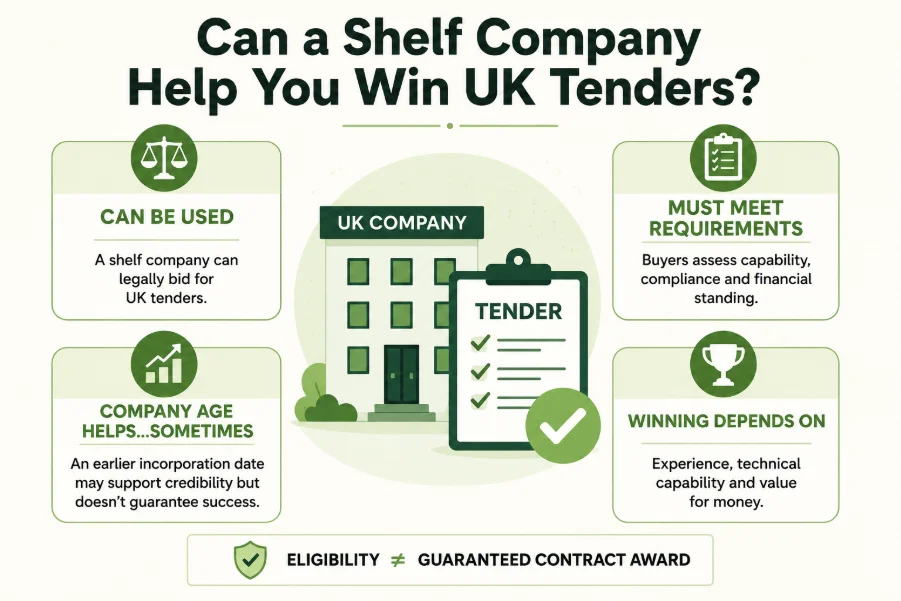
The simple answer is yes. A shelf company can legally submit bids for UK tenders, provided it meets all procurement requirements. There are no procurement rules that automatically prevent shelf companies from participating simply because they were purchased from a company formation provider. However, whether the company is actually eligible depends entirely on the specific requirements of each tender.
Many buyers assess suppliers based on factors such as
- Financial standing
- Previous experience
- Technical capability
- Insurance cover
- Professional accreditations
- Staff qualifications
- Capacity to deliver
- Regulatory compliance
A shelf company can satisfy these requirements if it has developed the necessary operational capability after purchase. Simply having an older incorporation date is rarely enough.
How UK Tender Evaluations Actually Work?
One of the biggest misconceptions is that procurement teams mainly look at the age of a company. In reality, most public and private procurement exercises follow structured evaluation criteria designed to identify the supplier most capable of delivering the contract successfully.
Typical assessment areas include
Financial Stability
Buyers often request financial information to determine whether your business has sufficient resources to complete the contract.
This may include
- Filed accounts
- Turnover
- Cash flow
- Creditworthiness
- Financial ratios
A dormant shelf company will usually have little or no financial history until it begins trading.
Technical Capability
Procurement teams want evidence that you can successfully deliver the required services or products.
This could include
- Previous projects
- Specialist knowledge
- Industry certifications
- Delivery methodology
- Quality assurance systems
The company’s incorporation date alone does not demonstrate capability.
Relevant Experience
Many tenders ask suppliers to provide examples of similar work completed within recent years.
Evidence may include
- Case studies
- Client references
- Contract values
- Project outcomes
A newly purchased shelf company cannot automatically claim work completed by another organisation unless legally appropriate and properly evidenced.
Compliance Requirements
Depending on the sector, buyers may request evidence such as
- Professional indemnity insurance
- Public liability insurance
- Employers’ liability insurance
- Cyber Essentials certification
- ISO certifications
- Health and safety policies
- Equality policies
- Environmental management systems
These requirements apply equally to shelf companies and newly incorporated businesses.
Does an Older Incorporation Date Help?
This is probably the most common question businesses ask. The answer is Sometimes, but only in limited circumstances. Some procurement teams may view an earlier incorporation date as one indicator that the company has existed for longer. However, experienced procurement professionals understand that incorporation date and trading history are two completely different things.
A company incorporated three years ago but purchased yesterday may still have
- No trading history
- No customers
- No completed contracts
- No filed trading accounts
Consequently, the incorporation date alone is unlikely to significantly influence evaluation scores. Where buyers specifically require several years of trading history, a dormant shelf company generally will not satisfy that requirement.
When Can a Shelf Company Be Beneficial?
Although it does not guarantee tender success, a shelf company can provide advantages in certain situations.
Professional Appearance
An older incorporation date may help present a more established corporate profile when dealing with customers, suppliers, and commercial partners. While procurement teams rely primarily on evidence, first impressions can still influence wider commercial relationships.
Immediate Availability
If you need a registered company quickly to begin preparing tender documentation, a shelf company allows you to start operating almost immediately after ownership transfer. This can be particularly useful when responding to short procurement deadlines.
Existing Corporate Identity
Because the company already exists within Companies House records, certain administrative processes may be completed sooner than waiting for a completely new incorporation. However, directors, shareholders and statutory records must still be updated before trading begins.
International Expansion
Some overseas investors prefer acquiring UK shelf companies when establishing a UK presence before pursuing procurement opportunities. The company provides an immediate legal entity from which operations can commence once all regulatory requirements have been completed.
When a Shelf Company Will Not Improve Your Chances?
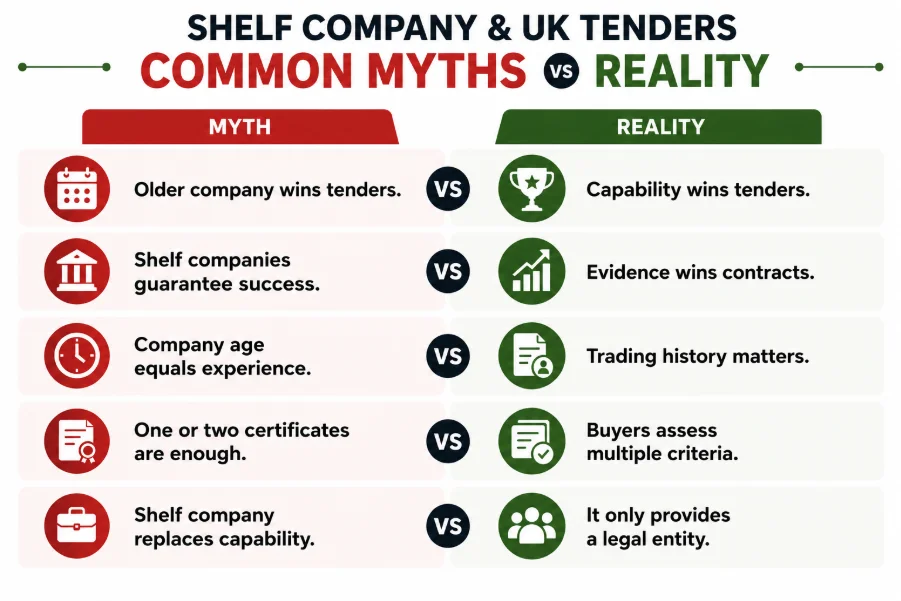
Many businesses assume buying an older company automatically increases credibility. This is rarely true. A shelf company will not compensate for weaknesses in other important areas.
For example, it cannot replace
- Proven industry experience
- Strong financial performance
- Skilled employees
- Relevant certifications
- Previous successful contracts
- Robust governance
- Quality management systems
If the tender requires three years of completed projects, purchasing a dormant company incorporated three years ago will usually not satisfy that requirement. Procurement teams increasingly focus on evidence rather than assumptions. As a result, businesses should view shelf companies as one part of their wider commercial strategy rather than a shortcut to winning contracts.
What Should You Check Before Using a Shelf Company for UK Tenders?
Before relying on a shelf company for procurement opportunities, it’s important to carry out proper due diligence. While reputable providers supply dormant companies with a clean history, buyers should still verify that the company is suitable for their intended use.
Key checks include
-
Dormant Status
Confirm that the company has never traded and has no outstanding commercial liabilities. A genuine shelf company should have remained dormant since incorporation.
-
Companies House Records
Review the company’s filing history to ensure all statutory filings are up to date and that there are no unexpected changes in ownership or registered details. Official records can be checked through Companies House
-
Outstanding Obligations
Ensure the company has
- No unpaid taxes
- No outstanding legal disputes
- No County Court Judgments (CCJs)
- No insolvency history
A reputable provider should supply a clean company with no hidden liabilities.
-
Company Name
Decide whether to retain the existing company name or change it to reflect your brand. If changing the name, also consider trademark availability and domain registration.
-
Tender Requirements
Review each tender carefully to understand whether it specifies
- Minimum turnover
- Trading history
- Industry certifications
- Previous contract experience
- Financial thresholds
A shelf company only helps if it can genuinely meet these requirements after acquisition.
Shelf Company vs New Company for UK Tender Applications
Both options allow businesses to participate in procurement opportunities, but each has different advantages.
| Shelf Company | Newly Incorporated Company |
| Earlier incorporation date | New incorporation date |
| Immediately available | Requires incorporation first |
| May appear more established | Brand-new corporate identity |
| Higher purchase cost | Lower incorporation cost |
| Still requires operational capability | Still requires operational capability |
Neither option guarantees procurement success. Buyers should choose the structure that best aligns with their business objectives rather than assuming one automatically performs better in tender evaluations.
Best Practices When Using a Shelf Company for Tenders
To maximise your chances of success, focus on strengthening your business rather than relying solely on the company’s incorporation date.
Consider the following best practices
- Build a strong portfolio of completed projects.
- Maintain accurate financial records.
- Obtain relevant industry certifications.
- Invest in qualified staff and operational capability.
- Develop clear policies for quality, health and safety, and data protection.
- Register for appropriate insurance cover.
- Carefully review every tender specification before submitting a bid.
- Keep Companies House records accurate and up to date.
A shelf company should support your wider business strategy, not replace the experience and capability buyers expect to see.
Conclusion
A shelf company for UK tenders can provide an established legal entity and allow businesses to begin operating quickly, but it should never be viewed as a shortcut to winning contracts. Procurement teams focus on evidence of financial stability, technical capability, relevant experience, and compliance rather than simply the company’s incorporation date. For businesses that need an immediate UK company, a shelf company can form part of an effective commercial strategy when combined with strong operational credentials and careful preparation.
Before purchasing, ensure the company has a clean history, understand the tender requirements, and build the experience and documentation needed to compete successfully. With the right experts preparation, a shelf company can support your growth, but your expertise, capability, and value proposition will remain the factors that ultimately win UK tenders.