

If you buy a shelf company that carries a County Court Judgment (CCJ), you inherit that liability the moment the company transfer completes. The debt does not disappear with the previous owner. It stays attached to the company as a legal entity. Creditors can pursue enforcement against you just as they could against whoever owned it before.
This is one of the most commonly misunderstood risks in shelf company acquisitions. Buyers focus on the purchase price, the company’s trading history, or the appeal of an aged credit profile. They overlook the legal baggage sitting quietly in the public record.
This guide exists to change that. By the time you finish reading, you will know exactly what a CCJ means for the company you are considering, how to identify one before you commit, what your practical options are if you discover one, and how to protect yourself legally and financially at every stage of the process.
What Is a CCJ? A Clear Definition for Business Buyers
A County Court Judgment (CCJ) is a court order issued in England, Wales, or Northern Ireland that formally confirms a company owes a specific debt to a creditor. It is not merely a dispute or a claim. It is a court-confirmed liability.
The process works like this a creditor is owed money and cannot get the company to pay. They issue a claim through the county court. If the company fails to respond adequately, or the court agrees the debt is owed, the court issues a judgment ordering repayment. That judgment is then registered on the public record and the company’s credit file.
CCJs are issued by the county court in England and Wales. In Scotland, the equivalent is a Sheriff Court decree. In Northern Ireland, it is a judgment from the County Court of Northern Ireland. The principles are broadly similar, but enforcement procedures vary slightly by jurisdiction.
Key Legal Characteristics of a CCJ
- It is a legal judgment, not a warning or a letter before action.
- It is a matter of public record, searchable by anyone.
- It remains on a company’s credit file for six years from the date it was issued.
- It can still be enforceable beyond six years in certain circumstances. The credit file drop-off does not automatically extinguish the debt.
- Multiple CCJs against the same company compound both the financial and reputational damage considerably.
Who Issues CCJs Against Companies?
Understanding who typically pursues CCJs helps you assess the risk level of any judgment you find during due diligence.
| Creditor Type | Common Reason for CCJ | Typical Amount | Enforcement Aggression |
|---|---|---|---|
| Suppliers | Unpaid invoices or goods | £5,000 to £50,000 | Medium – often open to settlement |
| HMRC | Unpaid VAT, corporation tax, PAYE | £20,000 to £200,000+ | Very High – HMRC pursues aggressively |
| Banks/lenders | Defaulted loans or overdrafts | Substantial, often £50,000+ | High – lenders are systematic enforcers |
| Landlords | Unpaid rent arrears | Several months of rent | Medium to High, especially if premises are still occupied |
| Other creditors | Service contracts, utilities, professional fees | Varies widely | Low to Medium – often willing to settle |
The nature of the creditor matters enormously when you are assessing risk. An unpaid trade invoice CCJ from a small supplier is a very different proposition to an active HMRC enforcement action for £80,000 in VAT debt.
How CCJs Are Created – The Process Explained
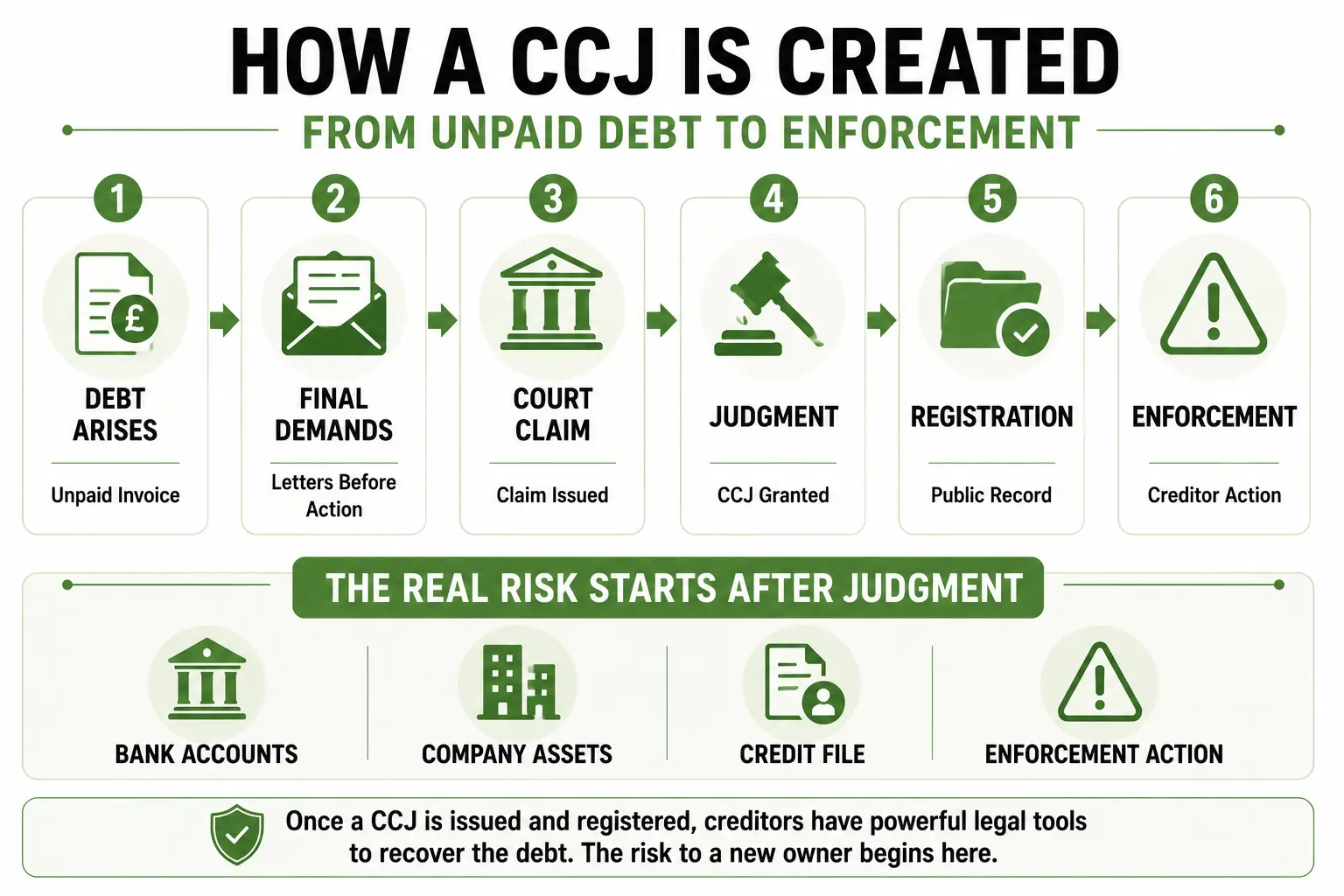
Most buyers see the result, a judgment on the register, without understanding how it got there. Knowing the process helps you interpret what you find during due diligence.
- Stage 1 – Debt arises. A company fails to pay a creditor. This could be an invoice, a tax bill, a loan repayment, or a lease obligation.
- Stage 2 – Pre-action steps. The creditor sends payment demands, letters before action, and ultimately a statutory demand. The company ignores or cannot respond adequately.
- Stage 3 – Court claim issued. The creditor files a claim with the county court. The company is notified and given 14 days to respond (or 28 days to request more time).
- Stage 4 – Judgment entered. If the company does not defend the claim or pay the debt, the court enters judgment automatically. If there is a defence, the case may proceed to a hearing.
- Stage 5 – Judgment registered. The CCJ is registered on the Register of Judgments, Orders and Fines and recorded on the company’s credit file.
- Stage 6 – Enforcement. The creditor now has legal authority to pursue enforcement. This is where the real danger for a new owner begins.
What Do You Actually Inherit When You Buy a Shelf Company with a CCJ?
This is the question most buyers get wrong. The misunderstanding is expensive.
What Transfers to You
When you purchase a shelf company, you are purchasing the legal entity itself. That means
- The CCJ judgment – it sits against the company, and the company is now yours.
- The full debt obligation, including any interest that has accrued since the judgment date.
- Liability for active enforcement action – if a creditor has already begun enforcement, that process does not pause because of a change of ownership.
- Reputational association – the public record links the company name to the judgment, and that applies regardless of who is currently running it.
- Ongoing credit damage – any bank, supplier, or partner conducting a credit check will see the CCJ immediately.
What Does Not Transfer to You
There are important limits on what you inherit. Understanding them helps you assess whether personal exposure is a risk.
- The previous owner’s personal liability – in most cases, this stays with the individual who signed or ran the company. Limited liability protects you from inheriting their personal debts.
- Personal guarantees given by the previous owner – these remain attached to the individual, not the company, unless they were explicitly written against the company itself.
- Claims that predate the company’s formation – you cannot inherit liability for events that occurred before the company existed.
- Criminal liability – In most circumstances, criminal responsibility for the previous owner’s conduct stays with them personally.
Critical point – Limited liability protects you personally in most cases, but it does not protect the company. The company, which you now own, carries the full CCJ liability.
How a CCJ Affects the Company You Are Buying
The impact of a CCJ stretches well beyond the debt itself. Before you buy, you need to understand every dimension of the problem you may be inheriting.
Financial Impact
An unsatisfied CCJ is not a dormant liability. It is an active legal instrument that creditors can use at any time. A CCJ signals to the market that a company has failed to meet its financial obligations. The downstream consequences affect trading ability, credit, and relationships simultaneously.
Enforcement options available to the creditor include
- Charging orders on company assets or property
- Third-party debt orders (previously known as garnishee orders) that freeze bank accounts
- A bailiff or sheriff visits the company premises to seize goods
- Winding-up petitions in severe or long-running cases
Note that once a creditor has obtained a CCJ, they have several enforcement routes open to them simultaneously, and they can pursue more than one at a time. If a bailiff has already seized assets before you complete the purchase, the situation becomes extremely complicated.
Interest also continues to accrue on unpaid CCJ amounts at the statutory rate. This means a £10,000 CCJ left unresolved for two years is not a £10,000 problem. It will be larger.
Banking Impact
Banks conduct credit checks on companies as a matter of routine when opening accounts, reviewing facilities, or processing lending applications. A CCJ on the record will
- Trigger internal risk flags, potentially causing account restrictions.
- Make it significantly harder to open a new business account.
- Almost certainly prevent or delay any lending, overdraft, or finance facility.
- Result in stricter payment terms on any banking products.
This is not a future risk. It is an immediate operational constraint the moment you take ownership.
Supplier and Trade Relationships
Trade credit, the ability to buy on account and pay in 30 or 60 days, is the lifeblood of many businesses. A CCJ destroys it immediately.
- Suppliers running credit checks (which most do on new or renewed accounts) will see the judgment.
- Many will switch the company to cash-only or pro-forma terms.
- Some suppliers, particularly in regulated or sensitive sectors, will refuse to deal with the company entirely.
- Insurance providers may increase premiums or decline to cover the business.
Reputational Damage
CCJs are publicly searchable. Anyone, whether a customer, a prospective business partner, or an investor, can find them in seconds with a commercial credit checking service. For B2B companies, especially, a publicly visible CCJ can cost you contracts before you have even had a conversation.
The reputational damage is disproportionate to the debt amount. A £6,000 CCJ from a supplier dispute can cost you a £600,000 contract opportunity if the other side runs a routine check and walks away.
Types of CCJs Commonly Found on Shelf Companies
Not all CCJs carry equal risk. Understanding the type helps you assess urgency, negotiability, and total exposure.
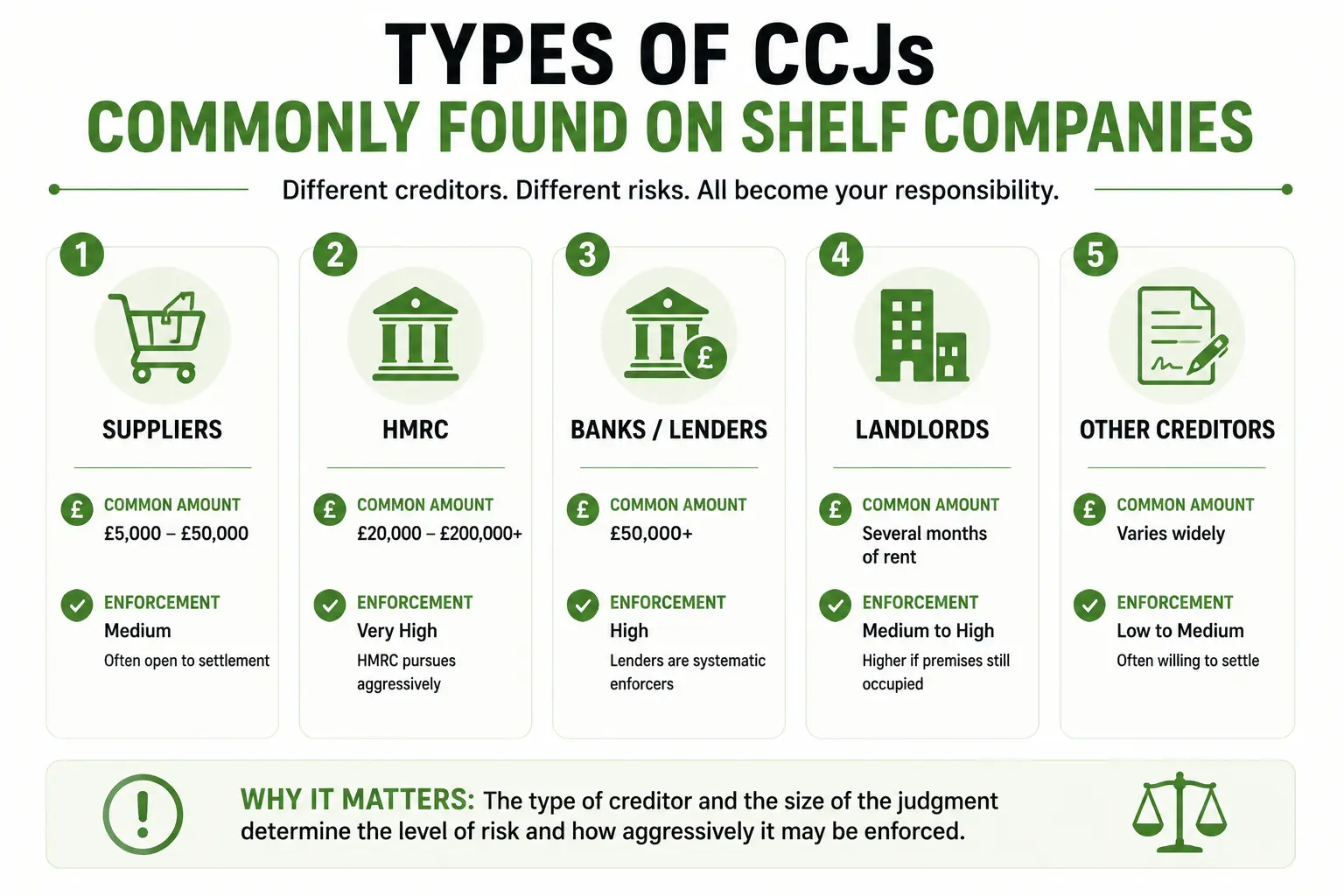
Unpaid invoice CCJ – typically from a supplier or service provider for goods or services delivered but not paid for. These are often the most negotiable, especially if the creditor has written off the debt internally.
HMRC tax or VAT CCJ – the highest-risk category. HMRC is a systematic and aggressive enforcer. They have legal powers that ordinary creditors do not, including the ability to pursue directors personally in cases of fraud or negligence. An active HMRC CCJ on a shelf company you are considering is a serious red flag.
Landlord rent arrears CCJ – medium to high risk, particularly if the company still has a connection to the premises. If the company’s registered address is the landlord’s property, the relationship becomes even more complicated.
Bank or finance provider CCJ – these creditors are systematic enforcers and will pursue the full amount. They also have the added complication that a CCJ from a lender may restrict your ability to open banking facilities with other providers.
Multiple CCJs – the most dangerous scenario. Three or more judgments against a single company indicate a pattern of systemic non-payment, not a one-off dispute. This type of company has almost certainly been through serious financial distress, and the total exposure may be far greater than the individual judgments suggest.
Can You Still Legally Buy a Shelf Company with a CCJ?
Yes. A CCJ does not prevent the sale of a company. The company remains a transferable legal entity regardless of its outstanding liabilities. However, anyone considering purchasing a shelf company should understand that the legal ability to buy it does not remove the need for careful due diligence.
But the legal question and the practical question are very different things.
Legally – The sale can proceed. The CCJ does not block the transfer.
Practically – You need to decide whether the company is worth buying at all, given the total cost of resolution.
Sensibly – You should only proceed if at least one of the following is true –
- The CCJ has been fully satisfied, and you can verify this with the creditor and on the public register.
- The seller agrees to satisfy the judgment before or at completion, and you have this in the purchase agreement.
- You have negotiated a creditor settlement that makes the total cost (purchase price + settlement) less than the value of what you are buying.
- You have robust indemnity protection from the seller covering any liability you cannot currently quantify.
If none of these conditions can be met cleanly, buying a new shelf company or registering a fresh company is almost always the smarter financial decision.
Step-by-Step Due Diligence – How to Check for CCJs Before Buying
The single most important thing you can do when buying a shelf company is to verify its CCJ status independently, not by relying on the seller’s disclosure alone.
Step 1 – Search the Public Register
The Register of Judgments, Orders and Fines is the official public database for CCJs in England, Wales, and Northern Ireland. You can search it for a small fee per search. Search using both the company name and the company number to ensure you catch all records.
Also search Companies House for the company’s full filing history. Late or missing accounts are often the first indicator of financial distress.
Step 2 – Use a Commercial Credit Report
Free public searches give you the basics. A commercial credit report from providers such as Experian Business, Creditsafe, or Dun & Bradstreet gives you
- A full CCJ history, including amounts and dates
- The current status of each judgment (satisfied or outstanding)
- Payment behaviour data and credit score
- Director of history, including associations with other companies
For any shelf company purchase above a few thousand pounds, the cost of a commercial credit report (typically £20 to £100) is a negligible due diligence expense.
Step 3 – Get Full Written Disclosure from the Seller
Never rely on verbal assurances. Ask the seller in writing, ideally via your solicitor, to answer the following questions explicitly
- Are there any CCJs against this company, satisfied or outstanding?
- Has HMRC ever obtained a judgment against the company?
- Has any bank, landlord, or trade creditor obtained a judgment?
- Are any enforcement actions currently active or threatened?
- Have any judgments been partially or fully satisfied? If so, what is the evidence?
The seller’s answers become part of the contractual basis for the sale. If they misrepresent the position, you have a legal claim.
Step 4 – Contact Known Creditors Directly
If your searches reveal a CCJ and you can identify the creditor, contact them before completing the purchase. Ask
- Is the judgment still outstanding?
- What is the current balance, including interest and costs?
- Is enforcement action currently active?
- Would the creditor accept a lump-sum settlement for less than the full amount?
Get every response in writing. A creditor’s willingness to negotiate, or their insistence on full repayment, directly affects whether the deal makes financial sense.
Step 5 – Review Filed Company Accounts
Filed accounts at Companies House can reveal warning signs that the CCJ itself does not capture
- Unexplained or sharp losses in a particular year
- Growing creditor balances without a corresponding increase in trade
- Notes referencing litigation or contingent liabilities
- Changes in the auditor, which sometimes signal a deteriorating relationship
Understanding when financial problems began helps you assess whether additional, as-yet-unissued claims might be coming.
Step 6 – Bring in the Right Professionals
| Professional | What They Help With |
|---|---|
| Solicitor | Reviewing the legal implications, drafting warranty and indemnity clauses, advising on enforceability |
| Accountant | Assessing the company’s true financial position and the cost of resolution |
| Credit check specialist | Running comprehensive credit searches across all providers |
| Debt negotiation specialist | Approaching creditors on your behalf to negotiate a settlement |
| Business advisor | Assessing whether the company’s trading value justifies the total acquisition cost |
Your Financial Options When You Discover a CCJ
Discovering a CCJ during due diligence is not the end of the conversation. It is the start of a negotiation. Here are your six main options.
Option 1 – Walk Away
The cleanest outcome. No inherited liability, no legal risk, no operational headaches. This is the right choice when the CCJ is large, when HMRC is actively enforcing, when multiple judgments exist, or when the seller is uncooperative. In these circumstances, choosing a clean UK shelf company may provide a more straightforward route to business ownership.
Option 2 – Require the Seller to Satisfy the Judgment Before Completion
This is the ideal outcome for you as a buyer. The seller pays off the CCJ in full before the company changes hands. You independently verify satisfaction with the creditor on the public register. You take over a clean company.
For this to work, the seller needs to have the funds and the willingness. Not all sellers can or will agree to this. But if they can, make it a condition of completion in the purchase agreement.
Option 3 – Negotiate a Purchase Price Reduction
If the CCJ is manageable, you can factor it into the purchase price. Reduce your offer by the outstanding amount, or more, to account for the time, effort, and uncertainty of resolving it yourself.
Example – A shelf company is listed at £8,000. It carries a £5,000 satisfied CCJ (visible but not active). You might offer £4,000 and use the savings to cover your solicitor’s costs and any residual credit rehabilitation effort.
If the CCJ is outstanding and not satisfied, your reduction needs to be at least equal to the full amount you will need to pay to resolve it, including any accrued interest and enforcement costs.
Option 4 – Negotiate a Settlement with the Creditor Yourself
Many creditors, particularly commercial ones, will accept a discounted lump-sum settlement rather than wait for full payment through an uncertain enforcement process. This is especially true for
- Trade creditors who have written the debt off internally
- Landlords who no longer have a connection to the company
- Smaller lenders who lack the enforcement infrastructure of major banks
A typical settlement might be 40 to 70% of the original judgment amount, depending on how old the debt is and how actively it has been pursued. Factor your agreed settlement figure into your total acquisition cost.
Important – Any settlement agreement must be in writing, signed by the creditor, and must state explicitly that it constitutes “full and final settlement” of the judgment. Verbal agreements are unenforceable.
Option 5 – Buy the Company at a Reduced Price and Resolve the CCJ Post-Completion
If the seller cannot satisfy the CCJ and you cannot negotiate a pre-completion settlement, you can take on the debt yourself, but only if the numbers still make sense.
Your calculation should look like this
Purchase price paid                £X
+ Cost to settle CCJ               £Y (including interest and professional fees)
+ Operational disruption costs     £Z
= Total acquisition cost           £X + Y + Z

Compare to
Cost of a clean shelf company     £A
or
Cost of registering a new company  £50 to £200 + time
If your total acquisition cost is still less than what the company’s age, history, and credit profile are worth to you, proceed. If not, the numbers are telling you something.
Option 6 – Indemnity Insurance
Where a CCJ is old (three years or more), appears satisfied on the register but cannot be fully verified, or sits in a legal grey area, indemnity insurance can provide a financial backstop against unexpected enforcement action.
Indemnity policies for CCJs are available from specialist insurers. Premiums vary depending on the judgment amount, age, and status. This option does not eliminate the CCJ. A creditor can still pursue the company, but it means your losses are covered if they do.
Real-World Case Studies
Case Study 1 – The Expensive Bargain
A first-time business owner spotted a shelf company listed for £2,000, significantly below the typical market rate for a company of its age. They completed the purchase quickly, eager to start trading.
Within three weeks, they received correspondence from HMRC. The company carried a £15,000 CCJ for unpaid VAT from its previous period of trading. HMRC was actively enforcing the judgment and had already begun the process of applying for a winding-up petition.
The buyer had two realistic choices – pay the £15,000 or lose the company to compulsory liquidation. They paid.
Total acquisition cost – £17,000 for a company worth £2,000.
What went wrong – No due diligence was conducted. No credit search was run. The seller disclosed nothing, and the buyer asked nothing.
Lesson – A low list price is often a low list price for a reason. Always run a credit check before you make an offer.
Case Study 2 – The Smart Negotiation
A buyer identified a shelf company with a £10,000 CCJ from an unpaid trade supplier. The company had been dormant for three years. The supplier had written the debt off internally over two years ago.
The buyer took the following steps
- Identified the creditor from the public register.
- Contacted the creditor’s accounts department directly and explained that they were considering purchasing the company.
- Offered £4,800 as a full and final settlement, which was 48% of the face value.
- The creditor accepted within a week (they had already written off the debt and were glad to recover anything).
- The buyer reduced their purchase price offer to the seller by £6,000 based on the outstanding judgment.
- Completion occurred once the settlement was confirmed in writing.
Net result – A clean shelf company, a satisfied CCJ on the register, and a total acquisition cost below what a clean equivalent company would have cost.
Lesson – CCJs are often negotiable. Creditors are frequently more pragmatic than the formal legal language suggests.
Case Study 3 – Three CCJs and the Right Call
A business owner was shown a shelf company with a compelling trading history and an established bank account. The seller was enthusiastic, and the price looked right.
A credit search revealed three separate CCJs against the company, totalling £47,000. One was from HMRC, issued 14 months earlier and still active. The second was from a bank for an unpaid business overdraft. The third was a landlord judgment for six months of unpaid rent.
The seller offered a substantial price reduction and insisted the CCJs were “all manageable.” The buyer consulted a solicitor, who advised that HMRC enforcement on an active judgment of that size, combined with a bank creditor, made the risk profile extremely high.
The buyer walked away. They found a clean shelf company two weeks later at a higher list price but a significantly lower total cost of acquisition.
Lesson – Multiple creditors, an active HMRC judgment, and a cooperative-but-vague seller are a combination that seldom resolves cleanly. Walk away early.
Case Study 4 – The Indemnity Solution
A buyer identified a shelf company with a £7,500 CCJ that appeared as “satisfied” on the register, but where the creditor, a dissolved supplier company, could not be contacted to verify final settlement.
The buyer’s solicitor recommended indemnity insurance. A policy was taken out covering the full £7,500 plus enforcement costs, at a one-time premium of approximately £600. The purchase is completed.
No enforcement action followed. The CCJ dropped off the credit file at the six-year mark.
Lesson – When a CCJ appears resolved but cannot be fully verified, indemnity insurance is a proportionate, cost-effective solution.
Red Flags – When to Walk Away Without Negotiating
Some situations are not worth trying to resolve. Recognising these early saves you time, money, and stress.
Walk away immediately if
- There are three or more unsatisfied CCJs on the register.
- HMRC holds an active, recent (less than 24 months old) CCJ.
- The seller refuses to disclose the CCJ details voluntarily.
- The seller cannot explain why the judgment was issued.
- The judgment was connected to fraud, misrepresentation, or dishonesty.
- A bank creditor with an active enforcement mandate is involved.
- The total CCJ value exceeds the company’s realistic market value.
Investigate carefully before deciding if
- There is a single CCJ of moderate size (under £15,000).
- The judgment is three or more years old and shows no enforcement activity.
- The creditor is a commercial trade supplier open to settlement discussions.
- The seller is cooperative, transparent, and willing to offer indemnity.
- The seller is willing to reduce the price meaningfully to reflect the liability.
What Your Purchase Agreement Must Include
Your solicitor needs to build robust protections into the purchase contract. Do not complete without these.
- Explicit CCJ warranty – the seller warrants that all CCJs (satisfied or otherwise) have been fully disclosed. If one emerges post-completion that was not disclosed, this warranty gives you a legal claim against the seller.
- Indemnity clause – the seller indemnifies you against any financial loss arising from undisclosed or misrepresented CCJs. This is your financial backstop.
- Conditions precedent – if you are requiring specific CCJs to be satisfied before completion, these should be written as conditions that must be met before the transfer takes place, not as post-completion obligations.
- Post-completion claim window – Establish a clear timeframe (typically 12 to 24 months) within which you can bring warranty or indemnity claims against the seller.
- Dispute resolution mechanism – specify how disagreements will be resolved (mediation, arbitration, litigation) and which courts have jurisdiction.
If the seller pushes back on any of these, particularly the CCJ warranty, treat that resistance as a serious warning sign about what they may not be telling you.
Operational Implications After Buying a Company with a CCJ
Even after you have identified and planned for a CCJ, the operational reality of running a company with a judgment history creates challenges that new owners frequently underestimate.
Banking Relationships
Expect friction with banks, particularly in the early months. Even a satisfied CCJ remains on the credit file for six years. When you approach banks for accounts, lending, or payment processing, you will need to be prepared to explain the company’s history and your plans.
Some banks have internal policies that restrict accounts for companies with recent CCJ history. Others will offer accounts, but at restricted terms or higher fees. It is worth approaching your banking relationships transparently and proactively rather than waiting to be asked.
Supplier Terms
Trade credit will not be automatic. Many suppliers run routine credit checks on new account applications and will see the CCJ immediately. You should –
- Lead with transparency – explain that the CCJ has been satisfied and that the company is under new ownership.
- Offer references from other suppliers or your own accountant.
- Accept that cash-on-delivery or pro-forma terms may be your reality for the first six to twelve months.
- Build a track record of prompt payment systematically. This is the fastest way to rebuild supplier confidence.
Customer and Partner Perception
Not every customer or partner runs credit checks. But in B2B environments, particularly where contracts are high-value or long-term, due diligence is standard. If a potential partner runs a check and finds an outstanding CCJ, you may not even find out why the deal did not progress.
For companies with significant outstanding CCJs, dealing with the judgment before actively pursuing new business is the sensible sequence.
Staff Awareness
If employees become aware of a CCJ, and in a small business, this is more likely than you might think, it can affect morale and retention. Staff worry about job security when they hear about the company’s debt. Handle this carefully – be honest that the issue is historic and being managed, and focus on the forward plan.
Can a CCJ Ever Be Fully Cleaned Up?
Yes. But you need to be realistic about the timeline.
What “satisfied” actually means – When a CCJ is paid in full, the register is updated to show the judgment as satisfied. This is publicly visible and significantly less damaging than an outstanding judgment. However, the record of the CCJ itself, the fact that one was issued, remains visible for the full six-year period.
The six-year rule – Six years after the date of the original judgment, it drops off the credit file automatically. No action is required. After this point, routine credit searches will not show it.
Beyond six years – The court record still exists, but it no longer appears in standard credit searches. In practice, the reputational and commercial impact of a CCJ largely disappears after the six-year mark.
A Realistic Rehabilitation Timeline
| Phase | Timeframe | Focus |
|---|---|---|
| Immediate | Months 1 to 3 | Satisfy any outstanding CCJ. Notify banks and key suppliers. Update public records |
| Early recovery | Months 3 to 12 | Consistent on-time payment to all creditors. Build a payment track record |
| Confidence rebuilding | Year 1 to 2 | Approach suppliers for credit terms. Be transparent with prospective partners. |
| Meaningful improvement | Year 2 to 3 | Credit profile substantially improved. Most commercial relationships are normalised |
| Full reset | 6 years post-judgment | CCJ drops off credit file; clean commercial credit history |
Once a judgment is satisfied, the company can begin rebuilding, but the process requires consistent, disciplined payment behaviour over an extended period. There are no shortcuts.
CCJ vs. Clean Shelf Company – How the Numbers Stack Up
Before committing to a shelf company with a CCJ, run this comparison honestly.
| Factor | Company with CCJ | Clean Shelf Company |
|---|---|---|
| Purchase price | Lower (reflects risk discount) | Higher (no liability discount) |
| CCJ resolution cost | Additional cost on top of the purchase price | None |
| Total acquisition cost | Often higher than it first appears | Predictable and contained |
| Time to operational readiness | Delayed – legal and financial resolution needed | Faster |
| Banking access | Restricted initially | Standard process |
| Supplier credit | Restricted; cash-only likely | Standard credit application |
| Customer perception | Potentially damaged | Clean |
| Professional fees (legal/accounting) | Higher due diligence and resolution costs | Lower |
| Long-term viability | Possible with effort and time | Straightforward |
The table above shows why shelf companies with CCJs are sold at a discount. The seller is transferring both the asset and the liability. Your job as a buyer is to ensure the discount reflects the full, realistic cost of resolution, not just the face value of the judgment.
Complete Due Diligence Checklist
Before Making an Offer
- Searched Trust Online for all registered CCJs against this company
- Searched Companies House for full filing history and director records
- Commissioned a commercial credit report
- Identified all creditors and verified the status of each judgment
- Contacted creditors directly for the current balance, including interest
- Requested settlement figures from all active creditors
- Calculated total acquisition cost (purchase price + all resolution costs)
- Compared the total cost to a clean shelf company or fresh registration
- Consulted a solicitor on legal implications
- Consulted an accountant on the financial position and rehabilitation timeline
Before Completion
- All CCJ details confirmed in writing by creditors
- Settlement agreements signed and in hand (if applicable)
- Explicit CCJ warranty in the purchase agreement
- Seller indemnity clause drafted and agreed
- Conditions precedent met (specific CCJs satisfied)
- Indemnity insurance arranged where needed
- Funds confirmed and available for any settlement payments
- The solicitor prepared all satisfaction documentation
After Completion
- Settlement payments made and written receipts obtained
- Court records updated to reflect judgment satisfaction
- Credit reference agencies notified of satisfaction
- Companies House records updated (ownership, directors)
- Banking relationships reviewed and updated
- Supplier accounts reviewed and contacted proactively
- Staff informed as appropriate
- Credit rehabilitation plan documented and in place
The Bottom Line
Buying a shelf company with a CCJ is not automatically a bad idea. But it demands a level of diligence and negotiation that most buyers do not apply. The risks are real – inherited debt, active creditor enforcement, banking restrictions, supplier friction, and reputational damage can all follow you into a business that looked like a bargain.
The buyers who come out ahead are not the ones who ignore the CCJ and hope for the best. They are the ones who search thoroughly, negotiate hard with both the seller and the creditor, get proper legal protection in the purchase agreement, and run the numbers honestly before signing anything.
If the numbers work and you can verify the full picture, proceed carefully and with proper professional support. If they do not, or if the seller is vague or uncooperative, the cleanest decision is almost always to walk away and buy a clean company instead.
Conclusion
A CCJ travels with the company, not the previous owner. The moment you complete the purchase, the judgment is yours to deal with. That does not mean you should always walk away. A single old, satisfied debt from a trade supplier is manageable. An active HMRC enforcement action or multiple stacked judgments is not. The type, age, and creditor behind a CCJ determine everything.
Never complete without a CCJ warranty and indemnity clause in the purchase agreement. And if the seller will not cooperate on disclosure or protections, that is your clearest signal to walk away. If you need help finding a suitable ready-made company, contact us to discuss your requirements with our team.