

You have built a limited company that genuinely benefits people. Now you want to protect that mission permanently, unlock grant funding, and work more easily with public sector bodies. Converting your Ltd to a Community Interest Company (CIC) is the formal, legal route to do exactly that.
This is not a simple rebrand. CIC conversion is a permanent legal change reviewed by the CIC regulator. It imposes a statutory asset lock on your company and restricts how profits and assets are used forever. Before you file a single form, you need to understand what you are agreeing to.
What is a Community Interest Company (CIC)?
A Community Interest Company is a special type of limited company designed to benefit the community rather than private shareholders. Introduced in 2005 under the Companies (Audit, Investigations, and Community Enterprise) Act 2004, the CIC sits in the middle ground between an ordinary Ltd. and a registered charity.
Three features define every CIC
- Asset lock. Assets and profits cannot be freely distributed to shareholders. They must be retained for community benefit or transferred only to another asset-locked body such as a charity or another CIC.
- Community Interest Test. A reasonable person must be able to conclude that the company’s activities genuinely benefit the community or a defined section of it. This test applies on formation and at all times thereafter.
- CIC regulator oversight. The Office of the Regulator of Community Interest Companies supervises all CICs, reviews applications, and investigates complaints.
How does a CIC differ from an ordinary Ltd. or a charity?
| Feature | Ordinary Ltd | CIC | Charity |
|---|---|---|---|
| Primary purpose | Profit for shareholders | Community benefit | Exclusively charitable purposes |
| Asset lock | None | Statutory (permanent)35% of distributable | Yes (charitable assets) |
| Dividend cap | Unrestricted | profits | None (no shares) |
| Tax reliefs | Standard Corp Tax | Standard Corp Tax | Full charity reliefs + Gift Aid |
| Funder credibility | Limited | Strong | Very Strong |
| Annual report | No | CIC34 required | Annual charity report |
| Convert back? | Yes, freely | No permanent | No |
Note – CICs pay Corporation Tax exactly like ordinary companies. They are not charities and cannot claim Gift Aid. If your model depends on tax-efficient giving, a registered charity or CIO may be more appropriate. Always seek independent advice.
Why Convert Your Existing Company to a CIC?
Conversion is not the right choice for everyone. Weigh these carefully before proceeding.
Benefits of CIC Status
- Grant and funding access. Many public sector bodies, trusts, and foundations will not fund ordinary limited companies. CIC status signals that your mission is legally protected and independently auditable.
- Public sector credibility. Local authorities and NHS bodies increasingly prefer to contract with CICs for community services over standard Ltd companies.
- Mission lock. The asset lock prevents future directors or shareholders from redirecting assets away from community benefit, protecting your organization’s purpose even if leadership changes.
- Profit reinvestment. Surpluses go back into your activities, reinforcing long-term impact over short-term returns.
- Transparency. The annual CIC34 report is public, which builds trust with communities, partners, and funders.
- Social enterprise networks. CICs can access mentoring, networks, and investment via organizations like Social Enterprise UK and UnLtd.
Drawbacks to Consider
- Permanent asset lock. Once in place, it cannot be reversed. All existing assets, retained profits, property, and intellectual property come under the lock immediately on conversion.
- Dividend restrictions. CICs limited by shares can pay dividends, but only up to 35% of distributable profits per year. This may deter or reduce returns to existing shareholders.
- No conversion back. Under section 53 of the 2004 Act, a CIC can only cease being a CIC by dissolving or converting to a charity. You cannot revert to an ordinary Ltd. This is an important consideration for founders who may want flexibility in the future, particularly if they plan to scale and eventually consider selling an accounting practice in the UK as part of their long-term business strategy.
- Additional reporting. You must file an annual CIC34 report alongside your accounts. It goes on the public register.
- No automatic tax reliefs. CICs pay standard corporation tax and cannot claim Gift Aid.
Is Conversion Right for You?
Conversion tends to be a strong fit where
- Your activities already deliver clear, demonstrable community benefit.
- Shareholders understand and accept permanent dividend restrictions.
- The business model depends on grant funding, public contracts, or social investment.
- You need a funder-credible legal structure to expand partnerships.
Who Can Convert to a CIC? Eligibility Requirements
Eligible Company Types
According to the GOV.UK CIC Business Activities guidance, the following company types are eligible
- Companies limited by shares. Fully eligible. Dividend restrictions apply after conversion.
- Companies limited by guarantee. Fully eligible. No dividend mechanism exists, so all surplus is retained in the CIC.
- Charitable companies. Eligible, but require written consent from the Charity Commission (England and Wales) or the Scottish Charity Regulator before proceeding. The company will cease to be a charity on conversion.
Unincorporated entities sole traders, partnerships, charitable trusts cannot convert directly. They must first incorporate as a limited company.
The Community Interest Test
Every application is assessed against the community interest test – would a reasonable person consider your activities to be carried out for the benefit of the community, or a section of it?
Activities fail the test where they
- Benefit only the company’s own members, shareholders, or employees.
- Are primarily political in nature.
- Serve purely private commercial interests with no identifiable community benefit.
Special Case – Charitable Companies
When a charitable company converts to a CIC, the existing corporate property (other than corporate capital) becomes impressed with a trust for charitable purposes. The CIC becomes a trustee of those assets for charitable purposes. This has significant legal and tax implications. Specialist legal advice is strongly recommended before proceeding.
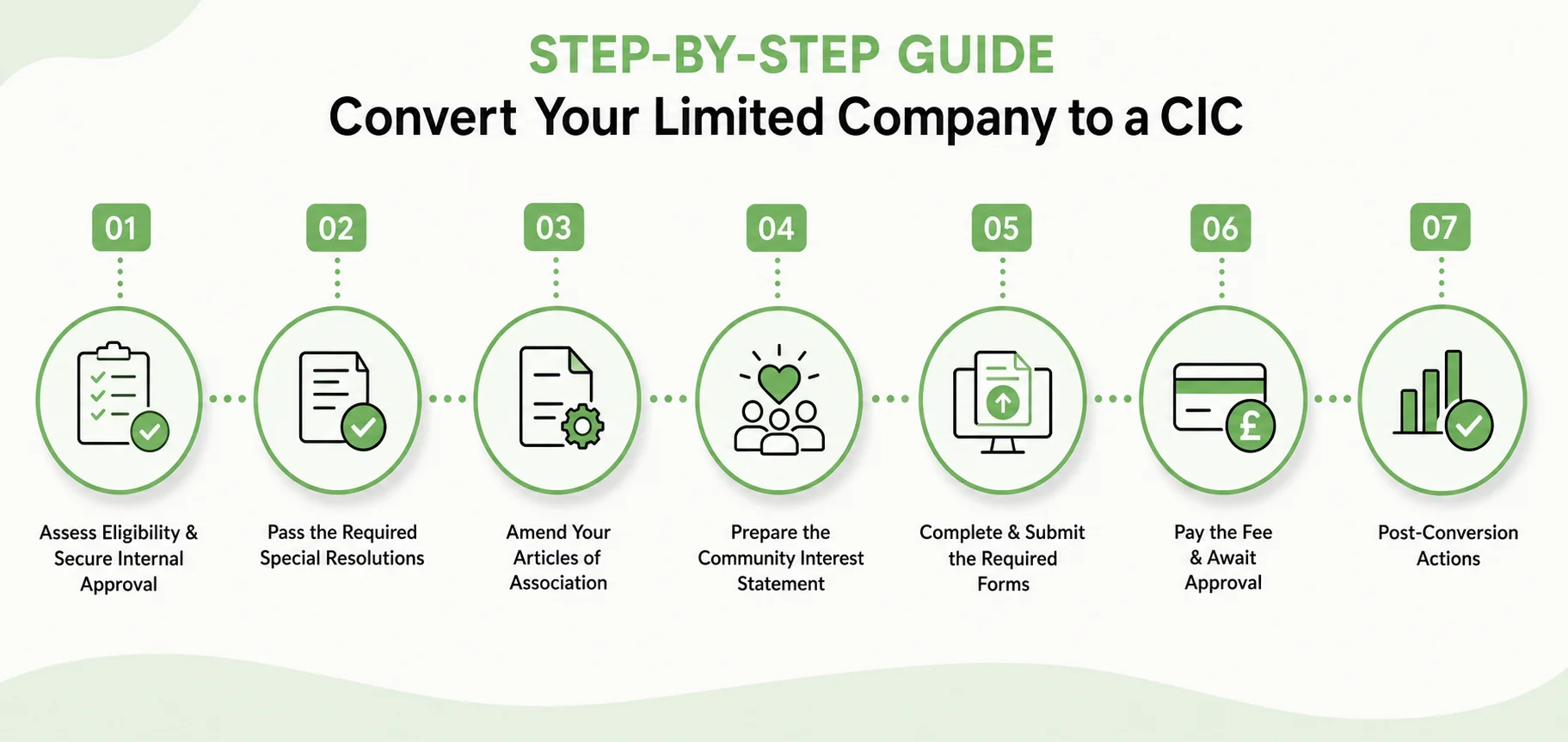
The conversion process has seven distinct steps. Complete them in order incomplete or inconsistent documents are a leading cause of delays.
Step 1 – Assess Eligibility and Secure Internal Approval
- Review your current activities against the community interest test.
- Hold a board meeting to formally resolve to pursue CIC conversion and record the minutes.
- Inform shareholders early especially about the asset lock and dividend restrictions. Conversion requires a special resolution (75% majority), so build consensus before calling the general meeting.
- Review existing contracts, funding agreements, and partnership terms that reference your Ltd status.
Step 2 – Pass the Required Special Resolutions
Hold a general meeting and pass special resolutions to
- Declare that the company will become a CIC.
- Amend the Articles of Association to comply with CIC regulations.
- Change the company name so it ends with Community Interest Company, CIC, or the Welsh equivalent.
As confirmed in the GOV.UK, step-by-step guidelines, there is no need to invent a new name a simple change from “Ltd” to “CIC” is sufficient.
Step 3 – Amend Your Articles of Association
Your Articles must include all mandatory CIC clauses. The CIC Regulator highlights these in red in its model constitutions, which cannot be removed or altered.
Mandatory clauses include
- A statement that the company is a CIC.
- Community benefit objects clause describing the community or section served.
- The statutory asset lock provision.
- Provisions on director and member rights consistent with CIC regulations.
- If limited by shares – rules on share transfers and the dividend cap.
Pro tip – Use the Regulator’s model constitutions as your starting point and layer in company-specific provisions. This consistently produces faster approvals than drafting entirely from scratch.
Step 4 – Prepare the Community Interest Statement
The Community Interest Statement (contained in Form CIC37) is the single most important document in your application. Per the GOV.UK CIC guidance, the Regulator views it as a “key feature of community interest companies” and it goes on the public register.
Your statement must clearly describe
- The community or section of the community you serve be specific, not just “the public.”
- The activities the company carries out or will carry out.
- How those activities benefit the community.
- How will any surpluses be used.
- How do your activities differ from a commercial company providing similar services for private gain.
The Regulator’s own guidance states – “The opportunity should be taken to showcase your intended activities and champion the benefits you intend to deliver to your community.” Vague or aspirational language is the top rejection reason. Describe what you actually do, not what you aspire to do.
Step 5 – Complete and Submit the Required Forms
Gather all documents before submitting. Incomplete packages are returned without processing.
As set out in the GOV.UK CIC Business Activities guidelines, you need
| Form / Document | Purpose |
| Form CIC37 | CIC conversion application + Community Interest Statement |
| Form NM01 | Notice of company name change |
| Special Resolution(s) | Shareholder approval to convert, rename, and amend articles |
| Amended Articles of Association | With all mandatory CIC clauses included |
| Charity Commission consent (if applicable) | Required if converting from a charitable company |
All documents must be posted there is no online conversion process as of 2026.
Address – Registrar of Companies, Companies House, Crown Way, Cardiff, CF14 3UZ
Step 6 – Pay the Fee and Await Approval
Per the GOV.UK CIC Regulator fee update (November 2025), the following fees apply from 1 February 2026 –
| Application type | Fee |
| Conversion of existing company to CIC (postal) | £45 (cheque payable to Companies House) |
| New CIC incorporation — online | £115 (up from £65) |
| New CIC incorporation — postal | £139 (up from £86) |
| Annual CIC34 report filing | £15 |
Processing timeline
- The CIC Regulator assesses community interest test eligibility first.
- If approved, Companies House registers the documents.
- Straightforward conversion – typically 4–8 weeks.
- Complex or charitable company conversions – 8–16 weeks or more.
Step 7 – Post-Conversion Actions
Once you receive your amended Certificate of Incorporation confirming CIC status
- Update all stakeholders — funders, banks, insurers, suppliers, and public sector partners.
- Update your branding — replace Ltd with CIC on all materials, website, and email signatures.
- Notify HMRC — update Corporation Tax, PAYE, and VAT records with the new name.
- File your first CIC34 report — due alongside your annual accounts (£15 fee).
- Maintain the community interest test — ongoing compliance is as important as the initial application. Extended dormancy (5+ years) triggers Regulator contact and eventually fails the test.
Required Documents and Forms for CIC Conversion
All of the following are confirmed in the GOV.UK CIC Business Activities guidance
- Form CIC37 — Conversion application and Community Interest Statement. Must be signed by each director. Placed on the public register.
- Form NM01 — Change of company name notice.
- Special Resolution — Must use the GOV.UK model wording as a base.
- Amended Articles of Association — Must include all mandatory CIC clauses from the Regulator’s model constitutions.
- Charity Commission letter (if applicable) — Written consent required before submission for charitable company conversions.
Costs and Timeline for Converting to a CIC
Official Government Fees (2026)
As confirmed by the GOV.UK CIC Regulator fee notice
| Item | Fee |
| Conversion application — postal (Form CIC37) | £45 |
| Annual CIC34 report | £15/year |
| New CIC incorporation — online | £115 |
| New CIC incorporation — postal | £139 |
Professional Help Costs
DIY conversion is legally possible, but professional support is strongly recommended where you have existing shareholders, retained profits, property, or charitable status.
- Solicitor to draft/review Articles and advise on the asset lock – £500–£2,000+
- Accountant to advise on tax and shareholder impact – £300–£1,500
Expected Timeline
- Straightforward Ltd conversion – 4–8 weeks
- Charitable company conversion – 8–16 weeks or more
- Each round of Regulator queries – add 2–4 weeks per round
Common Mistakes to Avoid When Converting to a CIC
A Vague Community Interest Statement
Per KG Accountants’ CIC conversion guide, poorly explained applications are one of the most common causes of delays or rejection. Statements like “we will benefit the community” are insufficient. Name the specific community, describe specific activities, and quantify impact where possible.
Missing or Incorrect Asset Lock Clauses
If any mandatory clause is absent from your Articles, the Registrar will reject the filing. The Regulator’s model constitutions highlight mandatory clauses in red. Do not remove or amend them.
Forgetting Charity Commission Consent
If your company holds charitable status, you must have written Charity Commission (or Scottish Charity Regulator) consent before filing CIC37. Submitting without it results in automatic rejection and this step alone can add 4–12 weeks.
Underestimating the Impact on Shareholders
As noted by MyLawyer’s CIC guidance, the Community Interest Statement in Form CIC37 includes an extra declaration for ordinary limited companies that the company is not a charity, or that Charity Commission consent has been obtained. Shareholders must also fully understand that the asset lock and dividend cap are permanent before voting.
Applying for the Wrong Company Type
A company limited by shares cannot simultaneously convert to limited by guarantee during CIC conversion. Seek legal advice on correct sequencing if a company type change is also needed.
Sending an Incomplete Document Package
Companies House returns incomplete submissions without processing. Cross-reference the GOV.UK conversion checklist before posting.
Ignoring Post-Conversion Compliance from Day One
Missing the first CIC34 annual report is a common error. It is a legal requirement, and failure to file triggers late-filing penalties.
After Conversion – Ongoing CIC Obligations
Annual Reporting
- CIC34 Annual Report. Filed alongside company accounts. Describes activities, stakeholder engagement, asset lock compliance, and financial performance. Fee – £15. Can be filed online.
- Company accounts. Filed as normal. Accounting requirements for CICs are identical to those for other limited companies.
Maintaining the Community Interest Test
You must continuously demonstrate that your activities pass the community interest test. Per GOV.UK, CICs unlike ordinary companies, are not expected to stay dormant for an extended period. Dormancy of 5+ years will cause them to fail the test and trigger Regulator contact.
Asset Lock Compliance
Every disposal of assets must comply with the asset lock. Transfers to non-asset-locked bodies at below market value require the Regulator’s explicit consent via Form CIC53.
Exit Options
- Convert to a charity or CIO — with Charity Commission approval.
- Dissolve the CIC — Form DS01 (fee – £44). Any remaining assets must go to an asset-locked body.
- Convert to a Registered Society — under the Co-operative and Community Benefit Societies Act 2014.
You cannot convert a CIC back to an ordinary limited company. This is prohibited under section 53 of the 2004 Act.
Conclusion
Converting your UK Limited Company into a Community Interest Company (CIC) is a powerful way to lock in your social purpose while maintaining a clear, professional corporate structure. Whether you are seeking community trust, social enterprise funding, or an asset lock to protect your mission, transitioning to a CIC sets a solid foundation for sustainable growth.
If you are ready to start the conversion process or need expert guidance with your Regulator forms and Articles of Association, contact our expert team today to get started smoothly.