
Launching a SaaS business often feels like a race. Founders want to finish the product, onboard users, sign contracts and begin generating recurring revenue before competitors capture the opportunity. A shelf company may appear to offer the perfect shortcut an already incorporated business that can be transferred to the founder and used without starting the incorporation process from zero.
But SaaS companies are not ordinary businesses. Intellectual property, customer data, equity arrangements, payment providers and future investment can all be affected by the company structure selected at the beginning. So, is a shelf company worth considering for a SaaS business? The answer depends less on the age of the company and more on its history, your funding plans and how quickly you genuinely need to begin operating.
What Is a Shelf Company?
A shelf company, also known as a ready-made company, is a company that has already been legally incorporated but is kept inactive until it is purchased. After a buyer selects the company, its ownership, directors, registered details and other relevant information can be updated. The buyer then uses the existing legal entity for their new business activity.
Through a specialist provider such as Ready-Made Companies entrepreneurs can explore previously incorporated companies in different jurisdictions rather than forming every entity from the beginning.
However, purchasing a shelf company does not remove all setup work. The new owners may still need to
- Complete identity and compliance checks
- Change the directors and shareholders
- Update the registered office and business activity
- Restructure the shares
- Open a suitable business bank account
- Register for applicable taxes
- Transfer intellectual property
- Establish contracts and data-protection procedures
For UK companies, identity verification is now a legal Companies House requirement for people setting up, running, owning or controlling a company. Buying an existing entity does not allow its new owners to avoid those obligations.
Why do SaaS businesses have different requirements?
A SaaS company provides software to customers through the internet, usually in return for a monthly or annual subscription. Unlike many traditional businesses, much of its value may exist in intangible assets rather than physical property.
These assets can include
- Source code
- Product designs
- Algorithms
- Databases
- Trademarks
- Customer information
- Subscription contracts
- Domain names
- Proprietary processes
SaaS businesses may also scale internationally, recruit employees using equity, integrate with third-party platforms and seek external investment. This makes a clean ownership and compliance structure particularly important.
A company that appears suitable for a local consulting business may not necessarily be suitable for a SaaS platform intending to raise capital, process sensitive data or sell to large corporate customers.
Potential benefits of a Shelf Company for SaaS
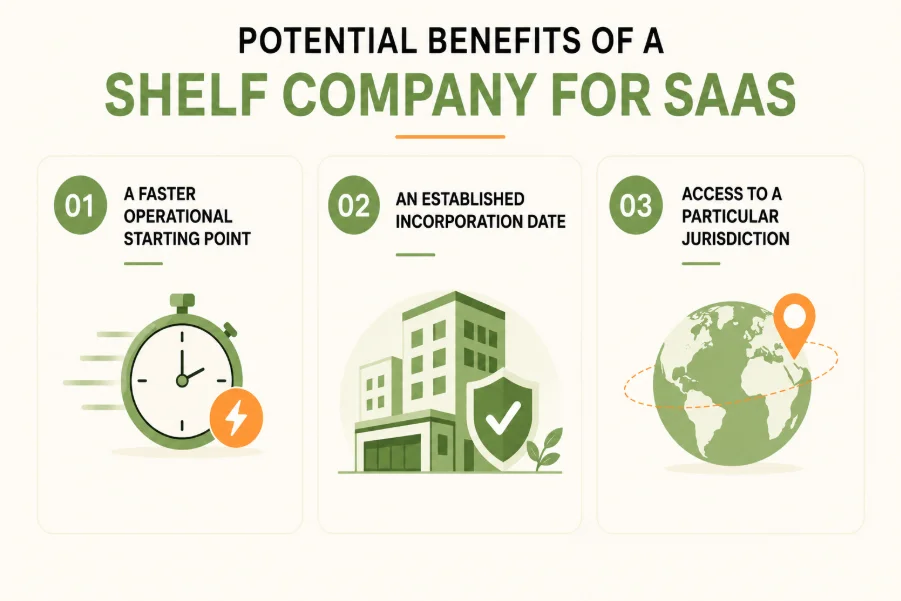
A faster operational starting point
A shelf company already exists as a legal entity. Once the transfer and required updates have been completed, it may be possible to use it for contracts, supplier arrangements and other business activities.
This can be valuable when a founder has
- A customer ready to sign a contract
- A time-sensitive commercial opportunity
- A product that is ready to launch
- An urgent requirement for a particular jurisdiction
- An upcoming partnership or tender deadline
However, founders should not assume that forming a new UK company always takes several weeks. Companies House provides an online incorporation service, and its current digital incorporation fee is £100. The practical time needed to become fully operational may still be longer because banking, tax, payment processing and compliance checks happen separately.
An established incorporation date
A shelf company has an earlier incorporation date than a newly registered company. In some commercial situations, that may support the appearance of continuity or maturity. This can sometimes help a bootstrapped B2B SaaS founder dealing with customers that prefer to contract with an established legal entity.
Nevertheless, incorporation age should never be presented as proof of trading experience, financial strength or customer success. A dormant company may be several years old while having no revenue, employees or active commercial history. Sophisticated customers, lenders and investors can review the public Companies House record, including filing history, officers, charges and company information.
Access to a particular jurisdiction
For an internationally focused SaaS company, the strongest reason for choosing a ready-made entity may be jurisdictional rather than reputational.
A SaaS founder may need a company in a specific country to
- Contract with local customers
- Enter a regional market
- Work with local suppliers
- Support an international group structure
- Meet a commercial deadline
- Establish a presence before a planned launch
RMC offers ready-made companies across multiple jurisdictions, including shelf companies in Australia. The suitability of any jurisdiction should be assessed against tax residency, local substance, reporting, employment, data transfers and the location of the company’s actual management.
The main risks for a SaaS founder
Corporate history and hidden liabilities
The greatest concern is not that the company is old. It is what happened during its previous existence. A shelf company should ideally have been incorporated and maintained without trading. If it previously conducted business, the buyer must investigate possible
- Debts
- Tax liabilities
- Legal disputes
- Charges or security interests
- Regulatory problems
- Missed filings
- Previous contracts
- Data-protection incidents
- Reputational issues
A change of ownership does not create a new legal entity. The company remains the same company, which means its existing obligations do not automatically disappear when its shares are transferred.
Before purchasing, the buyer should inspect the register, accounts, confirmation statements, officer history and any available evidence of the company’s activities. Professional legal and accounting reviews may also be necessary.
Intellectual property ownership
For a SaaS business, ownership of the software is one of the most important issues. Buying a shelf company does not automatically transfer the founder’s source code, designs, trademarks or other intellectual property into it. These assets need to be assigned properly.
The company should have written agreements confirming ownership of work created by
- Founders
- Employees
- Freelance developers
- Software agencies
- Designers
- Consultants
- Overseas development teams
Government guidance recognises that intellectual property may be owned because it was created by the owner or purchased from its creator or a previous owner. The ownership trail must therefore be documented rather than assumed.
Poor documentation can create serious problems during fundraising or acquisition. An investor may decline to proceed if a former contractor could claim ownership of part of the platform.
Cap table and future investment
SaaS companies frequently use equity to recruit key employees and attract investors. A clear capitalisation table is essential. A shelf company may begin with a share structure created for general incorporation rather than the founder’s long-term plans. It may therefore need changes involving
- Founder shareholdings
- Share classes
- Voting rights
- Option pools
- Vesting arrangements
- Investor rights
- Shareholder agreements
These changes are possible, but they can reduce the convenience that attracted the founder to the shelf company in the first place. Founders planning venture-capital funding should be especially careful. Investors generally want a transparent corporate history, clearly owned IP and an understandable cap table. A shelf company is not automatically unacceptable, but it may create additional questions and legal review.
Data protection and security
A SaaS company may collect names, contact details, payment information, usage records, employee information or highly sensitive customer data. Under UK GDPR principles, personal data must be handled lawfully, fairly and transparently, collected for defined purposes, limited to what is necessary, kept accurate and protected appropriately.
Data protection should be built into the SaaS product and its business processes from the design stage, not treated as an administrative task completed after launch. Founders should confirm that the shelf company has no previous data-processing history that could create unanswered obligations. They must then establish their own privacy notices, processing records, security controls, supplier agreements, retention policies and international transfer arrangements.
Shelf Company versus a newly Incorporated Company
A new company provides a clean corporate starting point. The founders can design its ownership, articles and governance around the SaaS business from day one.
It will normally be preferable when
- Venture funding is expected
- A complex equity structure is required
- The product handles sensitive information
- Regulatory approval may be needed
- The founders have enough time to complete formation
- A completely clean history is more important than company age
A shelf company may be more appropriate when
- The business is bootstrapped
- A legal entity is needed urgently
- A clean company is available in the required jurisdiction
- The founders understand the due-diligence requirements
- The product operates in a relatively low-risk sector
- The corporate structure can be adapted without extensive reconstruction
A shelf company should not be selected merely because it sounds faster. The founder must compare the total time and cost of purchase, due diligence, ownership changes, banking, tax registration, IP transfer and share restructuring against straightforward new incorporation.
Due diligence before buying
Before using a shelf company for a SaaS business, confirm
- The company has no debts, charges, disputes or outstanding obligations.
- Its statutory filings and accounts are complete.
- Its tax position has been reviewed.
- Its previous owners, directors and activities are understood.
- All shares can be transferred correctly.
- The intended capital structure can be implemented.
- The company has not previously owned or processed problematic data.
- The SaaS intellectual property can be assigned clearly.
- Banks and payment providers will still conduct their own checks.
- The company is appropriate for future investment and expansion.
Claims that an aged company automatically receives easier banking, stronger credit or better commercial terms should be treated carefully. Banks and payment processors normally assess the current owners, controllers, business model, source of funds and expected transactions rather than relying only on incorporation age.
Is a Shelf Company Worth It for SaaS?
A shelf company can work well for a SaaS business, but it is not a universal growth shortcut. It is most convincing for an experienced, bootstrapped founder who has an urgent commercial reason to begin operating and can obtain a genuinely clean entity. In that situation, the company can provide a useful legal starting point without waiting to build an international structure from scratch.
For a first-time founder expecting venture funding, processing sensitive data or building a complicated employee equity plan, a newly incorporated company will often be simpler. It provides a clean history, purpose-built share structure and clearer story for investors.
The correct decision is therefore not based on whether a shelf company is older. It is based on whether the company’s history, structure and jurisdiction support the SaaS business you intend to build.
Before proceeding, investigate the entity thoroughly, document the ownership of every important asset and obtain jurisdiction-specific legal and tax advice. Speed can be valuable, but for a SaaS company, a clean foundation is worth far more than an impressive incorporation date.
Conclusion
A shelf company can be a smart choice for some SaaS businesses, particularly when speed to market and an established legal entity are important. However, it also brings additional due diligence around company history, intellectual property, compliance and future fundraising.
For founders expecting venture investment or building a complex equity structure, a newly incorporated company is often the simpler and more transparent option. Ultimately, the right choice depends on your business goals, timeline and growth plans. Before making a decision, seek professional legal and tax advice, and if you’re considering a ready-made company.