

Opening a business bank account is an important step when purchasing a ready-made company, but approval is not always straightforward. Banks carefully examine company ownership, financial records, previous activities, and regulatory compliance before accepting a new business customer. This is where a clean shelf company history becomes valuable. A company with verified dormant status, transparent ownership, and properly maintained records can make the banking review more straightforward. Although purchasing an aged company does not guarantee account approval, a clean corporate background can reduce unnecessary questions, simplify due diligence, and help entrepreneurs establish their banking arrangements with fewer complications.
What Is a Clean Shelf Company History?
A clean shelf company history refers to the documented background of a legally incorporated business that has been maintained without commercial trading or unresolved financial and legal complications.
Unlike an actively trading company, a genuine shelf company is typically established in advance and kept dormant until purchased by a new owner.
A clean history generally includes
- No previous commercial trading or unexplained transactions.
- No outstanding debts or undisclosed financial liabilities.
- Up-to-date statutory filings and company records.
- Transparent shareholder and director information.
- No unresolved legal disputes or regulatory penalties.
- Verifiable dormant status and incorporation details.
For entrepreneurs purchasing through Ready Made Companies Worldwide, reviewing these factors before acquisition is an important part of preparing for future banking requirements.
Why Do Banks Check Shelf Company History?
Banks must understand the businesses they accept as customers. Their responsibilities include identifying beneficial owners, assessing financial crime risks, and understanding the purpose of the proposed banking relationship.
An older incorporation date alone does not establish that a business is financially reliable.
Ownership and Beneficial Ownership Verification
Banks need to identify the individuals who ultimately own or control the company.
They may review shareholder records, director appointments, previous ownership changes, and beneficial ownership declarations.
Previous Financial Activities
Banks may investigate whether the company previously conducted business, maintained bank accounts, or entered financial agreements.
Unexplained transactions or inconsistent financial records can result in additional questions.
Regulatory Compliance
A company’s filing history helps banks understand whether its statutory responsibilities have been maintained.
Missing documents, overdue filings, or unresolved compliance matters may require further investigation before an account can be approved.
Also read – Why Clean Company History Matters for Shelf Companies.
How Does a Clean Shelf Company History Speed Up Bank Account Approval?
A well-documented corporate background can simplify several parts of the banking review.
1. Reduces Uncertainty About Previous Activities
Banks need to understand whether a company has previously traded and whether any financial obligations remain outstanding.
When a shelf company has genuinely remained dormant, there may be fewer historical transactions or business relationships to investigate.
This allows the bank to concentrate on the company’s new ownership, proposed activities, and expected financial transactions.
2. Makes Ownership Verification Easier
Transparent ownership records help banks establish who controls the business.
A clear history of shareholders, directors, and ownership transfers can reduce confusion during customer verification.
However, banks must still complete their required identity and beneficial ownership checks.
3. Simplifies Document Reviews
Complete incorporation documents, statutory filings, and company registers allow banking teams to verify information more efficiently.
When documents are accurate and consistent, applicants may receive fewer requests for corrections or additional explanations.
4. Supports AML and KYC Compliance
Anti-money laundering (AML) and know-your-customer (KYC) procedures are essential parts of business banking.
A clean company history can make it easier to establish the company’s background, but it does not eliminate these checks.
Banks must still assess the new owners, source of funds, business activities, and other relevant risk factors.
5. Helps Prevent Avoidable Banking Delays
Banking applications can be delayed when company information is incomplete or inconsistent.
A properly maintained shelf company with organised records gives applicants a stronger starting point.
This preparation can help avoid preventable administrative delays, although the final approval timeline remains under the bank’s control.
Clean Shelf Company vs Company with a Complicated History
Not every registered company presents the same level of administrative or compliance complexity.
| Factor | Clean Shelf Company | Complicated Company History |
|---|---|---|
| Trading Activity | Verified dormant status | Previous or unclear transactions |
| Financial Records | No known outstanding liabilities | Possible debts or unresolved obligations |
| Ownership | Transparent and documented | Unclear or complex changes |
| Compliance | Required filings maintained | Missing or overdue records |
| Banking Review | Fewer historical issues to investigate | Potential additional verification |
Important: A clean history may simplify due diligence, but it does not guarantee faster approval. Banks evaluate each application independently.
What Documents Do Banks Require for a Shelf Company?
Banks generally request documents that establish the company’s legal identity, ownership, and intended business activities.
Requirements vary by jurisdiction and financial institution.
Company Registration Documents
These may include:
- Certificate of incorporation.
- Articles of association or equivalent constitutional documents.
- Company registration number.
- Registered office information.
Ownership and Identity Documents
Banks may request identification for directors, shareholders, and beneficial owners.
They may also require updated company registers and documents confirming the ownership transfer.
Business and Financial Information
Applicants should be prepared to explain their intended commercial activities.
Depending on the bank, supporting information may include
- Business plan or activity description.
- Expected transaction volumes.
- Source of funds and initial capital.
- Customer and supplier information.
- Relevant licences or tax registrations.
Providing accurate information from the beginning can make the application easier to assess.
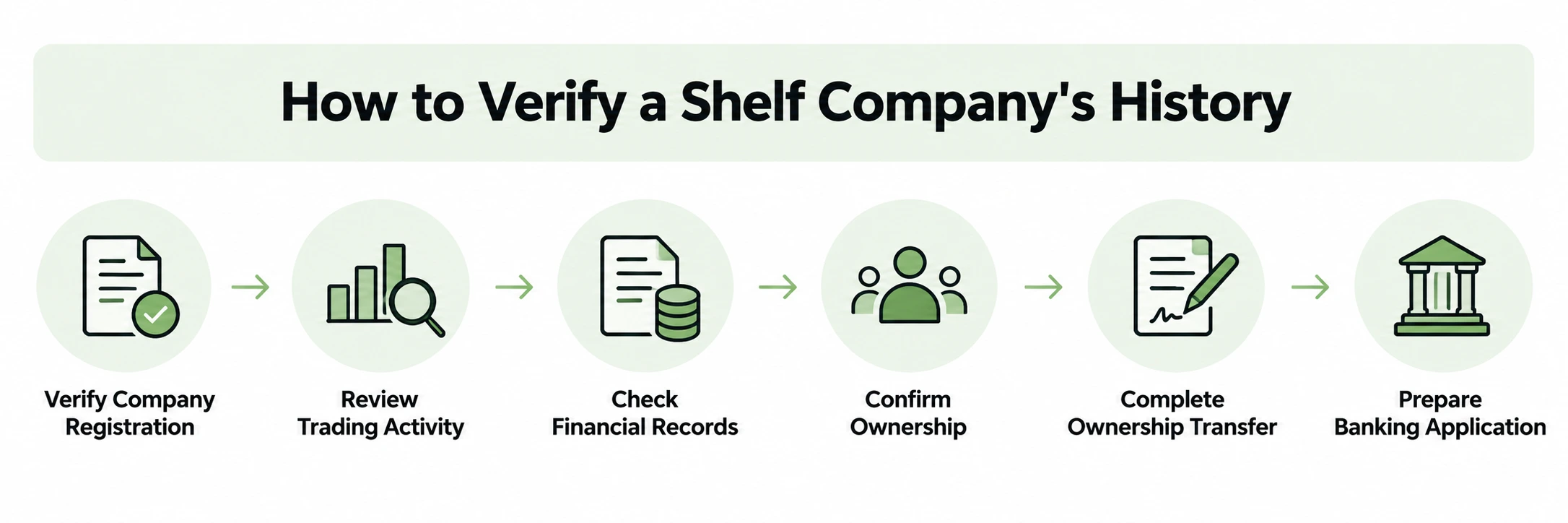
How to Verify a Shelf Company’s History Before Applying for a Bank Account
Before purchasing a shelf company, buyers should examine its corporate background and confirm that the available records support the seller’s representations.
Step 1 – Verify Company Registration
Check the company registration number, incorporation date, legal status, and registered address through the relevant corporate registry.
Step 2 – Review Previous Trading Activity
Request evidence of dormant status and confirm whether the company has previously conducted commercial transactions.
Step 3 – Examine Financial and Compliance Records
Review available financial statements, statutory filings, tax information, and any outstanding liabilities.
Step 4 – Confirm Ownership History
Check previous and current directors, shareholders, and beneficial ownership information.
Ensure all changes can be explained and supported by appropriate documents.
Step 5 – Complete the Ownership Transfer
Prepare the required share transfer, director appointment, and corporate update documents.
Make sure the relevant company records reflect the new ownership.
Step 6 – Prepare the Banking Application
Organise the incorporation documents, identification records, business information, and source-of-funds evidence before approaching a bank.
The more complete the application, the easier it may be for the bank to conduct its review.
Does an Aged Shelf Company Automatically Receive Faster Bank Approval?
No. A company’s incorporation date does not automatically improve its banking eligibility.
For example, a shelf company incorporated several years ago may have a longer legal existence than a newly registered business. However, if it has never traded, it does not have an established operating history.
Banks distinguish between:
- Company age: How long the legal entity has existed.
- Trading history: The company’s actual commercial activities.
- Financial history: Its financial performance, transactions, and obligations.
- Compliance history: Its record of meeting applicable legal requirements.
A clean shelf company can provide a transparent corporate starting point, but banking approval still depends on the applicant’s circumstances.
What Else Can Affect Shelf Company Bank Account Approval?
Even with a clean corporate history, banks consider additional factors.
Business Activities
Companies operating in regulated or higher-risk industries may face more extensive reviews.
Country of Incorporation
Banking requirements differ across jurisdictions, and some institutions impose additional conditions on foreign-owned companies.
Source of Funds
Banks may request evidence showing where the company’s initial capital and expected transaction funds originate.
Business Substance
Some banks require evidence of genuine commercial operations, such as contracts, business premises, local management, or other supporting information.
Understanding these requirements before purchasing a shelf company can help buyers select an appropriate jurisdiction and business structure.
Conclusion
A clean shelf company history can make business bank account applications more manageable by providing transparent ownership information, verifiable corporate records, and a clear picture of previous activities.
However, a company’s age or dormant status should never be mistaken for guaranteed banking approval. Financial institutions must independently assess ownership, business activities, source of funds, and regulatory risks.
Choosing a properly maintained shelf company and preparing complete documentation can help reduce avoidable delays. If you are considering purchasing a ready-made company, contact Ready Made Companies Worldwide to discuss available options and your business requirements.