

Buying a shelf company, also called a ready-made company or aged company, is one of the fastest ways for entrepreneurs to launch a credible business. Instead of starting from scratch, you acquire a pre-registered entity with an established incorporation date, giving you instant business history and a head start on credibility. In 2026, this route is more popular than ever. Rising compliance demands, tighter banking requirements, and increased scrutiny from investors mean that a company with a record of accomplishment is worth more than one registered yesterday. According to Companies House data, tens of thousands of readymade companies change ownership every year in the UK alone. But here is the critical truth most buyers overlook – A shelf company is only as good as its documentation. Without the right paperwork, you do not truly own the business, and you could be walking into someone else’s debt, legal dispute, or compliance failure.
The Risk – Buying a Shelf Company Without Proper Documents
Many buyers focus on the company name, its incorporation date, and the price. A few stops ask – ‘What documents will I receive?’ That gap is where problems begin. Here are the most common risks you face when documentation is incomplete or misleading
Hidden Liabilities
A company may have unpaid taxes, outstanding loans, or overdue supplier invoices that do not appear in a simple online search. Without reviewing the full company’s register, statutory books, and a Certificate of Good Standing, you could inherit those debts the moment the transfer is complete.
Legal Ownership Disputes
If a Stock Transfer Form is missing, unsigned, or incorrectly completed, the transfer of ownership is legally questionable. Previous directors or shareholders could challenge your right to the company, leaving you in costly litigation.
Non-Compliance with Local Regulations
Shelf companies must have up to date filings with regulatory bodies like Companies House (UK) or ASIC (Australia). Outdated confirmation statements, missing annual returns, or lapsed licenses mean you inherit a company that is already non-compliant, attracting fines from day one.
Difficulty Opening Bank Accounts
Banks perform rigorous Know Your Customer (KYC) and Anti Money Laundering (AML) checks before opening business accounts. Without proper shelf company documents, especially a Certificate of Incorporation, share certificates, and proof of ownership, most banks will decline your application outright. A 2024 survey noted that documentation gaps are among the top reasons professional service applications are rejected.
Potential Fraud or Incomplete Transfers
Fraudulent sellers do exist. They may use forged documents, sell the same company to multiple buyers, or provide documentation that refers to a different entity entirely. Proper verification before payment is your only protection.
Key Stat – According to UK government records, over 600,000 companies are dissolved each year due to compliance failures that could have been identified with proper due diligence.
Summary – Shelf Company Documentation Risks at a Glance
The table below maps each common risk to its root cause, severity, and the document level of action that prevents it.
| Risk | Cause | Severity | How to Avoid |
| Hidden Liabilities | Missing register of charges / statutory books | High | Review statutory books & run a charges search |
| Ownership Dispute | Unsigned or missing Stock Transfer Form | High | Demand a signed STF before any payment |
| Regulatory non-compliance | Outdated confirmation statements or returns | Medium | Check Companies House / ASIC filing history |
| Bank Account Rejection | Incomplete KYC/AML documentation | Medium | Provide full doc pack, including M&A and share certs |
| Fraud / False Transfer | Forged documents or duplicate sale | High | Cross check with the official registry before paying |
| License Lapse | Unverified or expired business licenses | Medium | Confirm license validity and transferability |
The Solution – Why Documentation Is Critical in Every Shelf Company Purchase
Proper shelf company documents serve four core functions
- They confirm that legal ownership has genuinely transferred to you.
- They prove the company is debt-free, compliant, and in good standing.
- They satisfy the requirements of banks, tax authorities, and business partners.
- They protect you from future legal challenges to your ownership.
Think of the document package as the title deed to a property. You would never complete a house purchase without seeing the deeds, searches, and land registry records. A shelf company purchase deserves the same rigour.
Core Documents You Must Receive When Buying a Shelf Company
Below is a full breakdown of each document, what it contains, and why it is essential for your purchase.
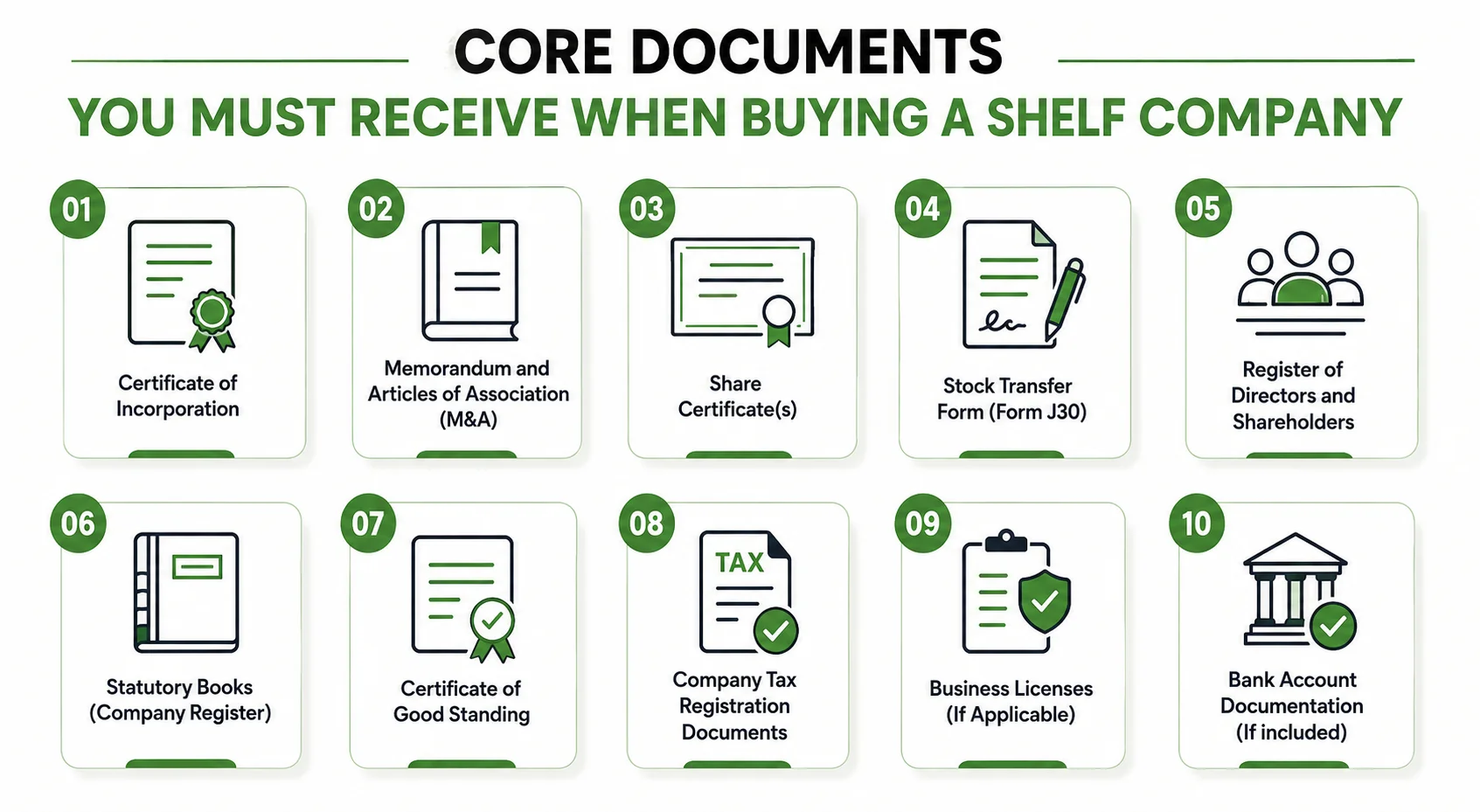
1. Certificate of Incorporation
This is the birth certificate of the company. Issued by the relevant authority (Companies House in the UK, ASIC in Australia, the Secretary of State in the USA), it confirms
- The company’s full registered name.
- It is a unique company registration number.
- The date it was incorporated.
- The jurisdiction in which it was registered.
This document is required for virtually every official interaction opening bank accounts, applying for licenses, and signing contracts. Without it, no authority or financial institution will take your company seriously.
2. Memorandum and Articles of Association (M&A)
This is the constitutional document of the company. It defines
- The company’s objectives and permitted activities.
- How the business is governed, and how decisions are made.
- The rights and responsibilities of directors and shareholders are important.
- Rules for issuing and transferring shares.
The M&A is essential for internal management, compliance checks, and demonstrating to banks or investors that the company is properly structured. Outdated or non-standard articles can restrict what you can do with the business after purchasing.
3. Share Certificate(s)
Share certificates are your proof of ownership. Each certificate states
- The name of the shareholder (should be updated to your name post-purchase).
- The class and number of shares were held.
- The date of the issue.
Without a valid share certificate in your name, you cannot prove that you are the legal owner of the company. This document is required by banks and government authorities, and it protects you in any future ownership dispute.
4. Stock Transfer Form (Form J30)
This is the official document that records the transfer of shares from the previous owner to you. It must be
- Fully completed with the correct details of the seller and buyer.
- Signed by the transferor (the person selling the shares).
- Matched to the corresponding share certificate.
A missing or incorrectly completed Stock Transfer Form can invalidate the entire purchase. Always verify the signature and ensure the details match the company’s register.
5. Register of Directors and Shareholders
This is a legal record showing who controls and owns the company. After your purchase, it must reflect
- Your name as the new director (if applicable).
- Your name is the new shareholder.
- Removal of previous directors and shareholders.
This register is cross-referenced by Companies House and ASIC during compliance checks. An outdated register can create legal ambiguity about who actually controls the business.
6. Statutory Books (Company Register)
The statutory books are the comprehensive legal history of the company. They include
- Register of members (all shareholders, past and present).
- Register of directors (all appointments and resignations).
- Register of charges (any secured debts or mortgages against the company).
- Minutes of shareholder and director meetings.
Reviewing these books is essential for due diligence. The register of charges in particular reveals whether any assets of the company are secured against outstanding debt a critical check before you proceed.
7. Certificate of Good Standing
It is not always available, but it is highly valuable. This certificate, issued by the registrar, confirms that
- The company has filed all required returns on time.
- There are no outstanding penalties or compliance failures.
- The company is legally permitted to operate.
Banks, international partners, and investors often request this document as part of their due diligence process. Its absence is not always a red flag, but its presence adds significant credibility.
8. Company Tax Registration Documents
To operate financially, your company needs
- A Unique Taxpayer Reference (UTR) or equivalent tax ID number.
- VAT registration certificate (if the company is VAT registered).
- Employer PAYE reference (if the company has been registered as an employer).
These documents are required for filing tax returns, reclaiming VAT, and working with HMRC (UK) or the ATO (Australia). Ensure all registrations are still active and correctly attributed.
9. Business Licenses (If Applicable)
If the shelf company operates in a regulated industry, such as financial services, healthcare, property, food, or security, it may hold licenses that are critical to its operation. You must confirm
- The license is still valid and has not been launched.
- It is transferable to a new owner.
- There are no conditions or restrictions attached.
Never assume a license transfers automatically. In many jurisdictions, a change of ownership triggers a review or re-application process.
10. Bank Account Documentation (If included)
Some shelf companies sell active bank accounts. If this is part of the transaction, you should receive
- Full account details (sort code, account number, IBAN where applicable).
- Online banking credentials and security tokens.
- Compliance documentation confirming the account passed KYC/AML checks.
- A transaction history showing the account is clean and free from suspicious activity.
Banks have the right to close accounts or freeze funds if they identify compliance concerns. Always review the account history and seek written confirmation from the bank where possible.
Quick Reference – Shelf Company Document Checklist
Use this table as your due diligence checklist before finalizing any shelf company purchase
| # | Document | Why It Matters |
| 1 | Certificate of Incorporation | Confirms legal registration and company number |
| 2 | Memorandum & Articles of Association | Defines governance and permitted activities |
| 3 | Share Certificate(s) | Proves your ownership of the company |
| 4 | Stock Transfer Form | Official record of the share transfer to you |
| 5 | Register of Directors & Shareholders | Must reflect your name post-purchase |
| 6 | Statutory Books (Company Register) | Full legal history, including charges |
| 7 | Certificate of Good Standing | Confirms compliance with all filings |
| 8 | Tax Registration Documents | UTR, VAT number, PAYE reference |
| 9 | Business Licenses (if applicable) | Must be valid, current, and transferable |
| 10 | Bank Account Documentation (if included) | Clean history, KYC/AML compliant |
The Problem – Buyers Often Receive Incomplete or Misleading Documentation
Even with the best intentions, some providers deliver shelf company documents that are
- Missing key certificates (often the Stock Transfer Form or Statutory Books).
- Outdated reflecting directors or shareholders from years ago.
- Incomplete with gaps in the register of charges or missing meeting minutes.
- Misleading documents that appear complete but relate to a different entity.
This is not always deliberate fraud. Poor record keeping, rushed sales, and lack of expertise mean some providers simply do not know what a complete package looks like.
Buyer Tip – Always request the full document pack before making any payment. A reputable provider will have no hesitation in sharing these. If they stall or claim documents are unavailable until after purchase, walk away.
How to Verify Shelf Company Documents Before Purchase
Verification is straightforward if you know where to look. Follow these steps
- Check out the official registry – In the UK, every company registered at Companies House can be searched for free at beta.companieshouse.gov.uk. Confirm that the company number, incorporation date, and filing history match the documents you have been provided.
- Confirm that filings are current – Check that the Confirmation Statement (UK) or ASIC annual review (Australia) has been filed within the required timeframe. Overdue filings can result in the company being struck off.
- Verify the ownership chain – Ensure the Stock Transfer Form reflects the full history of ownership, not just the most recent transfer. Multiple undisclosed transfers can complicate legal ownership.
- Search for charges and debts – Run a search on the register of charges at Companies House. Any registered charge against the company is publicly visible.
- Request a full document pack before payment – Never pay first and collect documents later. The documents are your assurance; secure them first.
Country Specific Documentation Requirements
Shelf company documentation requirements vary significantly by jurisdiction. Below is a guide for the two most common markets.
United Kingdom
The UK has one of the most transparent company registration systems in the world, managed by Companies House. Buyers considering a UK entity can explore our UK shelf companies and review available ready-made companies with established incorporation histories.
- Confirmation Statement filed annually (replaces the old Annual Return).
- Filing of director and shareholder changes within 14 days (about 2 weeks). TheThe
- Persons with Significant Control (PSC) register is mandatory for all UK companies.
- Mortgage and charge registers must be updated within 21 days (about 3 weeks) of creation.
Also Read – UK shelf companies
Australia
In Australia, companies are regulated by ASIC (Australian Securities and Investments Commission). Key requirements include
- Annual company review and payment of the ASIC annual review fee.
- Officeholder details are updated within 28 days (about 4 weeks) of any change.
- Financial reports (for larger companies) are filed annually.
- Business Activity Statement (BAS) filed with the ATO.
Check any Australian shelf company.
UK vs Australia – Side-by-Side Compliance Comparison
Use this table when deciding which jurisdiction to purchase in, or when verifying a company’s compliance status.
| Requirement | United Kingdom (Companies House) | Australia (ASIC) |
| Governing Body | Companies House | ASIC (Australian Securities & Investments Commission) |
| Annual Compliance Filing | Confirmation Statement (yearly) | ASIC Annual Review (yearly) |
| Director Change Deadline | Within 14 days (about 2 weeks) | Within 28 days (about 4 weeks) |
| PSC / Beneficial Owner Reg. | Persons with Significant Control (PSC) | Beneficial Owner Register (from 2024) |
| Charge Registration | Within 21 days (about 3 weeks) of creation | Within 20 business days |
| Registry Search Tool | beta.companieshouse.gov.uk (free) | connectonline.asic.gov.au |
| Good Standing Certificate | Available on request | Available via ASIC Connect |
| Tax Authority | HMRC UTR & VAT number | ATO ABN, ACN & GST registration |
The Problem – Choosing the Wrong Provider
Not all shelf company providers operate with the same standards. Some common warning signs include
- No documentation is provided until after payment.
- Inability to confirm the company’s filing history.
- No dedicated support to assist with post-transfer compliance.
- Prices that seem too good to be true often are because the company has hidden problems.
As noted in the context of digital trust, credibility is built on transparency, not promises. The same applies when choosing a shelf company provider.
Why Working with a Trusted Provider Matters
When you purchase a shelf company from a reputable provider, the entire process is structured to protect you. Here is what to expect from a best in class provider
- All companies are pre-vetted for compliance, debts, and filing history before being listed for sale.
- Complete documentation packages are prepared and reviewed before any transaction.
- The ownership transfer process is managed end to end, with Companies House or ASIC updates handled on your behalf.
- We provide support after purchase to help with bank account setup, additional compliance, and operational questions.
According to research, highlighted by authority in any field is built on delivering genuinely useful, accurate content. The same principle applies to shelf company providers the best ones to educate their buyers, not just sell to them.
Reputable vs Unverified Provider – What to Expect
Before choosing who to buy from, use this comparison to evaluate any provider you are considering.
| Feature | Reputable Provider (e.g., RMC) | Unverified / Unknown Provider |
| Document Pack | Complete all 10 core documents | Often incomplete or missing key docs |
| Pre-Sale Vetting | Full compliance & charges check | Minimal or no verification |
| Ownership Transfer | Professionally managed, legally sound | May lack signed STF or proper records |
| Registry Updates | Handled on your behalf | Left to the buyer |
| Bank Account Support | Guidance and KYC ready documentation | No support provided |
| Post Purchase Support | Ongoing compliance guidance included | None after the sale completes |
| Transparency | Full history shared before payment | Documents released after payment only |
| Price vs Value | Higher confidence, lower long-term risk | Lower price, hidden risks |
How RMC Ensures You Receive All Essential Documents
At RMC, every shelf company we sell goes through a rigorous pre-sale verification process. Here is exactly what we do
Pre-Vetting Every Company
- We confirm that the company is fully compliant with all filing obligations.
- We check the register of charges for any outstanding debts or secured assets.
- We verify the complete ownership history and ensure a clean title.
Complete Documentation from Day One
- Every buyer receives all ten core documents listed in this guide.
- Documents are reviewed by our compliance team before handover.
- Share certificates are updated and signed before the transaction is complete.
Fast, Secure Ownership Transfer
- We handle Companies House or ASIC updates on your behalf.
- Stock Transfer Forms are professionally prepared and witnessed.
- Transfers are typically completed within 24 to 48 hours (about 4 days).
Ongoing Support After Purchase
- Our team is available to assist with bank account applications.
- We provide guidance on post-transfer compliance obligations.
- We remain a resource for any documentation queries after the sale.
Conclusion
Buying a shelf company is a smart strategy, but only when it is done correctly. The company name, its age, and its incorporation date are all meaningless if the documentation is missing, outdated, or incorrect. Proper shelf company documents are not formal. They are your legal proof of ownership, your protection from hidden liabilities, and your gateway to business banking, compliance, and credibility. Every document in this guide serves a specific, critical purpose. If you are considering purchasing a shelf company and want help reviewing available options, documentation, or the ownership transfer process, contact us to discuss your requirements with our team.