

Starting a business in the United Kingdom does not always mean incorporating a company from scratch. Entrepreneurs, overseas investors and established businesses can also acquire a UK shelf company – a company that has already been incorporated and maintained until a buyer is ready to take ownership. This route can provide an existing incorporation date and a ready-made corporate structure, but it does not remove the need for due diligence, ownership updates, tax registration, banking checks or ongoing compliance. Understanding both the advantages and potential risks is therefore essential before purchasing a shelf company in the UK.
What Is a UK Shelf Company?
A UK shelf company is a business entity that has already been incorporated and registered but has generally not conducted commercial activity. The company is established in advance and kept available until an entrepreneur or investor purchases it.
Instead of establishing a completely new entity, the buyer takes control of an existing corporate structure. Depending on the individual company and transaction, changes may then be required to its directors, shareholders, people with significant control, registered office, business activities and other corporate records.
At Ready Made Companies Worldwide, businesses can explore ready-made corporate options across the UK and numerous international jurisdictions.
It is important to distinguish company age from company trading history. A shelf company may have been incorporated several years ago without ever operating. Its incorporation date is genuine, but buyers should not represent a dormant company as having years of commercial activity when no such activity exists.
Why Do Entrepreneurs Buy UK Shelf Companies?
The reasons for acquiring a shelf company vary according to the buyer’s commercial objectives.
For some entrepreneurs, the main consideration is speed. For others, having an earlier incorporation date is useful when dealing with suppliers, potential partners or commercial opportunities where the age of the legal entity is relevant.
International businesses may also use a ready-made company as part of their UK market-entry strategy. Instead of beginning with incorporation, they can acquire an existing entity and move directly to the necessary ownership, compliance, tax and operational arrangements.
Businesses specifically considering the UK can review available UK shelf companies and assess whether an existing entity fits their intended activities.
Benefits of Buying a UK Shelf Company
1. Existing Legal Entity
The company has already been incorporated, so the buyer is acquiring an existing legal entity rather than applying to create one from the beginning.
This can be useful where a transaction, contract or expansion project requires a company to already exist before other administrative processes can begin.
2. Earlier Incorporation Date
One of the main distinctions between a shelf company and a newly incorporated business is the incorporation date.
A company formed several years ago retains that original incorporation date after ownership changes. This may be relevant where counterparties or commercial opportunities consider company age.
However, buyers should avoid confusing an older incorporation date with operational experience. Company age alone does not prove revenue, successful trading, credit history or financial strength.
3. Faster Market Entry
For international entrepreneurs entering the UK, acquiring an already incorporated entity can remove one step from the market-entry process.
After the acquisition, attention can shift towards preparing the company for actual operations – including banking, tax registration, contracts, licences and sector-specific requirements.
4. Existing Corporate Documentation
A properly maintained shelf company should have documentation supporting its legal existence and corporate history.
Depending on the company, this can include its certificate of incorporation, memorandum and articles of association, statutory records and previous filings.
Buyers should verify these documents rather than simply assuming that every ready-made company has been properly maintained.
5. Useful for Certain Commercial Requirements
Some commercial arrangements, supplier onboarding processes or procurement opportunities may include requirements relating to company age.
An older shelf company can satisfy an incorporation-age condition where the requirement genuinely concerns the date of incorporation. It cannot legitimately satisfy requirements for trading experience, turnover, completed contracts or audited operational history if those things do not exist.
UK Shelf Company vs New Company Formation
| Factor | UK Shelf Company | Newly Formed UK Company |
|---|---|---|
| Legal entity | Already incorporated | Created when application is approved |
| Incorporation date | Pre-existing | Current |
| Previous trading | Normally none if genuinely dormant | None |
| Ownership changes | Required during acquisition | Established during formation |
| Due diligence | Particularly important | Generally simpler historical review |
| Purchase cost | Usually higher | Usually lower |
| Banking | Separate approval still required | Separate approval still required |
Neither structure is automatically suitable for every business. The decision should depend on the commercial reason for acquiring an existing company and whether that advantage justifies the additional purchase price and due-diligence requirements.
Risks of Buying a UK Shelf Company
Hidden Liabilities
One of the most important risks is discovering that a company described as dormant has previously incurred obligations.
Potential problems can include unpaid filing penalties, undisclosed agreements, outstanding debts, tax issues or incomplete statutory records.
This is why the company’s history should be reviewed before ownership is transferred.
Incomplete Filing History
An incorporated company continues to have statutory responsibilities even while dormant. Buyers should therefore examine Companies House records and confirm that required filings have been completed.
Missing accounts, overdue confirmation statements or inconsistencies in the register should be investigated before the purchase proceeds.
Misrepresentation of Company Age
An established incorporation date does not create an established trading record.
Buyers should never present a shelf company’s age as evidence that the business has been trading for the same period. Banks, investors, suppliers and procurement teams can examine public filings and request supporting financial information.
Banking Expectations
Purchasing an older company does not guarantee a UK business bank account.
Banks and other financial institutions conduct their own onboarding assessments, which may include checks on directors, beneficial owners, source of funds, expected transactions, business activities and geographic exposure.
A shelf company should therefore not be purchased solely on the assumption that its age will secure banking or finance.
Higher Acquisition Cost
A shelf company generally costs more than incorporating a new UK company. Older entities may carry a higher purchase price because of their incorporation date.
The buyer should therefore identify a genuine commercial reason for choosing a ready-made company rather than paying a premium simply for company age.
Thorough due diligence is one of the most effective ways to reduce these risks before committing to an acquisition.
Also read – Important Questions to Ask Before Buying a Shelf Company.
Legal Considerations for UK Shelf Companies in 2026
UK corporate compliance has continued to evolve under reforms introduced through the Economic Crime and Corporate Transparency Act.
Companies House Identity Verification
Identity verification is now an important consideration when acquiring and operating UK companies.
Mandatory identity verification began rolling out from 18 November 2025. New directors must verify their identity when being appointed, while existing directors are being brought into the system through the applicable transition arrangements. People with significant control are also subject to identity-verification requirements.
Verification can be completed directly through the official process or through an Authorised Corporate Service Provider where appropriate.
Shelf-company buyers should therefore consider identity verification as part of the ownership-transfer and post-acquisition compliance process.
Directors and PSC Information
After acquisition, the company’s official records must correctly reflect its current management and ownership.
Relevant changes may include
- Appointment or resignation of directors
- Changes to shareholder records
- People with significant control information
- Registered office details
- Registered email address
- Business activity or SIC codes where appropriate
The precise filings required depend on the structure of the transaction and the existing company information.
Confirmation Statement
UK companies must submit confirmation statements to Companies House to confirm that the information held on the register remains accurate.
Current Companies House procedures also incorporate identity-verification requirements for directors. Consequently, buyers should review the company’s confirmation-statement position and upcoming filing deadlines during due diligence.
Tax Responsibilities
Purchasing a shelf company does not remove tax responsibilities.
When the company begins conducting business, its tax position should be reviewed and the appropriate HMRC requirements completed. Depending on its activities, these can involve Corporation Tax, VAT and PAYE obligations.
Professional tax advice can be particularly useful where the buyer is a non-UK resident or the company will form part of an international group.
Due Diligence Before Buying a UK Shelf Company
Due diligence should be completed before the buyer assumes control.
Important checks include
- Confirm the company’s exact incorporation date.
- Review its Companies House filing history.
- Verify whether it has genuinely remained dormant.
- Check annual accounts and confirmation statements.
- Confirm existing and previous directors and shareholders.
- Review PSC information.
- Check for outstanding charges or other relevant registry entries.
- Verify whether any liabilities or agreements exist.
- Review the company’s statutory records and incorporation documents.
- Confirm what services and documents are included in the purchase.
Where necessary, professional legal and accounting advice should be obtained before completing the transaction.
Step-by-Step Process for Buying a UK Shelf Company
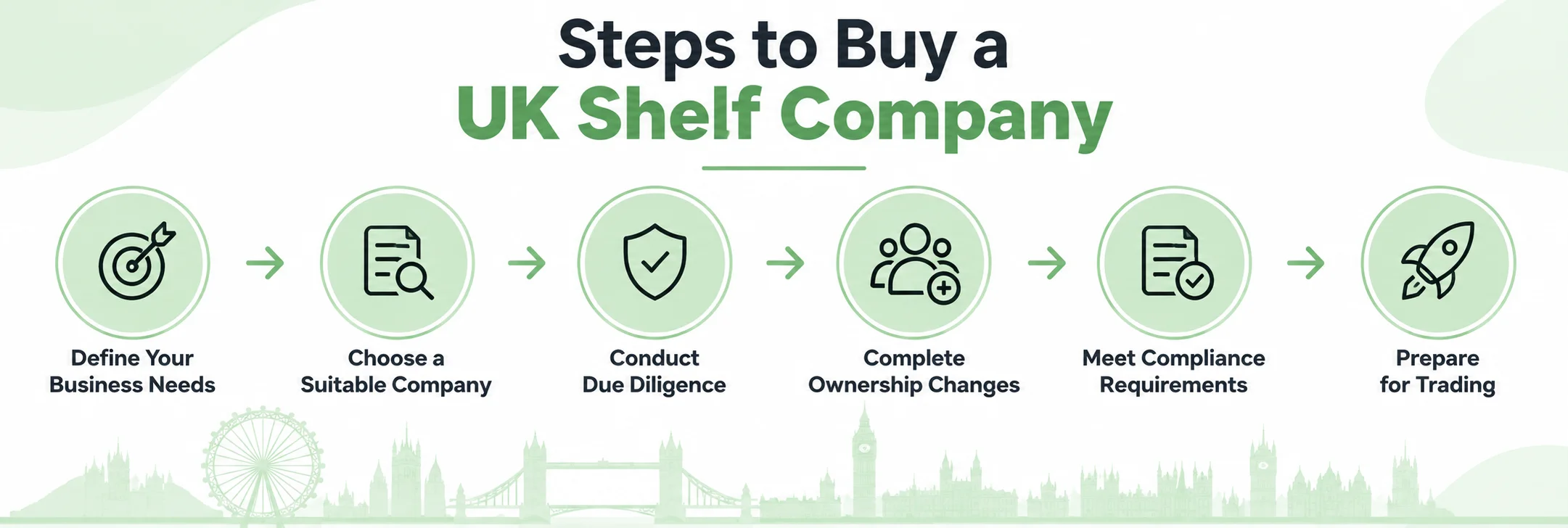
Step 1 – Define Why You Need the Company
Determine whether the key requirement is an earlier incorporation date, urgent market entry, international expansion or another genuine commercial objective.
Step 2 – Select a Suitable Shelf Company
Compare available companies based on age, status, structure, documentation and purchase cost.
Step 3 – Conduct Due Diligence
Review the company’s Companies House history and supporting records. Confirm that the entity meets the characteristics represented by the provider.
Step 4 – Complete Ownership and Management Changes
Complete the necessary documentation to transfer shares and appoint the appropriate directors. Update PSC information and other statutory records where required.
Step 5 – Complete Compliance Requirements
Address identity verification, Companies House filings, registered office arrangements and any outstanding statutory requirements.
Step 6 – Prepare the Company for Trading
Once the transfer is complete, arrange banking, accounting, tax registration, contracts, insurance and any licences or regulatory approvals required for the intended activities.
Who Should Consider a UK Shelf Company?
A shelf company may be worth considering for
- Overseas businesses establishing a UK entity
- Entrepreneurs facing time-sensitive commercial opportunities
- Businesses requiring a company incorporated before a particular date
- Corporate groups establishing an additional UK entity
- Investors with a legitimate commercial reason for acquiring an existing company
A newly incorporated company may be more practical when company age provides no meaningful benefit.
Conclusion
UK shelf companies can provide a practical route to acquiring an already incorporated business entity, particularly where an earlier incorporation date or immediate ownership supports a genuine commercial objective. However, company age should never be mistaken for trading history, financial strength or guaranteed access to banking and contracts.
The safest approach is to combine careful due diligence with accurate ownership transfers and ongoing Companies House and HMRC compliance. If you are considering purchasing a UK ready-made company, Contact Us to discuss available options and the requirements for transferring a suitable company into your ownership.