
Transferring ownership of a US shelf corporation allows entrepreneurs and investors to acquire an already incorporated business without establishing a new legal entity. However, the process involves more than purchasing an existing company. Buyers must verify corporate records, complete share transfers, update management information, and meet applicable state and federal requirements. Understanding these procedures is essential for ensuring a legally valid transfer, avoiding unexpected liabilities, and preparing the corporation for future business activities.
What Is a US Shelf Corporation?
A US shelf corporation is a company that has already been legally incorporated but is generally maintained without active trading until a purchaser acquires it. These entities are often established in advance and offered for sale to entrepreneurs seeking an existing corporate structure.
Unlike a newly incorporated business, a shelf corporation already has a registration date, corporate documents, and an established legal identity. However, it does not automatically possess business revenue, credit history, contracts, or banking relationships.
Entrepreneurs interested in acquiring an existing business entity can explore available options through Ready Made Companies Worldwide.
Why Transfer Ownership of a US Shelf Corporation?
Acquiring a shelf corporation can provide certain advantages when the buyer has a genuine commercial reason for purchasing an existing entity.
Faster Corporate Acquisition
Since the corporation has already been incorporated, the buyer does not need to complete the original company formation process.
However, the acquisition still requires legal documentation, ownership verification, and relevant corporate updates.
Existing Incorporation Date
A shelf corporation retains its original incorporation date after an ownership transfer. This may be relevant when evaluating corporate structures for specific commercial purposes.
Nevertheless, an older incorporation date should not be confused with genuine business experience or financial performance.
Flexible Business Planning
New shareholders can establish an appropriate management structure, appoint directors, and adapt the corporation’s operations to their intended business activities.
Also read – How to Buy a Shelf Company
Step-by-Step Process to Transfer Ownership of a US Shelf Corporation
The transfer process depends on the corporation’s state of incorporation, governing documents, ownership structure, and purchase agreement.
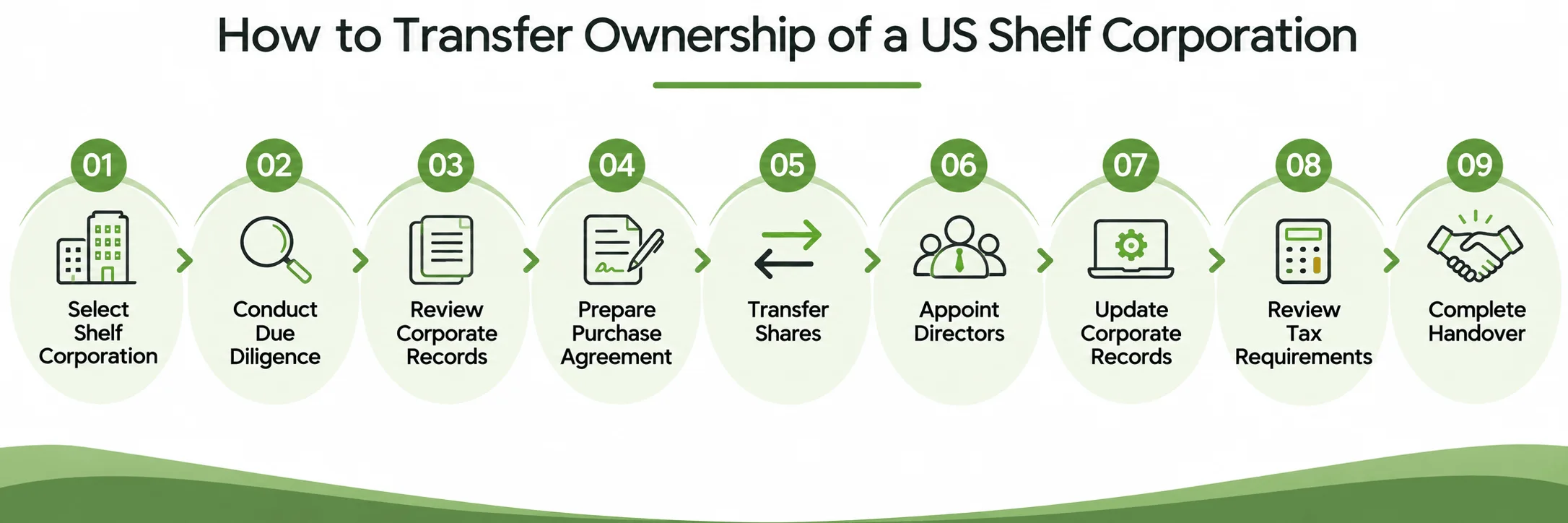
Step 1 – Select a Suitable US Shelf Corporation
Start by identifying a corporation that meets your business requirements.
Consider its state of incorporation, registration date, corporate status, and available documentation.
Entrepreneurs can review US shelf companies to compare existing corporate entities before proceeding with an acquisition.
Step 2 – Conduct Corporate Due Diligence
Before purchasing, investigate the corporation’s legal and financial background.
Review its incorporation records, annual reports, tax filings, shareholder information, and any outstanding liabilities.
Where appropriate, check for liens, litigation, unpaid state fees, and previous business activities.
A corporation described as dormant should have supporting documentation confirming its history and current status.
Step 3 – Review the Corporate Documents
Examine the corporation’s certificate or articles of incorporation, bylaws, stock ledger, and existing share certificates.
Confirm the number of authorised and issued shares and identify the legal shareholders.
Check whether the bylaws, shareholder agreements, or applicable state laws impose restrictions on transferring shares.
Step 4 – Prepare a Stock Purchase Agreement
A stock purchase agreement establishes the terms under which the existing shareholders sell their shares to the buyer.
It should clearly identify the parties, number of shares being transferred, purchase price, payment arrangements, and completion conditions.
The agreement may also include warranties concerning the corporation’s legal standing, financial obligations, and previous activities.
Step 5 – Execute the Share Transfer
Once the agreement is finalised, complete the transfer of the relevant shares.
Depending on the corporation’s records and applicable requirements, this may involve endorsed share certificates, stock powers, or other legally recognised transfer documentation.
The corporation should update its stock ledger to accurately record the new shareholder or shareholders.
Step 6 – Appoint New Directors and Officers
After acquiring ownership, the buyer may wish to establish a new management team.
Changes to directors and officers must follow the corporation’s bylaws and applicable state corporate law.
Relevant shareholder or board resolutions should document appointments, resignations, and management changes.
Step 7 – Update Corporate and Government Records
Review which company details require updating after the transfer.
Depending on the state and circumstances, updates may involve:
- Registered agent and registered office information
- Director and officer details
- Corporate mailing address
- State annual report information
- Internal shareholder and ownership records
A private corporation’s share transfer does not necessarily require a separate ownership filing with the Secretary of State.
Step 8 – Review Federal and State Tax Requirements
Confirm whether the corporation already has an Employer Identification Number (EIN) and whether any tax filings remain outstanding.
If the IRS responsible party changes, the corporation generally must report the change using Form 8822-B within 60 days.
The new owners should also review applicable federal income tax, state franchise tax, payroll tax, and other reporting obligations.
Step 9 – Complete the Corporate Handover
After the ownership transfer and necessary updates are completed, obtain the corporation’s final documentation.
This should include the executed purchase agreement, share transfer records, updated stock ledger, corporate resolutions, and relevant incorporation documents.
The buyer can then arrange business banking, accounting systems, licences, and other operational requirements.
Documents Required to Transfer Ownership of a US Shelf Corporation
Preparing the correct documentation helps establish clear ownership and reduces the likelihood of disputes.
| Document | Purpose |
|---|---|
| Stock Purchase Agreement | Establishes the terms of the acquisition |
| Share Certificates or Stock Powers | Documents the transfer of shares |
| Updated Stock Ledger | Records the corporation’s shareholders |
| Corporate Resolutions | Documents relevant management decisions |
| Incorporation Documents | Confirms the corporation’s legal structure |
Additional documentation may be required depending on the corporation’s state, ownership arrangements, and transaction structure.
How Long Does a US Shelf Corporation Ownership Transfer Take?
The timeline depends on the complexity of the transaction and the condition of the corporation’s records.
A straightforward share transfer may be completed relatively quickly when all documents are available and the parties agree on the transaction terms.
However, legal due diligence, missing records, management changes, and state filings can extend the process.
Business banking and licensing should be treated separately because these activities may require additional verification and approvals.
Legal and Compliance Requirements After Ownership Transfer
Purchasing an existing corporation does not eliminate its ongoing legal obligations.
State Corporate Compliance
The corporation must continue meeting applicable state requirements, including annual reports, registered agent arrangements, and franchise taxes where relevant.
Federal Tax Responsibilities
Existing tax obligations remain important after the acquisition. Buyers should review prior filings and confirm that the corporation’s IRS records are accurate.
A share purchase generally preserves the corporation’s legal identity and existing EIN, although specific tax consequences depend on the transaction.
Beneficial Ownership and Transparency
Under the federal FinCEN rules effective in August 2026, entities created in the United States are exempt from federal Corporate Transparency Act beneficial ownership reporting.
However, applicable state disclosure requirements, banking KYC procedures, and other transparency obligations may still apply.
Business Banking
A shelf corporation does not automatically provide an approved business bank account.
Banks may request identification, shareholder information, source-of-funds documentation, corporate records, and details about the intended business activities.
Why Choose Ready Made Companies Worldwide?
Purchasing a US shelf corporation requires careful company selection, transparent documentation, and a properly managed ownership transfer.
Ready Made Companies Worldwide helps entrepreneurs explore existing US corporate entities and understand the acquisition process.
By reviewing available companies and coordinating the necessary documentation, buyers can approach ownership transfers with greater clarity and confidence.
Conclusion
Transferring ownership of a US shelf corporation involves several important stages, from selecting a suitable entity and conducting due diligence to executing share transfers and updating corporate records.
A properly documented transaction helps establish clear ownership while protecting buyers from unnecessary legal and administrative complications.
Whether you are an international investor or an entrepreneur entering the US market, understanding these requirements is essential. Contact Us to discuss available US shelf corporations and the ownership transfer process.