
Buying a UK shelf company can provide an established legal entity with an earlier incorporation date, making it an option for entrepreneurs who have a genuine commercial reason for acquiring an existing company rather than incorporating a new one. However, company age alone does not guarantee credibility, banking access, credit history, tax advantages, or trading experience. Buyers need to examine the company’s history, filings, ownership, liabilities, and ongoing compliance requirements before completing the acquisition. Avoiding the most common mistakes can make the difference between acquiring a clean corporate vehicle and taking ownership of an entity with unnecessary legal, financial, or administrative problems.
What Is a UK Shelf Company?
A UK shelf company is an existing limited company that was incorporated previously and maintained until a buyer acquires it. It is often described as an aged, ready-made, or off-the-shelf company.
A genuine dormant shelf company may have an earlier incorporation date without having conducted commercial activity. This distinction is extremely important because the age of the legal entity should not be presented as years of active business experience.
Businesses comparing established entities Ready Made Companies Worldwide to understand the ready-made company options available across different jurisdictions.
A buyer acquiring a company incorporated in 2022, for example, may acquire an entity with a four-year incorporation history in 2026. That does not automatically mean the company has four years of revenue, customers, supplier relationships, business credit, contracts, or successful trading.
Why Do Buyers Choose UK Shelf Companies?
There are legitimate reasons why a business owner may prefer an existing company.
These can include
- Obtaining an established incorporation date
- Acquiring an immediately existing legal entity
- Meeting commercial requirements involving company age
- Using an existing company number
- Supporting particular corporate restructuring requirements
- Entering the UK through an existing corporate structure
The benefits depend heavily on the individual company and the buyer’s objectives.
If company age provides no meaningful commercial advantage, forming a new UK company may sometimes be simpler and less expensive.
Mistake 1 – Assuming Company Age Equals Trading History
This is one of the biggest misunderstandings surrounding shelf companies.
An entity incorporated several years ago can legitimately be described as an older company. But if it remained dormant, it should not be described as having traded throughout that period.
For example, a company incorporated in 2021 and dormant until its acquisition in 2026 has an incorporation date going back five years. It does not automatically have
- Five years of revenue
- Five years of customers
- Five years of contracts
- Five years of supplier relationships
- Five years of credit history
- Five years of operating experience
How to Avoid It
Establish exactly what you are purchasing.
Request evidence of the company’s status and investigate whether it has ever traded. The value of a clean shelf company should come from its genuine incorporation history and corporate status – not from claims about commercial activity that never occurred.
Mistake 2 – Failing to Check Companies House Records
A UK company’s public filing history can reveal important information about its corporate past.
Buyers should review the Companies House register before completing an acquisition. Relevant information can include previous accounts, confirmation statements, officers, registered-office changes, charges, company status, and other filed documents.
Do not rely entirely on screenshots or documents supplied by a seller when official records can be checked independently.
How to Avoid It
Search the company name and number and review its complete available filing history.
Pay particular attention to
- Incorporation date
- Company status
- Previous directors
- Filing dates
- Accounts
- Confirmation statements
- Registered-office changes
- Charges
- PSC information
- Any strike-off action
If something does not match the seller’s description, investigate it before proceeding.
Mistake 3 – Skipping Proper Due Diligence
An old incorporation date should never replace due diligence.
This becomes particularly important if the entity was previously used. A company that has traded may have obligations that are not immediately obvious from its age or name.
Potential issues can include
- Outstanding liabilities
- Unpaid suppliers
- Tax problems
- Existing contracts
- Litigation
- Charges
- Historical borrowing
- Missed filings
- Previous trading activity
- Negative credit information
The more complicated the company’s previous activity, the more detailed the investigation should be.
Before committing to a purchase, buyers should establish a clear picture of the entity’s corporate, financial, and compliance history.
Also read – Shelf Company Due Diligence – What to Check Before You Buy.
Mistake 4 – Assuming a Bank Account Is Included
A shelf company and a business bank account are separate matters.
Even if an entity previously had banking facilities, a change in ownership and control can trigger fresh checks by the bank. The financial institution may request information concerning the new shareholders, directors, beneficial owners, business activities, source of funds, customers, suppliers, and expected transactions.
A company’s age does not force a bank to approve or continue an account.
How to Avoid It
Treat banking as a separate workstream.
Before purchasing, establish
- Whether an account actually exists
- Whether it is active
- Which bank provides it
- Whether ownership changes must be reported
- Whether new KYC checks are required
- Whether the bank will continue the relationship
- What documents the new owners need to provide
Never purchase a company purely because a seller promises “guaranteed banking.”
Mistake 5 – Assuming an Aged Company Has Good Business Credit
Corporate age and business credit are not the same thing.
A genuine dormant shelf company may have existed for years without borrowing money, using supplier credit, generating revenue, or establishing meaningful payment history.
An incorporation date can be part of a company’s overall profile, but it should not be confused with demonstrated financial performance.
How to Avoid It
If business credit is important to your purchase, check the company’s available credit information independently.
Do not assume that
- An older company has a high credit score
- Loans will automatically be approved
- Suppliers will automatically provide credit
- Banks will treat the entity as an established trading business
- Company age replaces financial statements
Strong business credit normally needs to be built through genuine and responsible financial activity.
Mistake 6 – Ignoring Missed Filings and Compliance Problems
Shelf companies still have filing obligations.
Even dormant UK companies have continuing responsibilities, including annual accounts and confirmation statements where applicable. Companies House states that every company, including dormant and non-trading companies, must file a confirmation statement at least once every year.
Failure to maintain the entity properly can create penalties or potentially expose it to strike-off action.
How to Avoid It
Before buying, check that required filings are current.
Review
- Annual accounts
- Confirmation statements
- Registered office
- Registered email
- Directors
- PSC information
- SIC code
- Statement of capital
A clean filing record is more valuable than an older company with unresolved compliance problems.
Mistake 7 – Ignoring 2026 Identity Verification Requirements
UK corporate compliance changed significantly following the Economic Crime and Corporate Transparency Act reforms.
Mandatory Companies House identity verification began rolling out on 18 November 2025. By 2026, anyone buying or taking control of a UK shelf company needs to consider these requirements as part of the ownership and management transition.
Directors and PSCs are among those affected by identity verification requirements.
How to Avoid It
Determine who will become
- Director
- Shareholder
- Person with significant control
Then establish which individuals must verify their identities and when their Companies House personal codes need to be supplied.
Do not assume that purchasing an existing company avoids modern identity and transparency requirements.
Mistake 8 – Completing the Share Transfer Incorrectly
Buying a shelf company usually involves transferring existing shares to the purchaser.
The legal and administrative steps need to be completed accurately. Depending on the transaction, a stock transfer form may be required and Stamp Duty can arise.
For purchases using a stock transfer form, HMRC states that Stamp Duty generally applies when the chargeable consideration exceeds £1,000, subject to applicable reliefs or exemptions.
How to Avoid It
Ensure the transaction correctly records
- Seller
- Buyer
- Number of shares
- Share class
- Consideration
- Transfer date
- Updated ownership
Where Stamp Duty applies, ensure the relevant HMRC requirements and deadlines are followed.
Professional advice can be particularly useful where the share structure or consideration is more complicated.
Mistake 9 – Choosing the Oldest Company Instead of the Right Company
Buyers sometimes assume that the oldest available company must be the best option.
That is not necessarily true.
A ten-year-old company with an unclear history can be far less attractive than a three-year-old entity that has been properly maintained and has clean records.
How to Avoid It
Choose according to commercial suitability rather than age alone.
Consider
- Incorporation year
- Filing history
- Previous activity
- Corporate status
- Share structure
- Documentation
- Liabilities
- Business objectives
- Required industry
- Budget
Businesses specifically seeking an established UK entity can review available UK Shelf Companies and compare options based on genuine requirements rather than simply selecting the oldest company.
Mistake 10 – Failing to Update Company Information After Purchase
Completing the purchase is not the end of the process.
Corporate information needs to accurately reflect the company’s new ownership, management, activities, and contact details.
Depending on the acquisition, changes may be required to
- Directors
- PSCs
- Shareholders
- Registered office
- Registered email
- SIC code
- Business activity
- Company records
Companies House also requires a confirmation statement at least every 12 months to confirm that the information held about the company is accurate.
How to Avoid It
Prepare a post-acquisition compliance checklist and ensure every required change is made through the correct process.
Do not wait until the next annual filing to investigate whether key company information needs updating.
Mistake 11 – Assuming the Company Is Immediately Ready for Every Activity
Acquiring a UK limited company does not automatically provide every licence, registration, bank account, or regulatory permission needed for the intended business.
Certain activities can require separate authorisation or registration.
The requirements depend on what the company intends to do.
How to Avoid It
Before trading, establish whether your activities require
- Industry-specific licences
- Tax registrations
- VAT registration
- Employer registrations
- Data-protection obligations
- Professional authorisations
- Import or export arrangements
- Insurance
- Additional regulatory approval
The company should only commence activities once the necessary operational requirements have been addressed.
Mistake 12 – Buying From an Unreliable Provider
The quality of the provider matters.
A trustworthy seller should be transparent about the company’s age, previous use, filing history, documents, ownership-transfer process, and what is actually included in the purchase.
Be cautious when a provider promises
- Guaranteed bank accounts
- Guaranteed business loans
- Guaranteed credit scores
- False trading history
- Anonymous ownership
- Automatic tax advantages
- Regulatory approval without checks
These claims can create unrealistic expectations and expose the buyer to unnecessary risk.
How to Avoid It
Ask detailed questions before paying.
A reputable provider should be willing to explain exactly what you are acquiring, what checks have been completed, what documents are included, and which additional processes remain the buyer’s responsibility.
How to Buy a UK Shelf Company Safely
A structured process can substantially reduce acquisition risk.
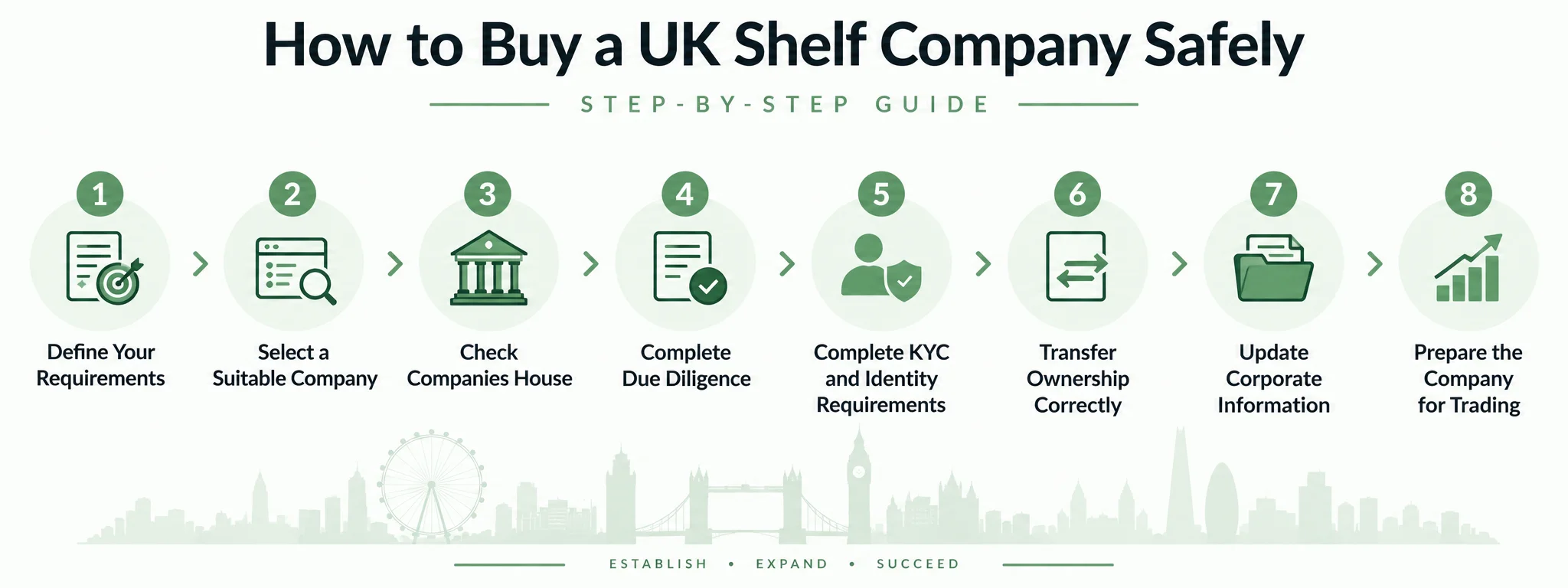
Step 1 – Define Your Requirements
Decide why you need an aged company and what incorporation date, structure, and features are genuinely important.
Step 2 – Select a Suitable Company
Compare available companies according to age, status, records, documentation, and commercial suitability.
Step 3 – Check Companies House
Review the company’s status, filing history, directors, accounts, confirmation statements, charges, and other available records.
Step 4 – Complete Due Diligence
Investigate previous trading, liabilities, tax issues, contracts, credit information, and other potential risks.
Step 5 – Complete KYC and Identity Requirements
Provide the required buyer information and ensure directors and relevant PSCs address applicable Companies House identity-verification requirements.
Step 6 – Transfer Ownership Correctly
Complete the share transfer and update the company’s internal ownership records, dealing with Stamp Duty where applicable.
Step 7 – Update Corporate Information
Make the necessary changes to directors, PSCs, shareholders, registered-office information, SIC codes, and other relevant details.
Step 8 – Prepare the Company for Trading
Arrange banking, accounting, tax registrations, licences, insurance, contracts, and other operational requirements before commencing business.
UK Shelf Company Buying Checklist
| Check | Why It Matters |
|---|---|
| Incorporation date | Confirms genuine company age |
| Companies House status | Confirms current corporate status |
| Filing history | Identifies late or missing records |
| Dormant/trading history | Establishes whether the entity was previously used |
| Directors and PSCs | Reveals previous control |
| Charges | Identifies registered security interests |
| Liabilities | Helps prevent unexpected obligations |
| Share structure | Confirms what is being transferred |
| Identity verification | Helps satisfy current Companies House requirements |
| Banking | Confirms that banking is a separate approval process |
| Licences | Determines whether intended activities need authorisation |
Conclusion
Buying a UK shelf company can provide an established incorporation date and an existing corporate structure, but the benefits depend on acquiring a clean, properly maintained entity that genuinely suits your commercial objectives. Buyers should avoid treating age as proof of trading experience, creditworthiness, banking access, or financial success and instead focus on Companies House records, previous activity, liabilities, share-transfer requirements, identity verification, and ongoing compliance. Thorough checks before acquisition and accurate corporate updates afterwards can significantly reduce unnecessary risk. If you are considering an established UK company and want help identifying an appropriate option, Contact Us to discuss your requirements.