

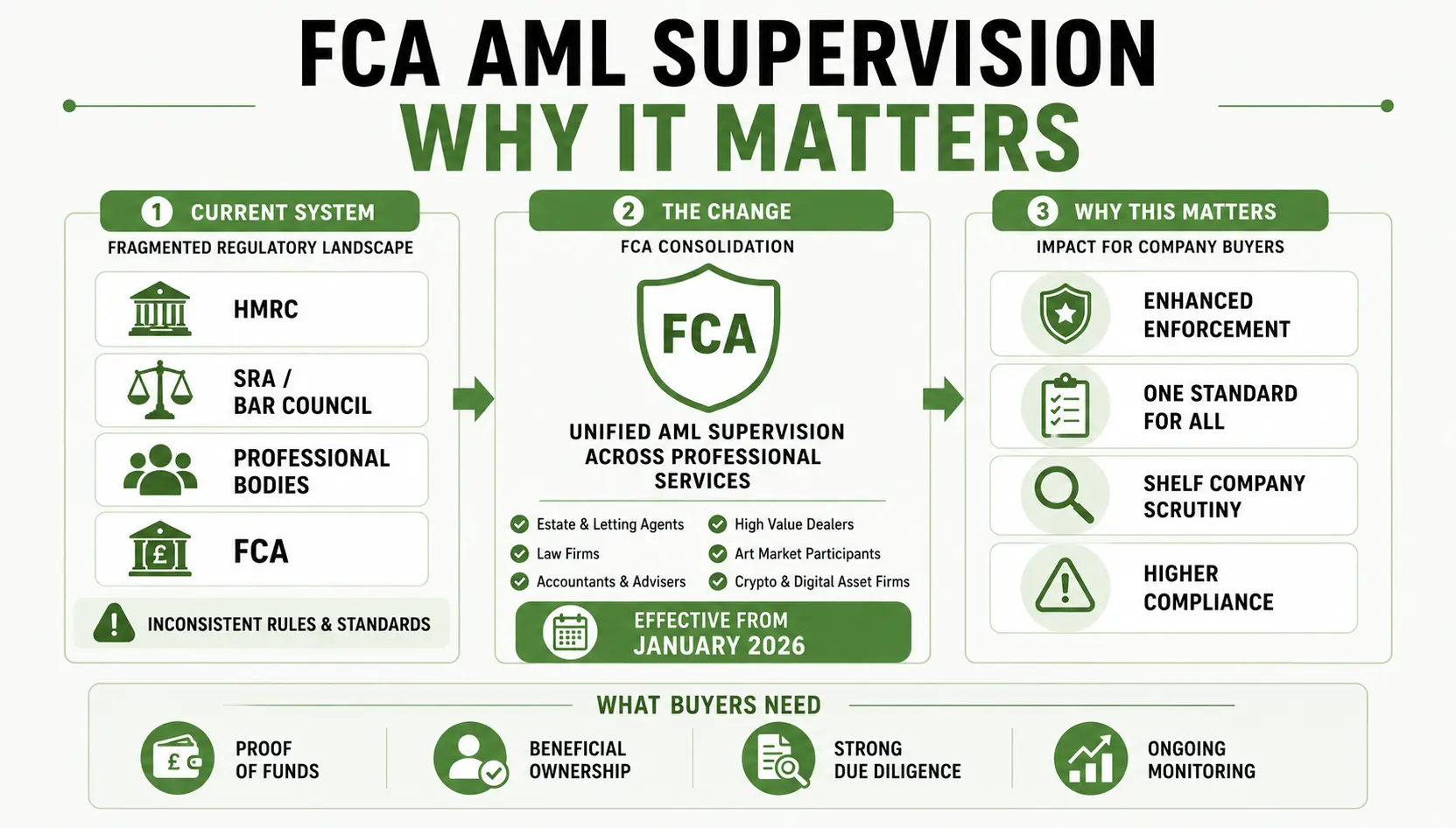
The UK financial landscape is undergoing a significant transformation. The Financial Conduct Authority (FCA) is set to become the single supervisor for anti-money laundering (AML) and counterterrorist financing (CTF) across professional services starting January 2026. This consolidation replaces the current fragmented system where multiple regulators, HMRC, professional bodies, and sector-specific authorities manage AML compliance separately.
For company buyers, particularly those purchasing shelf companies, this change carries substantial implications. The transition represents more than a bureaucratic reshuffle; it signals stricter enforcement, consistent standards, and enhanced scrutiny of transactions. The regulatory environment that once allowed relatively straightforward acquisitions has fundamentally shifted, requiring buyers to understand new requirements and adapt their processes accordingly.
This regulatory consolidation is part of a broader global movement toward stronger antimoney laundering frameworks. Countries worldwide are strengthening AML supervision following international compliance guidance and best practice recommendations. The UK’s move to consolidate under the FCA brings the country in line with international standards while creating uniform oversight that eliminates current regulatory inconsistencies and enforcement disparities.
Background – What’s Happening and Why It Matters
Current Situation – A Fragmented Regulatory Landscape
Today’s AML supervision in the UK resembles a patchwork quilt. Different sectors answer to different regulators
- Estate agents report to HMRC
- Law firms are supervised by the Solicitors Regulation Authority (SRA) and the Bar Council
- Accountants and advisers answer to their professional bodies
- Financial institutions fall under FCA oversight
- Art dealers and high-value dealers report to HMRC
- Cryptocurrency firms are regulated by the FCA
This fragmentation creates inconsistencies. One regulator might accept a particular verification method while another rejects it. Enforcement standards vary, creating loopholes and inefficiencies. According to research from London CDD, this patchwork system has resulted in inconsistent oversight across industries.
The Change – FCA Consolidation
Starting in Q4 2025 and becoming fully effective by January 2026, the FCA will consolidate AML supervision across most professional services. This shift affects
- Estate and letting agents (transitioning from HMRC)
- Law firms (keeping SRA/Bar Council as conduct regulator, adding FCA for AML)
- Accountants and professional advisers
- High value dealers
- Art market participants
- Cryptocurrency and digital asset firms
Why This Consolidation Matters for Company Buyers
Enhanced enforcement expectations
The FCA has earned a reputation for rigorous, data-driven supervision and substantial financial penalties when violations occur. Law firms have already experienced increased FCA AML fines since 2025, providing clear signals about the regulator’s enforcement commitment. When regulators make high-profile enforcement announcements early, it’s typically a warning shot, a demonstration of how seriously they take new supervisory responsibilities.
For company buyers, this means expecting real consequences for compliance failures. The days of minor violations resulting in gentle warning letters are ending. FCA enforcement means significant financial penalties, operational disruption, and potential personal director liability. This enforcement commitment is not temporary; it reflects the FCA’s institutional approach to regulation.
Consistent, stricter standards
The FCA applies uniform standards based on financial sector models, which tend to be more rigorous than legacy systems in less-regulated sectors. Where HMRC previously supervised estate agents with one set of standards and professional bodies supervised accountants with different standards, the FCA will apply consistent, financial sector-derived standards to all.
This consolidation eliminates regulatory arbitrage, the practice of exploiting differences between regulatory regimes. Historically, a transaction might be acceptable under one regulator’s framework but violate another’s standards. The FCA consolidation ends this ambiguity. A transaction that fails to meet FCA standards will be rejected, regardless of which sector it occurs in.
For company buyers, this means higher expectations for documentation, more rigorous risk assessment, and continuous transaction monitoring. The FCA’s financial sector standards were designed for high-volume, high-value transactions with sophisticated money laundering risks. Applying these standards to individual company purchases seems heavy-handed, but it is now a regulatory reality.
Increased scrutiny on shelf company transactions
Shelf companies, previously established corporate entities with minimal trading history, are viewed with particular suspicion under FCA frameworks. The reasoning is logical shelf companies have no operational history, no trading patterns, no documented business relationships. Any legitimate business purpose requires explanation and documentation.
From a money laundering perspective, shelf companies are ideal vehicles. A person can purchase a shelf company with minimal scrutiny, then use that company for high value transactions, potentially moving substantial funds while appearing to conduct legitimate business. The company has legal status (it’s officially registered), official documentation (incorporation certificates), and bank account access, but no actual business operations to scrutinize.
The FCA recognizes this risk profile and addresses it by applying enhanced scrutiny to shelf company purchases. Buyers must demonstrate clear, documented business purpose beyond “I want to operate a business.” Buyers must show detailed business plans, market research, competitive positioning, funding sources, and anticipated revenue models. Vague business purposes trigger regulatory suspicion and transaction delays.
Competitive and regulatory dynamics
The consolidation also reflects international regulatory pressure. Countries worldwide are strengthening AML supervision following international compliance recommendations. The UK’s consolidation under the FCA aligns the country with international best practices and prevents regulatory arbitrage internationally. A business that cannot meet FCA standards might attempt to operate through less regulated channels, creating systemic risk. Consolidation under a strong regulator prevents this global regulatory arbitrage.
The Timeline – When Changes Take Effect
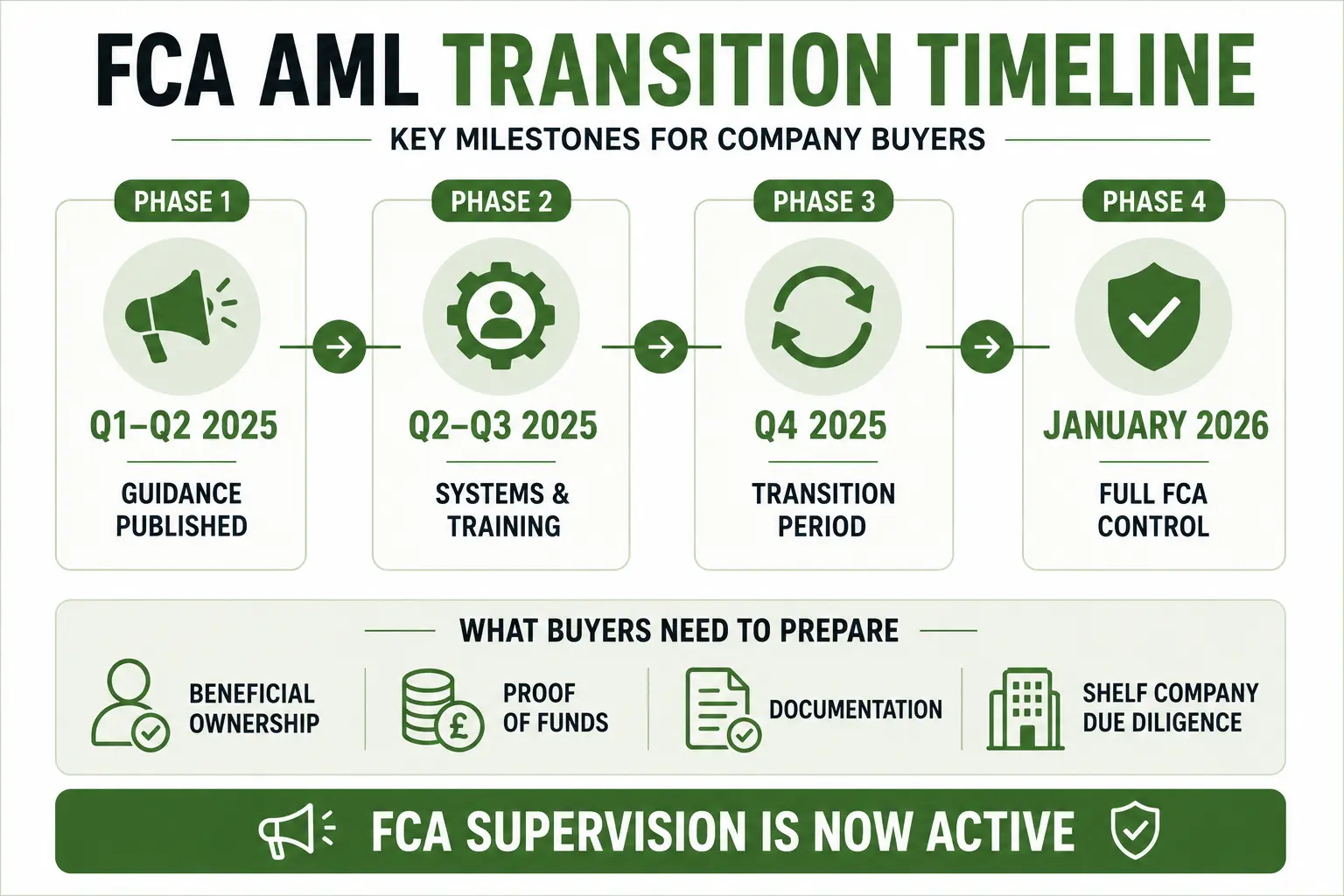
Understanding the transition schedule is crucial for preparation.
| Phase | Period | Key Actions |
|---|---|---|
| Phase 1 -Announcement & Guidance | Q1 2025 , Q2 2025 | FCA publishes formal supervision framework; businesses begin gap analysis |
| Phase 2 -Implementation Readiness | Q2 2025 , Q3 2025 | Systems updates; policy revisions; staff training; compliance documentation preparation |
| Phase 3 -Transition Period | Q4 2025 | Final testing; resolution of outstanding issues; migration to new systems |
| Phase 4 – Full FCA Control | January 2026 onwards | Complete supervisory transition; enforcement mechanisms fully active; ongoing monitoring |
Current Date -May 2026. The FCA has already assumed full supervisory control. Businesses should be fully compliant with new standards.
What Changes Under FCA AML Supervision
Enhanced Know Your Customer (KYC) Procedures
The FCA demands more rigorous customer identification than many legacy systems require.
Enhanced Due Diligence (EDD) is now mandatory for
- High-risk jurisdictions as identified by international compliance standards,
- Beneficial owners with PEP (Politically Exposed Person) status,
- Complex ownership structures
- Shelf company purchases
Beneficial Ownership Identification requires
- Naming all individuals controlling the company beyond 25% ownership threshold
- Identifying ultimate beneficial owners (UBOs)
- Verifying identity with government-issued documentation
- Regular updates to beneficial ownership records
Proof of Funds Verification
Company buyers must now document the source of funds used in purchase transactions.
Required documentation includes
- Bank statements showing fund origin (minimum 3 6 months)
- Proof of legitimate business income or asset sales
- Documentation of loans with appropriate agreements
- Evidence of inheritance or gifts with supporting documentation
For shelf company purchases, heightened scrutiny applies because
- Buyers cannot cite company operational cash flow
- Sellers must justify why they accumulated funds
- Payment methods undergo close examination
Transaction Monitoring Requirements
The FCA expects ongoing monitoring of company activity after purchase, not just one-time due diligence.
| Monitoring Element | Requirement | Frequency |
|---|---|---|
| Transaction patterns | Flag unusual amounts or velocity | Continuous |
| Geographic risk | Monitor high risk jurisdiction involvement | Continuous |
| Beneficial ownership changes | Verify and document all changes | Upon change |
| Business purpose alignment | Ensure transactions match stated purpose | Quarterly minimum |
| Suspicious activity | Report to the Financial Intelligence Unit (FIU) if warranted | Upon discovery |
Documentation Standards and Retention
The FCA mandates extended record-keeping
- Retention period – 5+ years after relationship termination
- Format requirements – Clearly organized, searchable, audit-ready systems
- Digital standards – Secure, encrypted storage with access controls
- Audit readiness – Documentation must support FCA inspection without delays
How This Affects Shelf Company, Buyers
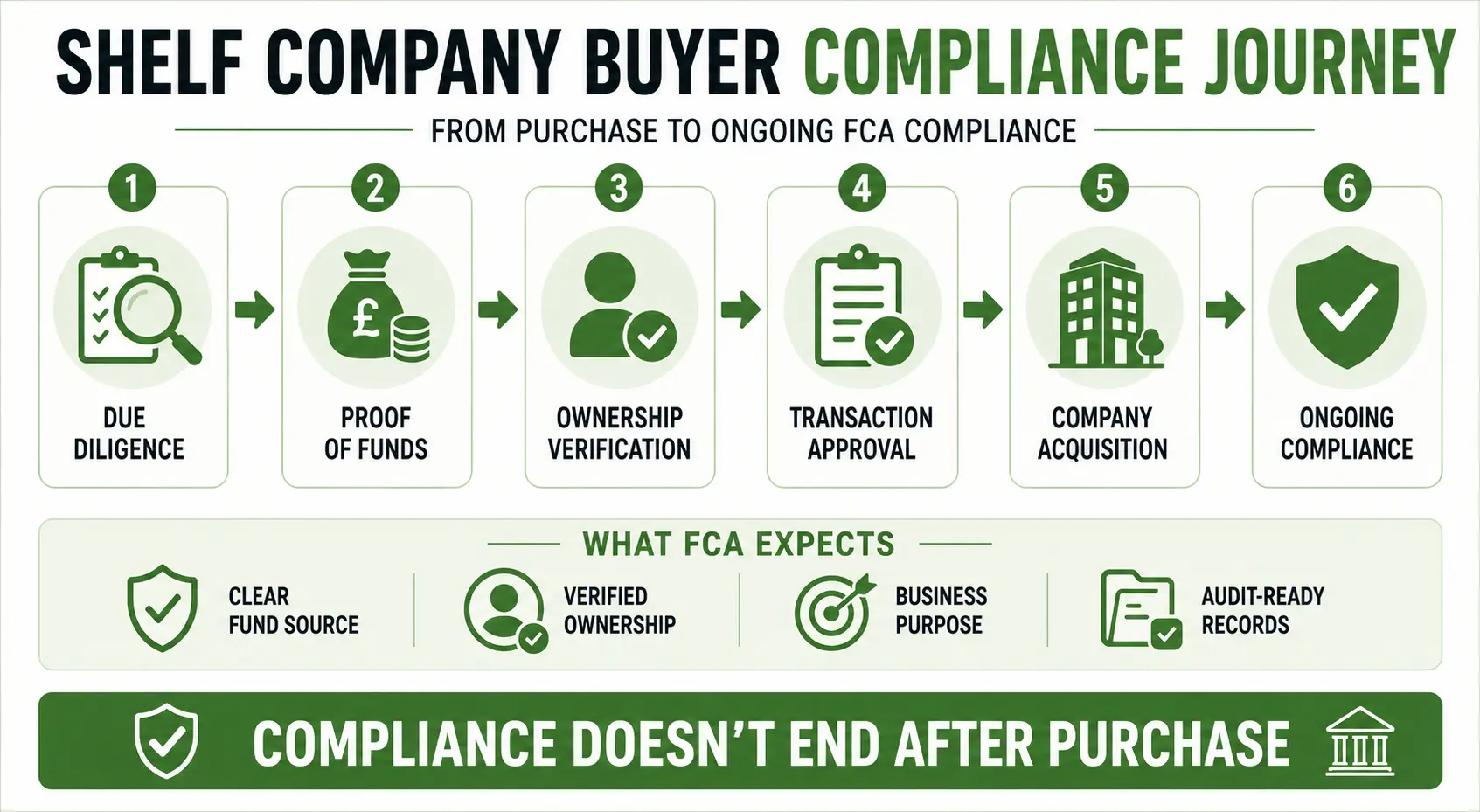
Phase 1 – During Purchase
Enhanced Due Diligence on Sellers
When purchasing a shelf company, you’re now subject to rigorous verification
- Seller identity verification – Government-issued ID, address confirmation
- Seller beneficial ownership – Who truly owns the company being sold?
- Source of seller funds – How did they finance the company’s initial setup and maintenance?
- Purpose of sale – Why are they selling now?
- Transaction documentation – Contracts, agreements, transfer documents all subject to scrutiny
Proof of Funds Documentation
As a buyer, you must demonstrate legitimate funding sources. This is perhaps the most critical element of FCA compliance for shelf company purchases. Regulators pay particular attention to proof of funds because legitimate businesses typically have clear, documented funding sources, while money laundering often involves obscure or undocumented funds.
What constitutes acceptable proof of funds varies by circumstance, but generally requires
- Business account statements showing consistent income if purchasing from business funds (typically 3 6 months minimum)
- Personal savings documentation if using personal capital, demonstrating fund accumulation over time
- Loan agreements with supporting bank documentation if financing the purchase (must show funds actually issued to you)
- Source of loan funds must itself be documented (where did the lender get the money to lend?)
- Gift letters with donor identification if funds are gifted, including the donor’s documentation of fund sources
- Asset sale documentation if purchasing with proceeds from selling other assets (evidence of sale transaction)
- Inheritance documentation if funds come from inheritance (estate documentation, probate records)
- Salary records, if accumulated from employment, should show regular deposits consistent with salary expectations
The FCA’s reasoning is straightforward – legitimate wealth has a documented source. When you trace backwards through documentation, legitimate funds always trace to an identifiable origin, salary, business income, asset sales, inheritance, or loans secured by legitimate means.
Money laundering, by contrast, attempts to hide or obscure fund origins. Regulators view inability to clearly document fund sources as a red flag for suspicious activity, even if the person’s explanations sound plausible.
For shelf company buyers specifically, this creates complications. You’re often purchasing from a seller who accumulated funds specifically to fund the company acquisition. The seller’s proof of funds becomes part of the verification process. If the seller cannot adequately document how they funded the company’s initial establishment, regulators become suspicious of the entire transaction. This suspicion extends to you as the buyer; regulators may question why you’re purchasing from someone with unclear fund documentation.
The practical implication – Don’t assume verbal explanations of fund sources suffice. Gather documentary evidence. If your funds come from employment, provide recent salary advice and bank statements showing regular deposits. If from savings, provide statements spanning several years showing accumulation. If from loans, provide loan documentation and evidence the lender released funds to your account. If from gifts, provide gift letters and the donor’s documentation of their own fund sources.
Increased Transaction Timelines
Regulatory scrutiny extends transaction timelines
- Traditional timeline – 2 4 weeks
- FCA era timeline – 4 8 weeks typical, potentially longer for higher risk profiles
- Due diligence periods – Extended timelines for document verification
- Regulatory review – Some transactions may require FCA pre-approval
Phase 2 – Post Purchase Compliance
Once you’ve purchased the shelf company, compliance obligations don’t end.
Ongoing monitoring requirements
- Regular beneficial ownership verification
- Annual compliance certifications
- Transaction monitoring (flagging unusual activity)
- Suspicious activity reporting (Suspicious Activity Reports, SARs)
- Updated risk assessments
Enhanced record keeping
- Maintain transaction records
- Document business decisions and board minutes
- Update company information with Companies House as required
- Create an audit trail for regulatory inspection
Phase 3 – Transaction Costs
Budget appropriately for regulatory compliance
| Cost Category | Typical Range | Notes |
|---|---|---|
| Professional verification fees | £500, £2,000 | Third party KYC providers, beneficial ownership verification |
| Legal advisory fees | £1,000, £5,000+ | Transaction structuring, compliance review |
| Compliance documentation | £300, £1,500 | Enhanced CDD, proof of funds verification |
| Systems and technology | £500, £2,000 | Compliance software, secure document storage |
| Ongoing monitoring | £200, £800 annually | Annual compliance certification, transaction monitoring |
Total estimated additional cost – £2,500, £11,500 depending on transaction complexity.
FCA’s Expectations – The New Standard
For Company Buyers
The FCA expects you to provide
- Proof of funds documentation, Complete transaction funding trail
- Beneficial ownership declaration, Full disclosure of who controls your funds and company
- Business purpose statement, Clear explanation of intended company use
- Risk profile assessment, Honest assessment of transaction risk factors
For Company Sellers and Intermediaries
If you’re selling a shelf company or acting as an intermediary
- Enhanced customer due diligence (CDD)- Rigorous buyer verification
- Source of funds verification – Documentation of purchase funding
- Ongoing client monitoring – Periodic contact to verify business legitimacy
- Suspicious activity reporting – Mandatory reporting of suspected money laundering
For Professional Intermediaries (Accountants, Lawyers, Business Advisers)
If you facilitate company purchases
- Higher accountability standards – Personal and professional liability for oversights
- Documentation retention – 5+ year requirement for all transaction-related files
- Regular compliance audits – Internal and external audit readiness
- Training and certification – Ongoing AML training for staff members
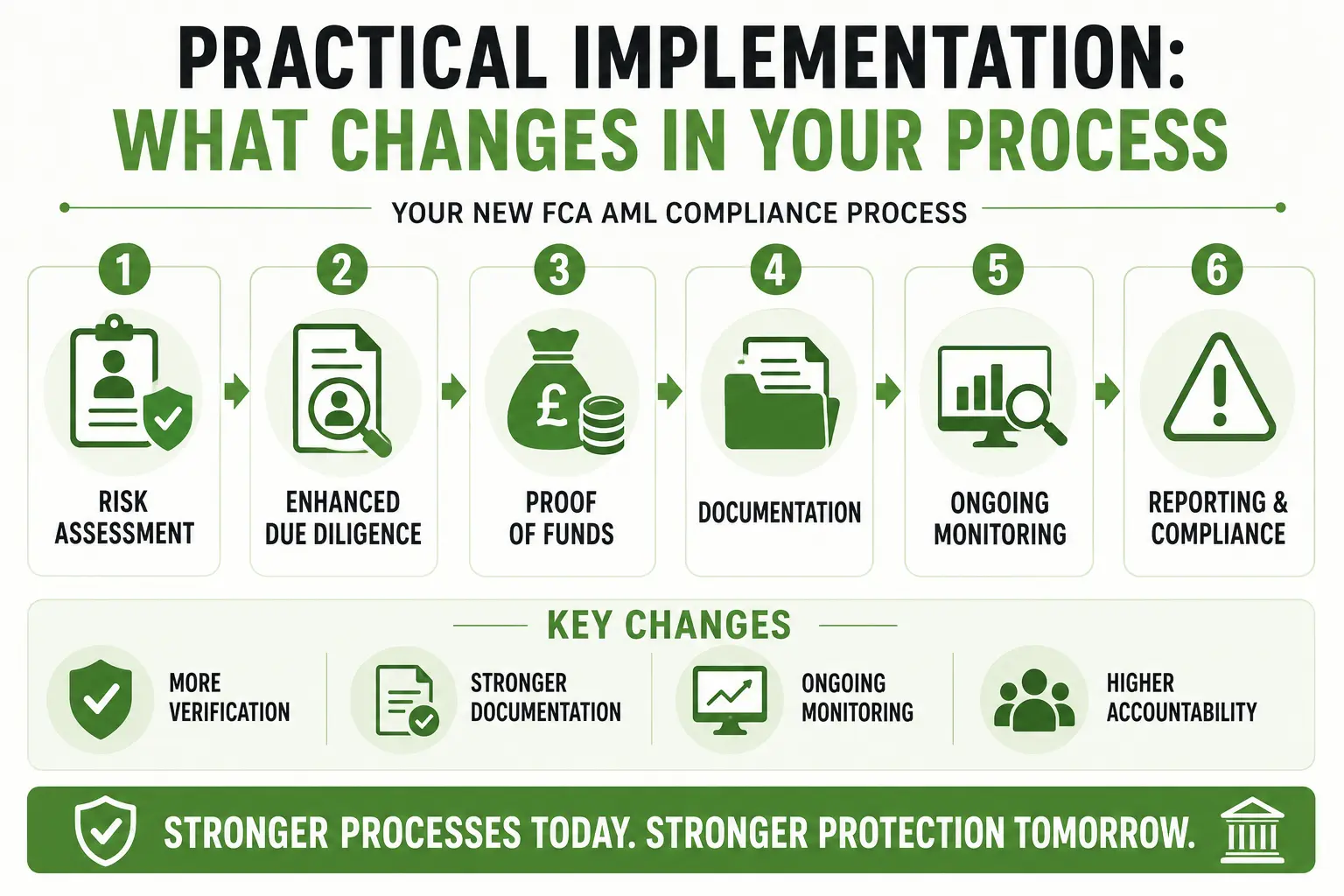
Practical Implementation – What Changes in Your Process
If You’re Buying a Shelf Company
Preparation (Before Purchase)
- Gather 3 to 6 months of bank statements showing fund sources
- Prepare a business plan documenting the intended company use
- Compile beneficial ownership documentation
- Engage a professional AML advisor early
During Transaction
- Expect extended due diligence timeline (4 8 weeks)
- Provide detailed explanations of fund sources
- Complete enhanced KYC questionnaires
- Accept verification of all submitted documentation
After Purchase
- Maintain transaction records for 5+ years
- Prepare annual compliance certifications
- Update beneficial ownership records with Companies House
- Document all significant transactions
If You’re Selling or Advising
KYC Enhancement
- Request comprehensive buyer identification
- Verify fund sources before transaction completion
- Document buyer’s business purpose in writing
- Maintain a clear audit trail
Client Communication
- Explain new verification requirements clearly
- Provide compliance documentation templates
- Set realistic timelines (4 8 weeks standard)
- Offer professional advisor referrals
Documentation Management
- Create an organized filing system (digital preferred)
- Ensure documents are searchable and secure
- Retain all records for a minimum of 5 years
- Prepare for a potential FCA inspection
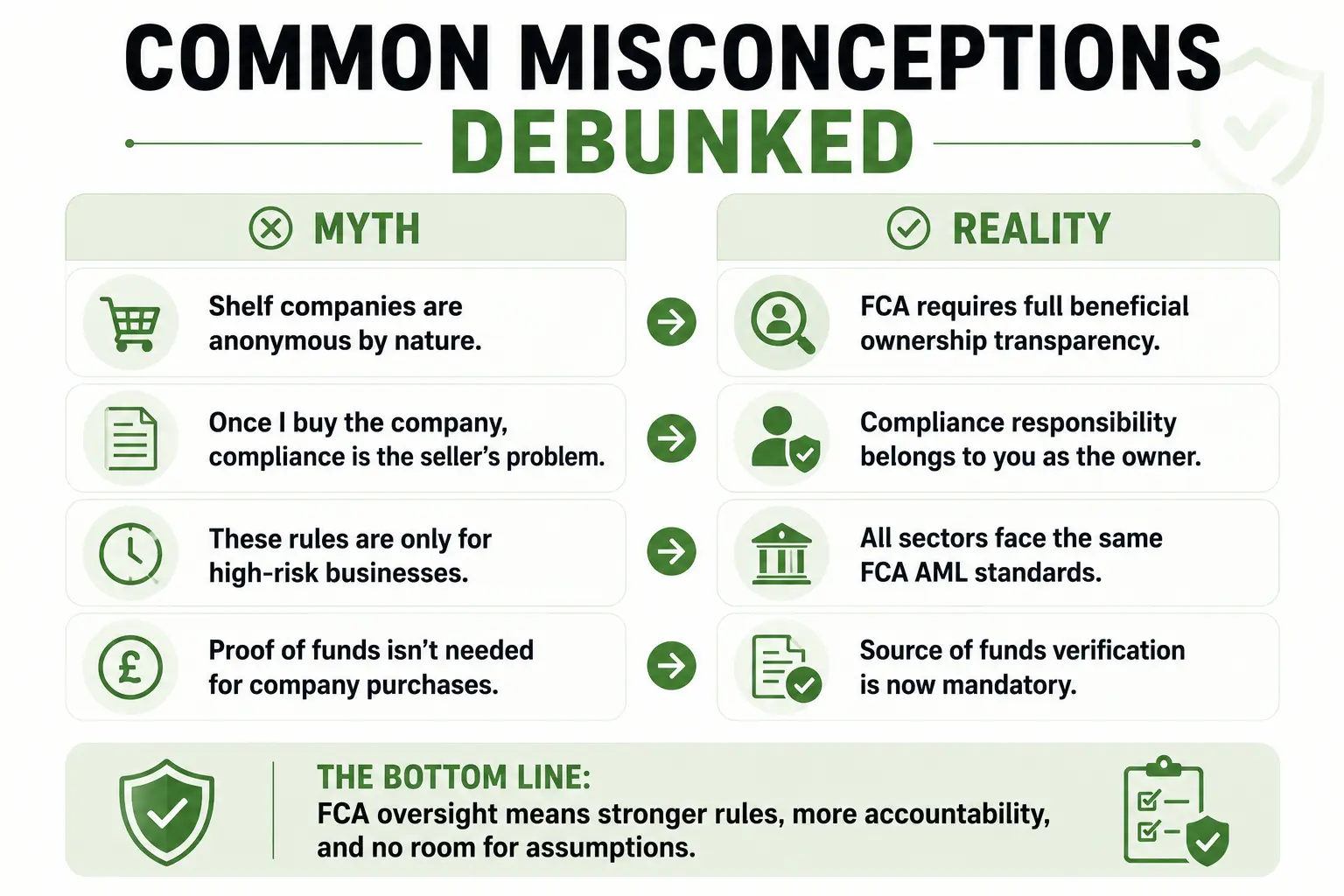
Common Misconceptions Debunked
Understanding what won’t work is as important as understanding what will. Below are five persistent misconceptions about FCA AML supervision that could derail your compliance efforts if left unchallenged.
Misconception 1 – “This Only Affects Large Companies”
Reality – The FCA supervision applies uniformly across all professional services using AML-regulated entities, regardless of company size. Shelf company buyers, small estate agents operating solo, and freelance accountants are all equally affected. Regulatory standards don’t scale down for smaller operations; if anything, smaller entities receive stricter scrutiny because they typically lack sophisticated compliance infrastructure.
Why does this matter? Small company founders often believe regulatory requirements target corporations with thousands of employees. This mindset leads to an underestimation of compliance obligations. The FCA’s framework applies equally to one-person consultancies and multinational firms. If you’re purchasing a shelf company, you’re entering the regulatory system at the same level as much larger entities.
The practical implication – Don’t assume your small transaction size exempts you from rigorous documentation requirements. The FCA focuses on transaction nature and risk profile, not company size. A small company acquisition carrying higher risk factors may require more extensive due diligence than a larger acquisition with clear, documented legitimacy.
Misconception 2 – “FCA Won’t Enforce Vigorously at First”
Reality – Historical evidence directly contradicts this assumption. The FCA has already issued substantial AML fines to law firms since early 2025, well before the consolidation becomes fully effective. The regulator has consistently demonstrated a pattern of active enforcement from day one of the new supervision arrangements.
The financial services sector learned this lesson after the FCA’s 2016 authorization processes. Firms that assumed a grace period for compliance soon faced enforcement actions. The same pattern is repeating with AML supervision expansion.
Why would FCA enforcement be vigorous from day one? Consider the regulatory politics. The FCA’s leadership staked political capital on the AML consolidation. Early, visible enforcement demonstrates competence and effectiveness to policymakers and the public. Regulators that appear lenient risk criticism for ineffective oversight. Therefore, early enforcement is practically inevitable.
The practical implication – Assume enforcement pressure will be immediate and consistent. Don’t budget for a grace period. Firms that prepare for January 2026 enforcement will be ready; those assuming a delayed enforcement timeline will scramble at the last moment, incurring higher costs and creating operational disruption.
Misconception 3 – “Only Criminals Need to Worry”
Reality – Ironically, legitimate businesses face higher scrutiny than attempted criminal activity. Criminals use sophisticated techniques specifically designed to avoid triggering regulatory flags, techniques that legitimate businesses naturally wouldn’t employ. Compliant businesses actually trigger more regulatory flags because they follow prescribed documentation procedures and report suspicious activity as required.
Consider how AML procedures work. You’re required to verify beneficial ownership and document proof of funds. When you complete this documentation properly, you create a paper trail. That trail is what regulators examine. A business attempting to conceal its activities would generate fewer documents, less documentation, and fewer traceable transactions, all of which would be less visible to regulators.
This creates a paradox – the most scrutinized transactions are often the most legitimate ones, conducted by conscientious business people who properly document everything. Meanwhile, sophisticated criminal operations specifically design their activities to minimize the documentation trail that triggers regulatory concern.
The practical implication – Don’t fall into the false comfort of “I’m legitimate, so regulators won’t scrutinize me.” Legitimate status makes you more, not less, likely to trigger detailed regulatory review. Prepare for thorough examination and cooperate fully with verification requests.
Misconception 4 – “My Lawyer Will Handle It All”
Reality – While legal advice and professional support are valuable, regulatory compliance cannot be delegated entirely to external advisors. Directors and principals bear personal liability for compliance failures. You cannot outsource your responsibility, only supplement it with professional guidance.
This is a critical distinction. A lawyer can advise you on compliance requirements. An accountant can help organize documentation. A compliance specialist can recommend procedures. But you, the director, principal, and beneficial owner, remain personally accountable to regulators for compliance.
The FCA enforcement approach confirms this. When the FCA investigates AML deficiencies, it often holds individual directors and principals personally accountable, separate from company-level penalties. Directors cannot defend themselves by claiming “my lawyer said this was acceptable” without demonstrating they personally understood the requirements and actively implemented systems to ensure compliance.
The practical implication – Develop personal understanding of FCA requirements relevant to your transactions. Don’t blindly delegate to professionals without understanding their recommendations. Actively participate in compliance implementation. Understand your personal regulatory obligations and ensure you’re meeting them, not just outsourcing them.
Misconception 5 – “It’s Just More Paperwork”
Reality – Non compliance carries severe consequences far exceeding the additional documentation burden. Individual director personal liability, company dissolution risk, substantial financial penalties, operational disruption, professional reputation damage, criminal prosecution in serious cases, these consequences dwarf any paperwork burden compliance creates.
This misconception typically arises because people focus on the surface-level requirement more forms to complete, more documentation to maintain, longer transaction timelines. From this narrow perspective, compliance seems like a paperwork exercise. But regulatory consequences transform this “mere paperwork” into an existential business risk.
Consider the actual risk profile. A company purchasing a shelf company without proper proof of funds documentation faces potential regulatory penalties of £50,000, £500,000+. The paperwork required to prevent this penalty might cost £2,000, £5,000 in professional fees. Mathematically, the paperwork is a bargain. But many companies refuse to pay this bargain price, gambling that regulators won’t investigate, a gamble that fails with increasing frequency.
The practical implication View compliance documentation as essential risk management, not a bureaucratic burden. The investment in proper documentation is minimal compared to the potential consequences of inadequate documentation. Frame compliance as protecting your business, not impeding it.
Your Compliance Checklist – Getting Ready for 2026
Use this checklist to assess your readiness. Mark completion as you address each item.
Documentation Review
- Audit all beneficial ownership documentation for accuracy
- Verify proof of funds documentation completeness
- Document a clear business purpose statement
- Review all company records and declarations
- Update the beneficial ownership register with Companies House
Systems and Procedures
- Review current AML policies against the FCA framework
- Identify gaps between current practices and FCA requirements
- Establish monitoring procedures for ongoing compliance
- Set up compliance review schedule (recommend quarterly)
- Implement a secure document storage system
Professional Support
- Engage a compliance advisor for gap analysis
- Consult legal counsel on transaction structuring
- Consider a professional verification service for KYC
- Train staff on new requirements
- Test all systems before January 2026
Regulatory Readiness
- Stay informed about FCA updates and guidance documents
- Download FCA Supervision Framework documentation
- Review sector-specific guidance for your industry
- Document compliance training completion
Penalties and Consequences of Non-Compliance
Understanding potential consequences motivates proactive compliance.
Financial Penalties
The FCA has authority to impose fines
- Minor violations – £5,000, £50,000
- Moderate violations – £50,000, £500,000
- Serious violations – £500,000, £5,000,000+
- Factors affecting penalty – Company size, violation severity, duration, intent, and remediation efforts
Director Personal Liability
Directors and principals can face
- Personal financial penalties (separate from company penalties)
- Disqualification from directorship (up to 15 years)
- Potential criminal prosecution
- Loss of professional qualifications
- Personal reputational damage
Company Dissolution Risk
The FCA can
- Issue enforcement notices requiring specific remediation
- Suspend company operations until compliance is demonstrated
- Pursue company dissolution in severe cases
- Remove beneficial owners from registers
Additional Consequences
- Financing restrictions – Banks become reluctant to work with noncompliant entities
- Professional relationships – Other businesses avoid partnerships due to compliance risk
- Insurance costs – Professional indemnity insurance becomes expensive or unavailable
- Operational disruption – Regulatory investigations consume management time
- Reputational damage – Regulatory action becomes public record
Real World Penalty Examples
While specific figures vary, regulatory trends show
- Law firms have received fines ranging from £100,000 to £1,000,000+ for AML deficiencies
- Property sector companies have faced penalties of £50,000 and £500,000 for inadequate beneficial ownership verification
- Professional services firms commonly receive £200,000 to £800,000 fines for documentation failures
These examples demonstrate that regulatory enforcement is not theoretical; real companies face real, substantial penalties for compliance failures.
Strategic Preparation – Action Plan
Success in FCA compliance requires a structured, phased implementation. Following this roadmap systematically prevents overlooking critical requirements and distributes implementation effort across a manageable timeline.
Phase 1 – Assessment & Planning (Now , Q2 2026)
Note – The current date is May 2026, so this phase should be completed. If not, act immediately.
This assessment phase is critical because it establishes your current position and identifies gaps between existing practices and FCA requirements. Skip this phase, and you risk implementing unnecessary changes or missing important requirements.
Immediate actions
Begin by conducting a comprehensive compliance gap analysis. Document every process you currently use for customer due diligence, beneficial ownership verification, proof of funds assessment, and transaction monitoring. For each process, compare it against FCA requirements. Identify gaps, areas where FCA requirements exceed your current practices.
Document all current processes and procedures in writing. This documentation serves multiple purposes it provides a baseline for measuring progress, helps staff understand existing procedures, and creates a reference against which to measure compliance improvements.
Identify specific areas requiring change and prioritize them by risk. Higher risk areas (proof of funds verification, beneficial ownership identification) require immediate attention. Lower risk areas (record formatting, archival systems) can be addressed later.
If gaps are significant, engage compliance professionals early. Professional guidance prevents false starts and ensures you implement solutions that satisfy FCA requirements rather than simply adding bureaucracy.
Create a realistic implementation timeline. Don’t attempt everything at once; phased implementation prevents overwhelming staff and reduces implementation errors. Typically, significant compliance changes require 3 to 4 months from planning to full implementation.
Expected outcome – Clear understanding of compliance gaps and required changes, with a prioritized list of implementation tasks.
Phase 2 – Implementation (Q2, Q4 2026)
This phase involves actually implementing the required changes. It’s the most resource-intensive phase but critical for establishing compliant processes before enforcement begins.
Implementation actions
Update AML policies to reflect the FCA framework. Your policies should address enhanced KYC, beneficial ownership identification, proof of funds verification, transaction monitoring, and suspicious activity reporting. Ensure policies are written clearly enough that staff can understand and follow them without constant supervision.
Implement new KYC verification systems. If you’re currently relying on manual verification processes, consider software solutions that automate identity verification, PEP screening, and sanctions checking. These systems are more reliable than manual processes and create audit trails demonstrating compliance.
Train team members thoroughly on new procedures. Compliance failures often result from staff misunderstanding requirements, not deliberate noncompliance. Invest time in training. Have staff practice new procedures with sample transactions before using them on real transactions.
Establish transaction monitoring mechanisms. Define what constitutes suspicious activity in your business context. Create procedures for staff to report suspected suspicious activity. Document all monitoring activity, creating an audit trail showing you implemented systems and took concerns seriously.
Conduct an internal audit of implementation. Before declaring compliance achieved, test your new procedures against sample transactions. Identify any procedures that don’t work as intended and refine them before using them on real business transactions.
Expected outcome – Fully implemented FCA-compliant AML framework operational across your organization, with staff trained and systems tested.
Phase 3 – Transition and Testing (Q4 2026)
By this phase, full FCA enforcement is active. This final preparation phase ensures you’re genuinely ready for regulatory oversight.
Pre-enforcement actions
Monitor FCA guidance updates continuously. The regulator will issue periodic clarifications, updates, and enforcement actions. Stay informed about guidance relevant to your business sector.
Test all new procedures with sample transactions before deploying them on real business transactions. Simulation testing identifies problems before they affect actual customers and transactions.
Address any discovered issues immediately. If testing reveals procedures don’t work as intended, fix them now rather than discovering problems during FCA inspection.
Conduct a final compliance review with external auditors if possible. Independent review identifies blind spots your staff might miss. This review creates documentary evidence that you took compliance seriously.
Prepare documentation for potential FCA inspection. Organize files, evidence of staff training, compliance policies, transaction monitoring records, and procedural documentation so it’s readily available if FCA requests inspection.
Expected outcome – Complete readiness for full FCA oversight, with all procedures tested and working correctly, comprehensive documentation organized, and staff prepared to explain compliance processes to regulators if necessary.
Phase 4 – Ongoing Compliance (2026+)
Compliance isn’t a one-time project; it’s an ongoing requirement. This phase details activities required to maintain compliance with FCA standards continuously.
Sustained compliance
Maintain enhanced verification procedures for all transactions without exception. Don’t become complacent and reduce verification rigor after the initial period. Consistent rigor across all transactions is essential.
Monitor regulatory updates quarterly. The FCA will issue updates, clarifications, and guidance throughout the year. Staying informed ensures you’re implementing current requirements, not outdated interpretations.
Review and improve compliance processes annually. Identify inefficiencies and opportunities for improvement. Compliance procedures should evolve as your business changes.
Maintain comprehensive documentation. Document every transaction, verification, monitoring activity, and decision. This documentation creates evidence of compliance if regulators investigate.
Stay audit-ready at all times. Assume FCA inspection could occur at any moment. If your documentation organization, record retention, and procedure implementation do not satisfy regulatory review, improve them now rather than scrambling during inspection.
Expected outcome – Sustained compliance with FCA standards as a normal business operation, with procedures integrated into regular business activities rather than treated as separate compliance functions.
Conclusion
The FCA’s takeover of AML supervision represents a fundamental shift in how company purchases are regulated. What was once a straightforward process has become a complex compliance operation requiring meticulous documentation and professional oversight. This regulatory transformation presents both challenges and opportunities for legitimate businesses.
Companies that embrace FCA standards now gain significant competitive advantages. Early compliance improves operational efficiency, builds stronger relationships with banks and financial institutions, creates positive relationships with regulators, and enhances reputation in professional circles. In contrast, attempting to circumvent requirements or treating compliance superficially carries unacceptable risks, including substantial financial penalties and potential criminal prosecution.
The path forward is clear: assess your current compliance status against FCA requirements, engage qualified professionals early, develop a realistic implementation timeline, and recognize that compliance readiness is now a business requirement. With professional support for ready-made company services and expert guidance, businesses can adapt more efficiently to changing regulatory requirements.
The regulatory environment has changed permanently. Companies that adapt quickly will thrive, while those that resist face increasing operational friction and regulatory exposure. If you need guidance on maintaining compliance or selecting the right company structure, Contact Us to discuss your requirements with the team.