

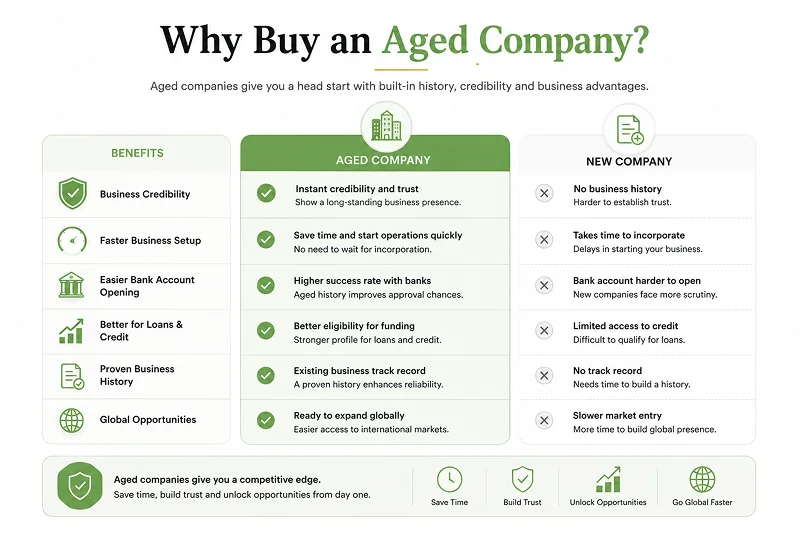
If you are launching a business, time is your most valuable asset. Traditional company formation takes weeks, sometimes months, to complete. Aged companies (also called shelf companies) offer a shortcut – fully formed, registered businesses ready for immediate use.
The demand for aged companies has surged in 2026. Here is why
- Speed – Aged companies are already registered, so you skip months of paperwork. You acquire ownership and start trading within days instead of waiting 6-12 weeks for standard incorporation.
- Credibility – A company with a registration history (often 1-3 years old) appears more established than a brand-new entity. Banks, suppliers, and clients perceive aged companies as more trustworthy, a critical advantage in competitive markets.
- Global expansion – For entrepreneurs entering new markets, an aged company in that jurisdiction gives instant local legitimacy. Operating as a local business, rather than a foreign entity, opens doors to partnerships and banking relationships.
- Access to funding and contracts – Some institutional investors and government contracts prefer companies with a documented operating history. An aged company satisfies this requirement immediately.
However, not all countries are equal when it comes to aged companies. The jurisdiction you choose determines your banking options, tax obligations, compliance burden, and long-term scalability. A 2-year-old company in the UK offers different advantages than one in the UAE or Singapore, and the wrong choice can derail your plans.
This guide compares the top countries for buying aged companies in 2026, reveals what to look for, and shows how to find trusted providers.
The Problem – Choosing the Wrong Country Costs Time and Money
Most entrepreneurs focus on the business idea and overlook jurisdiction selection, a costly mistake.
- Each jurisdiction operates under its own rules. A company structure that is tax-efficient in Ireland may be cumbersome in the UK. Banking practices differ dramatically. The UAE offers 0% corporate tax but requires free zone setup; the US offers market access but state-level complexity; the EU provides passport benefits but stricter compliance.
- Banking challenges vary by location. Some countries, like the UK and UAE, have robust banking infrastructure for non-resident business owners. Others have tightened compliance post-2024 FATCA/CRS regulations, making bank account opening slower and more expensive. Buy an aged company in the wrong jurisdiction, and you might face months of delays trying to open a business bank account.
- Tax and compliance risks compound over time. Choosing a jurisdiction with unfavorable tax treatment or unclear compliance pathways creates ongoing headaches. VAT registration, annual filings, and audits differ by country. A company in Estonia might require digital-only filings (simple); one in Germany requires extensive accounting (complex).
- This decision impacts your 5-year plan. An aged company purchased for speed should also support your growth. Will you expand internationally? Do you need access to EU markets? Are you serving US clients and need USD banking? These questions should guide jurisdiction selection, not be afterthoughts.
The Solution – Key Factors to Evaluate
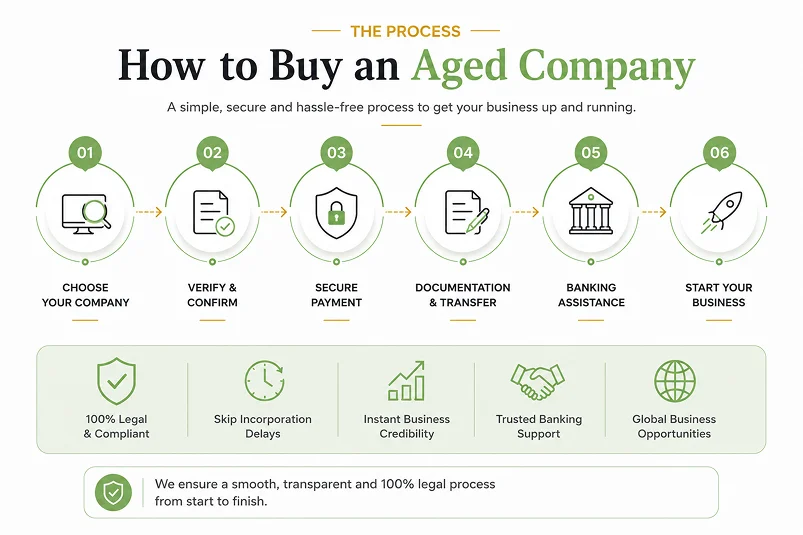
Before comparing specific countries, understand what makes a jurisdiction ideal for aged companies. Evaluate these factors
1. Business Reputation and Global Recognition
What it means – How credible is a company registered in this jurisdiction?
A UK company carries immediate weight in Western markets. A Delaware corporation signals seriousness to US investors. An Estonia registration suggests tech-savviness. Conversely, some jurisdictions carry baggage, as companies registered in certain offshore locations face extra scrutiny from banks and clients.
Why it matters – Your company’s jurisdiction appears on every contract, invoice, and banking application. Clients and partners form impressions instantly. A strong reputation shortens deal cycles and reduces friction.
2. Banking Accessibility
What it means – How easily can you open a business bank account? What are the costs and requirements?
Post-2024, banks globally demand extensive documentation from non-resident account holders. Some countries are bank friendly (UK, UAE, Australia) with established relationships and faster processing. Others require visits, proof of residence, and months of verification.
Why it matters – Without a business bank account, you cannot operate legally. Choosing a jurisdiction where banking is slow or expensive defeats the purpose of buying an aged company.
3. Tax Environment
What it means – Corporate tax rates, VAT, income tax, and whether profits are taxed on a worldwide or territorial basis.
The UAE offers 0% corporate tax (for most businesses) until recently; Estonia has digital-first, low-tax structure (20% corporate tax on distributed profits); the UK charges 19% corporate tax; the US federal rate is 21% (plus state taxes).
Why it matters – Your tax bill directly impacts profitability. A 10% tax difference on 100,000 pounds profit equals 10,000 pounds saved annually. Over 5 years, that is 50,000 pounds.
4. Setup and Transfer Process
What it means – How fast can you take ownership? What paperwork is required?
Some countries enable transfers within 24-48 hours (UK, UAE). Others require in-person visits, notarized documents, or government approvals (slower). The simpler the process, the faster you can start trading.
Why it matters – You are buying an aged company for speed. A jurisdiction requiring complex transfers negates this advantage.
5. Ongoing Compliance and Regulatory Burden
What it means – Annual filing requirements, audit thresholds, accounting standards, and cost of compliance.
UK companies require simple Companies House filings (100-300 pounds per year in compliance costs). Delaware corporations need minimal annual filings. Estonia operates entirely digitally. Some jurisdictions demand full audits regardless of size.
Why it matters – Compliance costs accumulate. A jurisdiction with minimal burden saves thousands annually and reduces administrative headaches.
Top Countries to Buy Aged Companies in 2026
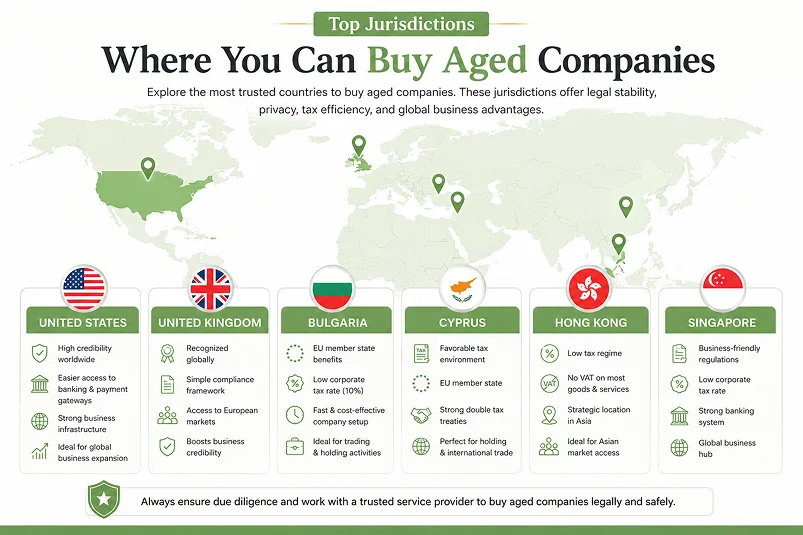
United Kingdom – Global Credibility and Easy Operations
The UK remains the gold standard for international business credibility.
Why it stands out
- Global recognition – A UK Limited Company is trusted worldwide. It signals stability and legitimacy.
- Easy ownership transfer – Changing directors takes minutes online via Companies House. No complex paperwork required.
- Robust banking system – UK banks understand shelf companies and open accounts relatively quickly for established providers.
- Simple compliance – File accounts annually with Companies House (100-300 pounds). No quarterly filings. Minimal audit requirements if turnover is below 10.2 million pounds.
- Tax efficiency – 19% corporation tax (competitive), but relief is available for small profits. No VAT until 85,000 pounds turnover.
Ideal for
e-commerce businesses targeting Western markets, consulting and professional services, international trading companies, SaaS and tech startups Agencies serving UK and US clients
Cost and timeline
Aged company price – 1,500-3,500 pounds (depending on age and bank account status). Transfer – 24-48 hours. Bank account – 2-4 weeks with established account holder; 4-8 weeks for new applicants. Annual compliance – 500-1,500 pounds
Considerations
Requires proof of identity (passport or driving license). UK tax residency rules apply if you are UK-based; non-residents face limited complexity. Recent regulations require Persons of Significant Control (PSC) disclosure
Australia – Stability and Local-Market Credibility
Australia offers a stable business environment with strong regulatory frameworks, ideal for those targeting the Asia-Pacific region.
Why it stands out
- Stable economy – Political and economic stability inspires confidence. ASIC (regulator) is well-respected.
- Local credibility – If you are targeting Australia or Asia-Pacific, a local company is invaluable.
- Trusted regulatory environment – ASIC maintains strict standards; doing business with an Australian company signals compliance.
- Favorable tax treaties – Extensive tax agreements with other nations reduce double-taxation risks.
- Digital-friendly processes – Online registration and updates through the ASIC portal.
Ideal for
Asia-Pacific market expansion, eCommerce targeting Australia and NZ, Resource and logistics companies, Tech and SaaS serving Australian clients
Cost and timeline
Aged company price – AUD 2,000-5,000 (1,050-2,650 pounds) Transfer – 1-2 weeks Bank account – 2-4 weeks Annual compliance – AUD 800-2,000 (ABN renewal, ASIC lodgment)
Considerations
Corporate tax – 30% (higher than many alternatives, but recent reductions available for smaller businesses). Limited partnership structure is less favorable than in other countries. Requires Australian Tax File Number (TFN) setup
United Arab Emirates – Tax Advantages and International Trade
The UAE has become a favorite for international business, particularly for holding companies, e-commerce, and trade-focused ventures.
Why it stands out
- Zero corporate tax – Most businesses pay 0% corporate tax (until recently, 0% for most sectors; recent 0% threshold is AED 375,000 profit, above which 9% applies).
- Free zones versus the mainland – Free zones (DMCC, Dubai South, Jebel Ali, RAK) offer 100% foreign ownership, 0% corporate tax, and no VAT. Mainland companies have different benefits.
- International payment flows – Unmatched advantage for holding companies, trading, and international fund transfers.
- Strong banking system – Despite AML scrutiny, UAE banks remain accessible for legitimate businesses. Relationships with major international banks are strong.
- Rapid business setup – The government streamlines processes; audits are minimal for certain structures.
Ideal for
Holding companies and investment vehicles, international trading and procurement, eCommerce with regional focus, freelancers and service providers (free zone license), import and export businesses
Cost and timeline
Aged company price – AED 8,000-20,000 (1,800-4,500 pounds). Transfer – 1-2 weeks. Bank account – 2-6 weeks (more complex post-compliance tightening) Annual compliance – AED 3,000-8,000 (varying by structure)
Considerations
Requires UAE residency or a visit for document signing (for some structures). Free zone companies cannot sell to the mainland UAE without a mainland partner or distributor. Recent corporate tax changes (0% only up to AED 375,000 profit), VAT (5%) applies to most transactions
United States – Market Access and Investor Appeal
The US offers unmatched access to global capital, markets, and funding, essential if you are targeting US growth or investor attention.
Why it stands out
- Market dominance – The US represents 25% of global GDP; a US company signals market seriousness.
- State flexibility – Delaware, Wyoming, and Nevada each offer unique advantages. Delaware – strong legal precedent, investor-preferred. Wyoming – strongest privacy, with minimal reporting. Nevada – no state corporate income tax.
- Funding ecosystem – Venture capital, angel investors, and institutional capital, predominantly US-based. A US company is near the money.
- Global brand. A US corporation carries weight internationally.
- IP protection. US IP laws are unmatched. Critical if you are building tech, software, or branded products.
Ideal for
Tech startups targeting US and global funding, SaaS and software companies, eCommerce and digital products, Companies seeking US investor backing, and IP-heavy businesses
Cost and timeline
- Aged company price – 2,000-8,000 dollars (Delaware and Wyoming variations).
- Transfer – 3-5 days (state-dependent)
- Bank account – 2-4 weeks.
- Annual compliance – 500-1,500 dollars (state filing and federal EIN)
Considerations
State selection is critical (Delaware most common, but Wyoming rising in popularity) Federal tax – 21% corporate tax (flat rate, no deductions on distributions) State tax varies (Delaware – 0% corporate tax; Wyoming – 0% corporate tax; Nevada – 0% corporate tax) Requires US bank account; ITIN (Individual Tax ID Number) may be needed Annual state filings required; some states demand registered agent services
European Union – Market Access and Digital Infrastructure
EU jurisdictions (particularly Ireland, the Netherlands, and Estonia) combine strong business environments with access to 27 member markets.
Why it stands out
- Single market access. Trade freely across 27 EU countries. One company, multiple markets.
- Digital infrastructure . Estonia leads the world in e-governance (digital signatures, online registration). Ireland and Netherlands have digital-friendly processes.
- VAT and tax efficiency . VAT recovery across EU. Transfer pricing rules for holding structures.
- Strong legal frameworks. Predictable, transparent regulations; protection of investor rights.
Ireland
- Tax rate – 12.5% corporate tax (highly competitive).
- Ideal for – Tech, IP-holding, international trading
- Cost – 2,000-4,000 euros (aged company)
- Timeline – 2-3 weeks transfer
Netherlands
- Tax rate – 19% corporate tax plus dividend tax (5.5-49.5% depending on distribution).
- Ideal for – Holding companies, international trading, fintech
- Cost – 2,500-5,000 euros (aged company)
- Timeline – 1-2 weeks transfer
- Advantage – Strong privacy, financial hub status
Estonia
- Tax rate – 20% corporate tax (only on distributed profits; retained earnings are untaxed).
- Ideal for – Digital businesses, startups, tech companies. Cost – 500-2,000 euros (aged company).
- Timeline – 24-48 hours online transfer.
- Advantage – Fully digital, blockchain-friendly, EU access
Why the EU matters in 2026
Post-Brexit, EU market access is even more valuable. Companies within the EU face fewer trade barriers and can operate seamlessly across member states. VAT rules favor EU-registered businesses.
Comparison Table – Best Countries for Aged Companies in 2026
| Factor | UK | Australia | UAE | USA (Delaware) | EU (Estonia) |
|---|---|---|---|---|---|
| Corporate Tax Rate | 19% | 30% | 0-9% | 21% federal | 20% (retained earnings tax-free) |
| Setup Speed | 24-48 hrs | 1-2 weeks | 1-2 weeks | 3-5 days | 24-48 hrs |
| Banking Access | Excellent | Good | Good | Excellent | Good |
| Annual Compliance | Simple | Medium | Medium | Medium | Simple (digital) |
| Global Reputation | Excellent | Excellent | Very Good | Excellent | Very Good |
| Market Focus | Western markets | Asia-Pacific | Middle East/Africa | US/Global | EU and Global |
| Ideal for | Consultancy, eCommerce | APAC expansion | Trading, holding | Tech, funding | Digital, EU trade |
| Aged Company Cost | 1,500-3,500 pounds | AUD 2,000-5,000 | AED 8,000-20,000 | 2,000-8,000 dollars | 500-2,000 euros |
| Privacy Level | Medium | Medium | Very Good | High (Wyoming) | Medium-High |
UAE – 0% until AED 375,000 profit; 9% thereafter, UAE banking tightened post-2024 AML regulations
The Problem – Buyers Do Not Know What to Look for in an Aged Company
You have narrowed down the country. Now comes the critical decision – which aged company to buy?
Not all aged companies are created equal. The worst-case scenario – you purchase a company, pay the transfer fees, and then discover hidden liabilities, unpaid taxes, undisclosed loans, or legal claims against the company. You might find poor maintenance, no accounting records, missed filings, abandoned compliance, or unclear ownership history with multiple previous owners and signature issues. Banking complications emerge when the company is deregistered from banking due to inactivity, so opening a new account takes months. Regulatory red flags appear such as the company was used for non-compliant purposes, a money laundering shell, a dormant shell with sanctions links.
These issues transform a shortcut into a nightmare, requiring weeks of legal work, accountant fees, and delays.
The Solution – What to Check Before Buying an Aged Company
Before committing, verify these essentials
1. Clean Financial History
What to verify – The company has filed accounts annually with no gaps. There are no outstanding tax liens or debt notices. Bank statements show normal activity; sporadic activity is acceptable, while zero activity suggests shell status. Accounting records are available and organized. There are no audit qualifications or warnings from regulators.
How to check – Request 2-3 years of filed accounts. Search the government registry for any legal notices (Companies House, ASIC, etc.). Ask your provider – Has this company been involved in any legal proceedings?
2. No Liabilities or Debts
What to verify – No outstanding loans or mortgages exist. There are no unpaid suppliers or creditors. No tax arrears are present. No employment-related claims exist. No dispute history is evident.
How to check – Request a signed statement – Company has no liabilities. Search public records for creditor claims and judgments. Verify with the company’s bank (if accessible) that there are no disputes.
3. Proper Filings and Compliance
What to verify – All annual filings are up-to-date. There are no regulatory warnings or suspension notices. Registered office is valid. Directors are correctly registered. No outstanding compliance obligations exist.
How to check – Download full company details from the government registry (free in most countries). Check filing history for any gaps. Verify the director’s details match the identity documents.
4. Company Age Verification
What to verify – Company registration date is confirmed (typically 1-3 years for aged companies). No red flags exist about age (too young does not truly count as aged; too old without activity raises some concerns). Registration documents are authentic.
How to check – Request a certified copy of the incorporation documents. Verify date against the government registry. Confirm the company has filed at least 1-2 sets of annual accounts.
5. Ownership Transfer Process
What to verify – Seller confirms transfer timeline (24-48 hours is typical; if longer, ask why). All legal documents required for transfer are prepared. The transfer fee is clearly stated, and no hidden costs exist. Post-transfer support is included (assisting with bank account opening, etc.).
How to check – Request a written transfer timeline and process document. Verify transfer fee does not exceed market rate. Ask – Will you help me open a bank account? (trusted providers assist)
Comparison Table – Red Flags vs Green Flags in Aged Companies
| Red Flag | Green Flag |
|---|---|
| Vague company history or unclear prior owners | Clear ownership history with 2-3 documented owners |
| No financial records available | 2-3 years of filed accounts provided |
| Transfer promised in hours; provider seems rushed | Transfer timeline is 24-48 hours; process is clearly documented |
| Provider cannot explain prior business activity | Prior activity is clear (consulting, trading, holding) |
| Cheap price (less than 50% market rate) | Fair market price; provider explains rationale |
| Provider refuses to provide guarantees | Seller provides written guarantees (no liabilities, clean history) |
| Bank account not available or complications mentioned | Bank account included or provider assists with opening |
| No documentation beyond registration | Full file – accounts, incorporation docs, director IDs, compliance certs |
The Problem – Finding Trusted Providers Is Difficult
The aged company market has exploded, and so have scams.
Common provider issues in 2026 include unverified companies, where buying from unknown sellers means no recourse if the company has problems. Hidden costs appear as the initial price is low, but transfer fees, bank account setup, and compliance costs are not disclosed upfront. Poor documentation exists as companies are sold without proper accounts or compliance records. Lack of transparency emerges as the seller will not explain the company’s history or prior activity. No ongoing support exists, as once sold, you are on your own with no help opening bank accounts, filing taxes, or addressing regulatory issues.
How to spot untrustworthy providers – No verifiable online presence or reviews. Pressure to buy quickly without documentation review. Unwillingness to provide written guarantees. Suspiciously low prices, well below market rate. Unable to explain the company history. Limited communication channels (email only, no phone support).
The Solution – Why Choose a Trusted Shelf Company Provider
A reputable, aged company provider adds significant value
- Verified Companies – Established providers maintain relationships with accountants, company formation agents, and regulators in each jurisdiction. They acquire companies through verified channels, maintain them properly, and can guarantee clean history.
- Global Inventory – Rather than searching multiple jurisdictions separately, trusted providers maintain catalogs across 10-20 plus countries. One platform, unlimited options.
- Transparent Process – Legitimate providers publish clear pricing with no hidden costs, company details including age, jurisdiction, tax ID, prior activity, account statements or proof of compliance, detailed transfer process, and timeline guarantees.
- Fast and Secure Transfer – Providers handle legal paperwork, coordinate with government registries, and manage director and owner changes. They work with your accountant or lawyer to ensure smooth transitions.
- Ongoing Support – Beyond transfer, trusted providers assist with opening business bank accounts, tax registration and VAT setup, first-year compliance (filings, accounts preparation), and regulatory guidance specific to your jurisdiction.
How RMC Helps You Buy Aged Companies Worldwide
As a global ready-made company provider, RMC specializes in connecting entrepreneurs with verified, aged companies across top jurisdictions.
What we offer
- Wide range of jurisdictions – UK, UAE, US, Australia, EU (Ireland, Netherlands, Estonia), Singapore, Hong Kong, and 15 plus others.
- Pre-vetted companies – Every company undergoes a compliance review; all accounts and filings are verified.
- Transparent pricing – Clear upfront costs; no hidden fees.
- Fast transfer – Most companies transfer within 24-48 hours.
- Comprehensive support – Help opening bank accounts, tax registration, and first-year filings.
- Customization – Special requests (specific company name, industry focus, etc.) can be accommodated.
Ready-made company inventory includes companies aged 1-10 plus years with pristine compliance records available with or without bank accounts and options across all industries (eCommerce, consulting, trading, tech, etc.).
Making Your Decision – Jurisdiction Selection Framework
Before comparing individual companies, answer these questions
- Where are your clients and markets? (Determines jurisdiction priority)
- Do you need investor funding? (US advantage; UK and EU alternative)
- What is your timeline? (EU and UK fastest)
- Tax efficiency versus complexity? (UAE best for tax; UK and US for simplicity)
What are your ongoing support needs? (Choose a jurisdiction with a strong provider ecosystem)
Decision matrix –
- If your priority is fastest setup plus global credibility, choose the UK.
- If your priority is tax efficiency plus international trading, choose the UAE.
- If your priority is the US market plus investor credibility, choose the USA (Delaware).
- If your priority is an Asia-Pacific focus, choose Australia.
- If your priority is digital-first plus EU access, choose Estonia.
- If your priority is privacy plus no state tax, choose Wyoming (USA).
- If your priority is IP protection plus tech ecosystem, choose the USA.
Why Aged Companies Remain the Smart Choice in 2026
In a competitive, fast-moving business environment, speed equals advantage. Aged companies compress months of bureaucracy into days.
Beyond speed, they offer credibility where business partners and banks trust established companies. They enable market entry so you can enter new jurisdictions with local registration immediately. They provide fundraising readiness as investors prefer companies with an operating history. They offer flexibility to scale up with a proven structure already in place.
In 2026, the question is not whether aged companies are worth it, it is which jurisdiction serves your specific goals.
Conclusion – Choose Your Jurisdiction, Choose Your Future
The right aged company accelerates your growth. The wrong one creates delays and complications.
Your decision framework is simple –
- Identify your market (where are your clients?)
- Evaluate tax implications (what matters – growth capital, tax efficiency, or investor appeal?)
- Confirm banking access (can you open accounts easily?)
- Select a trusted provider (verified, transparent, supportive)
- Launch within days (instead of waiting weeks)
The 2026 landscape favors entrepreneurs who move fast. Readymade Companies Worldwide helps you do exactly that. For tailored guidance, Contact Us.