

An aged shelf company is an already incorporated business entity that has existed for a period of time but has typically remained dormant rather than actively trading. For entrepreneurs, investors and international businesses, buying one can provide an existing corporate vehicle with an earlier incorporation date. However, in 2026, buyers need to look beyond company age. Due diligence, identity verification, corporate history, tax status and the company’s suitability for its intended purpose are far more important than the date printed on its certificate of incorporation.
So, when does buying an aged company make commercial sense, and when would forming a new company be the better choice? This guide explains the benefits, limitations, risks and key checks businesses should understand before making a decision.
What Is an Aged Shelf Company?
A shelf company, also known as a ready-made company, is incorporated and then kept “on the shelf” until a buyer acquires it. An aged shelf company is essentially a shelf company that was incorporated some time ago. Depending on the available inventory, it might have been registered one, three, five or more years before being purchased. A genuine dormant aged company should not be confused with an established trading business.
For Companies House purposes in the UK, a company is generally dormant if it has had no significant accounting transactions during the financial year. Importantly, even dormant UK companies continue to have filing obligations, including annual accounts and confirmation statements.
When purchasing an aged shelf company, ownership and control will normally need to be updated to reflect the buyer, including relevant changes to directors, shareholders and Persons with Significant Control (PSCs). Businesses interested in acquiring an existing corporate entity can explore the ready-made company options available through RMC, including companies across multiple international jurisdictions.
Aged Shelf Company vs Trading Company – The Important Difference
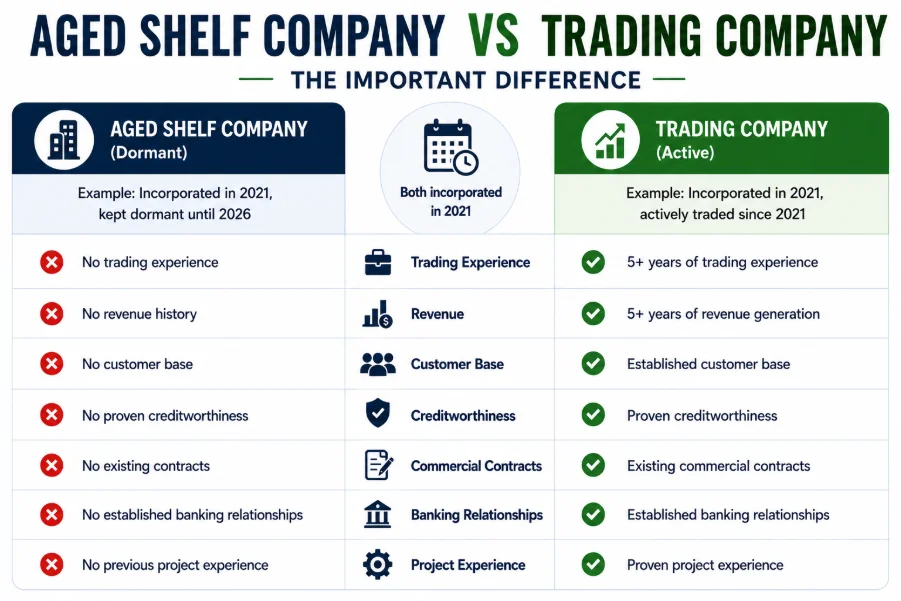
One of the most important distinctions buyers need to understand is the difference between corporate age and trading history. Imagine two companies were both incorporated in 2021. Company A was incorporated and maintained as a dormant shelf company until 2026.
Company B has actively traded since 2021, employing staff, generating revenue and serving customers.
Although both companies have existed legally for five years, their commercial histories are completely different. An aged dormant company does not automatically come with
- Five years of trading experience
- Five years of revenue
- An established customer base
- Proven creditworthiness
- Existing commercial contracts
- Established banking relationships
- Previous project experience
This distinction is essential when presenting the business to banks, customers, suppliers, investors or procurement teams. An older incorporation date should never be represented as trading experience that did not actually occur.
Why Do Businesses Buy Aged Shelf Companies?
Despite these limitations, aged companies can serve legitimate commercial purposes.
-
An Earlier Incorporation Date
The most obvious characteristic is that the company already has an established incorporation date. For example, instead of launching with a company incorporated in 2026, a business might acquire an entity originally registered several years earlier. The earlier date becomes part of the company’s corporate record, although it should not be used to imply previous trading activity.
-
Immediate Access to an Existing Legal Entity
In some circumstances, a business needs an existing corporate entity quickly. This could arise when
- Entering a new jurisdiction
- Negotiating a commercial transaction
- Establishing an overseas subsidiary
- Restructuring a corporate group
- Responding to a time-sensitive opportunity
An aged shelf company already exists, meaning the process centres on transferring and updating the entity rather than creating it from scratch. However, existing does not necessarily mean immediately ready to trade. Banking, tax registrations, licensing, insurance and compliance may still need to be arranged.
-
International Expansion
International expansion is one of the more practical use cases for ready-made companies. An overseas organisation may need a legal entity in another country to support its expansion plans. Purchasing a suitable shelf company can provide an existing corporate vehicle that can then be configured for the new operation. Local legal, tax, substance and regulatory requirements should always be assessed before selecting the jurisdiction.
-
Corporate Restructuring
Established business groups sometimes require additional legal entities for subsidiaries, new divisions, acquisitions or restructuring. In these situations, the appeal may be administrative convenience rather than perceived credibility.
What an Aged Shelf Company Does NOT Give You
This is where buyers need to be particularly careful. The word “aged” can create expectations that the company has accumulated commercial advantages simply by existing. That is not necessarily true.
-
It Does Not Automatically Give You Business Credit
An earlier incorporation date alone does not create a strong business credit profile. Banks, lenders and suppliers may consider numerous factors, including financial statements, revenue, payment behaviour, ownership, business activities and risk.
-
It Does Not Guarantee a Bank Account
Purchasing an aged company does not mean a bank must approve your business account. Banks conduct their own onboarding, KYC and risk assessments. They may examine the directors, beneficial owners, source of funds, expected transactions, business model and jurisdictions involved.
-
It Does Not Create Trading History
A five-year-old dormant company has five years of corporate existence, not five years of active trading. That distinction should remain clear in marketing, applications and commercial negotiations.
-
It Does Not Guarantee Tender Eligibility
Some buyers believe an aged company can help meet requirements for contracts or tenders. If a tender asks for proven project experience, turnover, references or several years of trading accounts, an aged dormant company will not automatically meet those requirements.
-
It Does Not Guarantee Investment
Investors generally examine far more than incorporation date. Ownership, financial performance, intellectual property, liabilities, governance and the quality of the business itself are likely to matter substantially more.
What Should You Check Before Buying an Aged Shelf Company?
The older the entity, the more important it becomes to understand what has happened during its lifetime.
Companies House or Corporate Registry Records
For a UK company, examine its Companies House record carefully.
Check
- Incorporation date
- Filing history
- Previous and current officers
- Registered office history
- Confirmation statements
- Accounts
- Charges
- Previous company names
- PSC information
The objective is not simply to confirm its age, but to understand its complete corporate record.
Dormant Status
Confirm that the company has genuinely remained dormant. Companies House states that a company is dormant for its purposes when it has had no significant transactions during the relevant financial year. Ask the provider for appropriate evidence supporting the company’s history.
Debts and Liabilities
A buyer should establish that there are no unexpected
- Debts
- Tax liabilities
- Loans
- Charges
- Legal claims
- Employee obligations
- Supplier agreements
- Commercial contracts
This is one reason purchasing from a reputable specialist and obtaining appropriate professional advice matters.
Filing Compliance
Age is not valuable if the company has a poor compliance history. Even dormant UK companies generally need to file annual accounts and confirmation statements with Companies House. Late filings, penalties or unexplained irregularities should therefore be investigated before purchase.
Previous Activity
Ask a simple but crucial question – Has this company ever traded? If the answer is yes, you are no longer assessing the same risk profile as a genuinely dormant shelf company. Any previous commercial activity requires substantially more investigation.
Buying an Aged Shelf Company in the UK – What Changed in 2026?
UK corporate compliance has changed significantly following reforms under the Economic Crime and Corporate Transparency Act. One of the biggest developments affecting company ownership is Companies House identity verification. Mandatory identity verification began on 18 November 2025, with a 12-month transition period for existing directors and PSCs. New directors must verify their identity when being appointed, while PSCs are also subject to verification requirements.
As of 2026, Companies House guidance states that directors and PSCs need to verify their identities and use their personal codes to connect their verified identities with their company roles. For someone acquiring a UK aged shelf company, this means ownership transfer should not be viewed simply as changing names on paperwork. The buyer and provider need to ensure that director, PSC and other relevant Companies House requirements are properly addressed. This makes working with an experienced provider particularly valuable.
How Does the Aged Shelf Company Purchase Process Work?
Although procedures vary by jurisdiction and provider, a typical transaction follows several stages.
Step 1 – Define Your Requirements
Determine the jurisdiction, approximate company age, intended activities and ownership structure you require.
Step 2 – Select a Suitable Company
Review available entities and choose one that aligns with your business requirements rather than simply selecting the oldest company available.
Step 3 – Conduct Due Diligence
Review the company’s corporate record, dormancy, filings and potential liabilities. For older companies, this step is especially important.
Step 4 – Complete KYC and Identity Requirements
The purchaser, directors and beneficial owners may need to complete identification and compliance procedures. For UK companies, relevant Companies House identity-verification requirements must also be considered.
Step 5 – Transfer Ownership and Control
The required corporate documentation is prepared to reflect the new shareholders, directors and PSCs as applicable.
Step 6 – Customise the Company
Depending on your requirements, you may need to update
- Company name
- Registered office
- SIC code
- Share structure
- Contact information
Step 7 – Prepare for Trading
The business may then need banking, Corporation Tax registration, VAT or PAYE registration where applicable, insurance, licences and accounting systems before operations begin.
How Much Does an Aged Shelf Company Cost?
There is no universal price. Aged shelf companies normally cost more than forming a brand-new entity because the provider has maintained the company and its compliance obligations while it remained available for sale.
Pricing can depend on
- Age
- Jurisdiction
- Corporate structure
- Maintenance history
- Included documentation
- Registered office services
- Transfer support
- Additional professional services
Generally, the older or more specialised the company, the higher the purchase price may be. For comparison, simply incorporating a new UK company directly is relatively straightforward. Therefore, buyers should ask what genuine commercial benefit the aged entity provides before paying a premium. Do not buy an older company solely because “older sounds better.” The additional cost should serve a real business objective.
Aged Shelf Company vs Newly Formed Company
| Factor | Aged Shelf Company | New Company |
| Incorporation date | Earlier | Current |
| Trading history | Usually none if genuinely dormant | None |
| Corporate records | Existing | New |
| Due diligence | Essential | Generally simpler |
| Initial cost | Usually higher | Usually lower |
| Ownership | Transferred | Created for founders |
| Structure | May require changes | Designed from outset |
| Compliance history | Must be reviewed | Starts fresh |
| Best suited to | Specific commercial/expansion needs | Most standard startups |
Neither option is inherently superior. The question is whether the additional characteristics of the aged entity solve an actual business problem.
When Is an Aged Shelf Company Worth Buying?
An aged shelf company may be worth considering when
- You specifically require an existing corporate entity.
- You are expanding internationally.
- An earlier incorporation date serves a legitimate commercial purpose.
- You are establishing a subsidiary or group company.
- Timing is commercially important.
- The entity has a fully documented and clean history.
- The additional cost is justified by your objectives.
In these circumstances, a professionally maintained ready-made company can provide a useful foundation.
When Is a New Company Probably Better?
Forming a new company may make more sense when
- You have no particular need for an older incorporation date.
- Cost is your main concern.
- You want a completely fresh corporate record.
- You need a highly customised share or governance structure.
- You are a straightforward startup.
- The available aged companies do not pass due diligence.
For many ordinary startups, a newly incorporated entity will be perfectly adequate.
Red Flags to Avoid When Buying an Aged Company
Be cautious if a seller claims that an aged shelf company automatically provides
- Guaranteed credit
- Guaranteed bank accounts
- Guaranteed loans or finance
- Guaranteed tender success
- Artificial trading history
- Guaranteed commercial credibility
Also investigate any company with unexplained previous activity, missing filings, outstanding charges, unusual director changes or unclear beneficial ownership. A reputable provider should be transparent about what the company does and does not provide.
Why Buy an Aged Shelf Company Through RMC?
Purchasing an aged company involves more than finding an old incorporation date. The entity needs to be appropriate for your business objectives and supported by clear corporate records. Ready Made Companies Worldwide (RMC) helps businesses access shelf and ready-made companies across multiple jurisdictions while supporting the ownership-transfer process.
Working with a specialist can help you
- Identify an appropriate jurisdiction.
- Review suitable available companies.
- Understand the company’s corporate history.
- Complete ownership changes.
- Update relevant company details.
- Navigate the steps required before beginning operations.
If you already own a suitable dormant entity that you no longer require, RMC also provides a Sell Your Company Here service.
Conclusion
An aged shelf company can be worth buying in 2026, but only when its existing incorporation date and corporate structure provide a genuine commercial advantage. The key is understanding exactly what you are purchasing. An aged dormant company provides an existing legal entity with an earlier incorporation date; it does not automatically provide trading history, creditworthiness, customers, banking facilities or guaranteed access to contracts. For businesses with specific timing, international expansion or corporate-structuring requirements, the right aged company can be valuable.
For an entrepreneur who simply needs a standard legal entity, forming a new company may be cheaper and simpler. Whichever route you choose, conduct proper due diligence, verify the company’s history and consider professional legal, tax and accounting advice before completing the transaction. In 2026’s more transparent compliance environment, a clean and well-documented company is ultimately more valuable than age alone.