

The EU’s Anti-Money Laundering Regulation (EU AMLR) takes full effect on 10 July 2027. For shelf company owners, this means mandatory beneficial ownership verification, full UBO disclosure, detailed source-of-funds documentation, and registration in EU-wide transparency registers. Companies that fail to comply face bank account freezes, blocked transactions, and personal director liability. The time to act is now, not in 2027.
Introduction – Why 2027 Is a Turning Point
The EU has spent three decades layering anti-money laundering directives onto national legal frameworks. The result has been a patchwork of rules with inconsistent enforcement, exploitable gaps, and wildly different KYC compliance standards from one member state to the next. Scandals like the Danske Bank laundering case, in which approximately 200 billion euros in suspicious funds moved through its Estonian branch, and the broader “Global Laundromat” schemes exposed just how badly fragmented oversight had failed. At Ready Made Companies Worldwide, we help businesses navigate these complex regulatory environments with complete transparency and compliance.
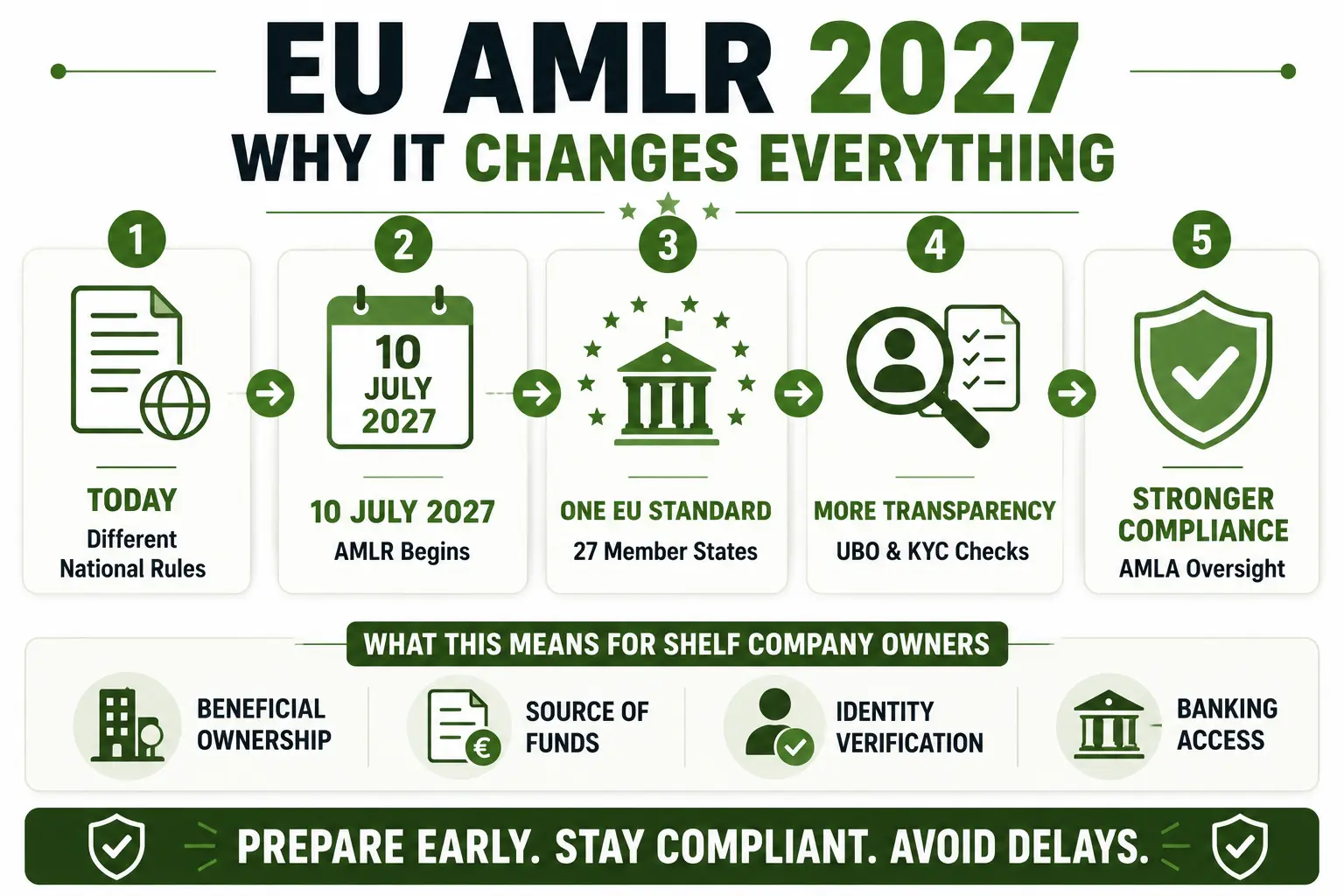
That era ends in 2027.
From 10 July 2027, the EU will apply a single Anti-Money Laundering Regulation (AMLR) across all Member States. This is not another directive to be loosely interpreted at the national level. It is a directly applicable regulation, meaning every provision takes effect uniformly across all 27 member states from the same date, with no room for local carve-outs.
For shelf company owners, this is not a minor administrative adjustment. It is a structural shift in the enforcement of corporate transparency. Whether you own a shelf company in Germany, are buying one in the Netherlands, advise clients across the EU, or manage compliance for a financial institution that handles shelf company clients, the rules are changing in ways that affect you directly.
The window to prepare is open right now. Businesses that act in 2025 and 2026 will face lower compliance costs, fewer documentation gaps, and smoother transactions from day one of enforcement. Those who wait until mid-2027 will face rushed timelines, premium advisory rates, and the real possibility of blocked transactions or banking access issues.
This guide covers everything you need to know what the AMLR is, what it changes, why shelf companies face specific scrutiny, what documentation you need, and how to get ready before the deadline.
What Is the EU AMLR? The Full Picture
From Directives to Direct Regulation
Anti-money laundering legislation is not new to the EU. The first AML directive was published in 1991, and as of 2026, organisations operate under a combination of the Fourth, Fifth, and Sixth AML Directives (AMLD 4, 5, and 6). These directives established shared objectives across member states, but they left enormous discretion to national governments on implementation, supervision, and enforcement.
The practical result was deeply inconsistent. Onboarding rules varied significantly by country. The evidence standards for identity verification differed. The use of digital identification was inconsistent. Cross-border onboarding was slow, complex, and prone to compliance gaps. National supervisors applied different standards and had different tolerances for risk.
The AMLR fixes this by operating as a regulation, not a directive. That distinction is legally fundamental. A directive requires national governments to pass their own implementing legislation, allowing for local variations. A regulation, by contrast, applies directly and uniformly without any national transposition step. From 10 July 2027, the AMLR’s requirements become the law across all 27 EU member states simultaneously.
What the AMLR Standardises
The regulation defines harmonised rules across five core areas. First, customer identification and verification, which is the KYC process for onboarding individuals and entities. Second, business verification and beneficial ownership checks, which covers KYB and UBO identification for corporate clients. Third, politically exposed person (PEP) checks, with clearer definitions and more rigorous screening requirements. Fourth, ongoing monitoring and risk assessment, mandating continuous rather than periodic reviews. Fifth, documentation, audit trails, and record-keeping, with specific retention periods and evidence standards.
Every EU-regulated entity, including banks, payment institutions, fintechs, insurance companies, investment firms, crypto exchanges, and high-value transaction businesses, must align with these standards from the same date.
Meet AMLA – The New Central Enforcer
One of the most significant structural changes accompanying the AMLR is the creation of the Anti-Money Laundering Authority, known as AMLA. This is a central EU-level supervisory body that will work alongside national supervisors to enforce the regulation consistently.
AMLA changes the enforcement dynamic in a meaningful way. Previously, a company operating across multiple EU jurisdictions might face different supervisory standards depending on where its regulator was based. AMLA creates a single enforcement layer above national authorities. Compliance teams will see tighter expectations, fewer opportunities to argue local interpretations, and more pressure for evidence-based, documented controls.
You can read the official AMLR text directly at EUR-Lex under Regulation EU 2024/1624, and monitor AMLA’s guidance at the official AMLA website.
The Shelf Company Problem – Why Regulators Are Watching Closely
Shelf companies, which are pre-incorporated entities held dormant until they are purchased and activated by a new owner, have legitimate uses. A shelf company offers a quick path to a legal entity with an established registration date, which can be valuable for contract eligibility, credit history purposes, or speed-to-market requirements. Many businesses have perfectly legitimate reasons to acquire one.
But regulators view shelf companies with deep suspicion, and for well-documented historical reasons.
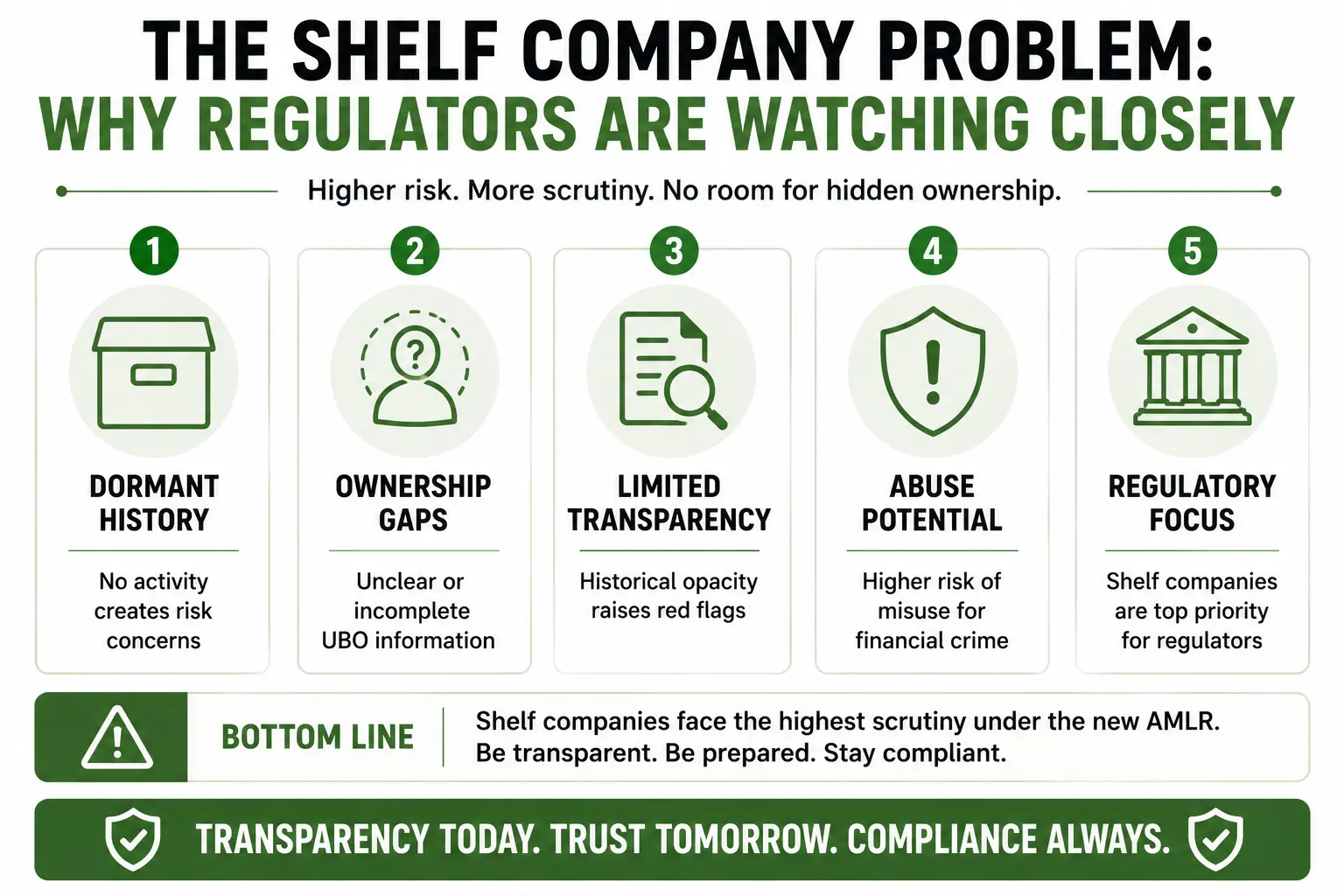
Why Shelf Companies Attract Heightened Scrutiny
Dormancy creates documentation gaps
Years or even decades of inactivity mean that ownership records, source-of-funds trails, and business purpose documentation are frequently missing, incomplete, or unverifiable. A company incorporated in 2010 and purchased in 2024 may have had three different shareholders, none of whom documented their ownership chain in a way that satisfies today’s verification standards.
Opaque ownership chains are common
Multiple historic shareholders, nominee director arrangements, and bearer share structures have historically been features of shelf company packages. Under EU AMLR, every one of these historical arrangements is now a compliance red flag that must be investigated and resolved.
Historical use in concealment schemes
High-profile EU money laundering cases consistently involved inactive or recently reactivated corporate structures. The Moldovan-Russian “Laundromat” schemes, the Azerbaijan Laundromat, and the Danske Bank scandal all used shell or shelf-type companies to move money through the EU financial system. Regulators are acutely aware of this pattern.
Weak ultimate beneficial owner trails
The UBO of a shelf company purchased through an intermediary is often difficult to trace cleanly. When the beneficial owner of the company that sold the shelf company is itself unclear, you have exactly the kind of layered opacity that the AMLR was designed to eliminate.
Inactive status raises red flags
Under risk-based due diligence frameworks, dormant companies with no trading history, no employees, and no visible business purpose score poorly on every risk assessment dimension. Regulated counterparties will automatically apply enhanced due diligence to shelf companies, regardless of the buyer’s personal compliance record.
Under EU AMLR, this profile makes shelf companies high-risk entities by default, subject to enhanced due diligence from the moment they are presented to any regulated institution.
KYC Rules Under EU AMLR – What Is Changing
Today vs. Post-2027 – A Direct Comparison
| Requirement | Pre-AMLR (Current) | Post-AMLR (From July 2027) |
|---|---|---|
| KYC standard | Varies by member state | Uniform across all 27 EU states |
| UBO threshold | 25% ownership trigger, varies nationally | Standardised, consistently applied thresholds |
| Verification method | Often document scan plus self-declaration | Digital identity verification preferred; ETSI 119 461 standard proofing |
| Ongoing monitoring | Periodic, at institutional discretion | Mandatory, risk-based, continuous |
| Enforcement authority | National supervisors with inconsistent standards | AMLA plus national supervisors, uniform expectations |
| Beneficial ownership register | National registers, inconsistent access and data | EU-wide coordination, mandatory registration and updates |
Enhanced Customer Due Diligence Requirements
The AMLR introduces a cleaner, more demanding version of Customer Due Diligence (CDD). For standard customers, CDD is thorough. For high-risk entities such as shelf companies, Enhanced Due Diligence (EDD) applies automatically.
From 10 July 2027, these requirements will apply directly across all Member States, with far fewer national variations than anything seen under previous directives.
For shelf companies specifically, EDD means every historic beneficial owner must be documented and verified, not just the current one. The current UBO must be identified with government-grade assurance, which means verified electronic identity or in-person verification meeting ETSI standards. Source of funds must be traced and explained with documentation, not merely declared. Business purpose must be specific and credible, supported by evidence of actual or intended legitimate activity. Residential addresses and tax identification numbers for all UBOs must be verified against authoritative sources.
Digital Identity Verification Takes Centre Stage
The AMLR is explicitly aligned with Europe’s digital identity architecture. The regulation supports and encourages the use of eIDAS 2 electronic identification, notified national eIDs, Qualified Trust Services, and the European Digital Identity Wallet that is being rolled out across member states.
Under AMLR, electronic identification is the preferred verification method. Traditional document scan and liveness check onboarding is not eliminated, but it becomes a fallback option where electronic ID is unavailable rather than a default approach. ETSI 119 461 identity proofing standards define the technical requirements for both electronic and document-based verification pathways.
What this means practically for shelf company owners is that when a regulated entity is doing their due diligence on your company, they will expect to verify your identity digitally where possible, and the bar for what counts as adequate verification has risen substantially compared to the document self-certification practices many companies relied on previously.
Specific KYC Documentation Requirements for Shelf Company Owners
If you own or are acquiring a shelf company, the following documentation framework reflects what regulated EU counterparties will require before engaging in any significant transaction. Getting this documentation in order now, rather than under time pressure in 2027, gives you control over the process, reduces costs, and prevents transaction delays.
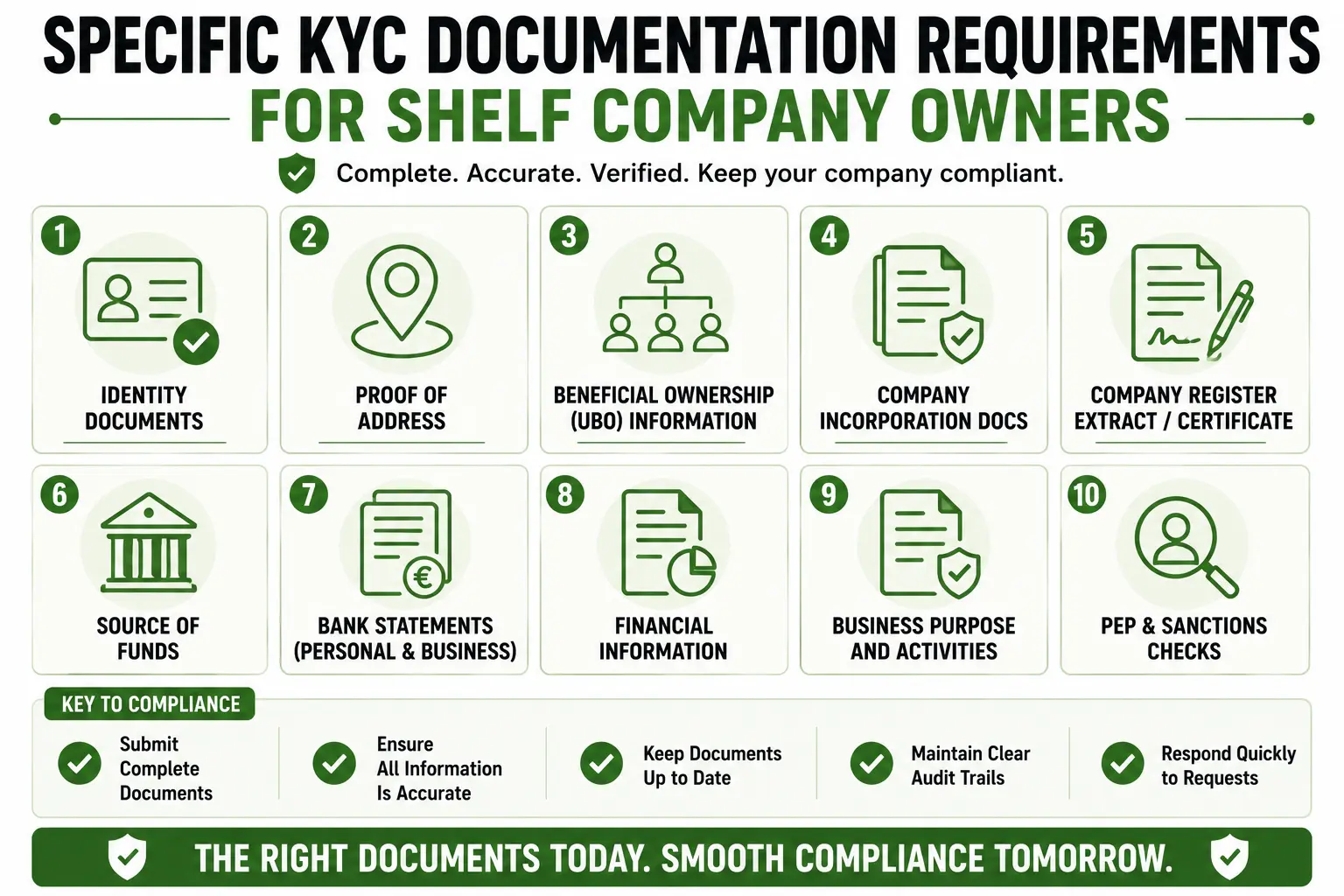
Beneficial Ownership Documentation
The most important and often most challenging documentation requirement concerns ownership history and UBO identification. You will need a complete and verifiable ownership history going back at least five years, with the full chain from incorporation being strongly preferable. For each beneficial owner in the chain, you need verified identification documents meeting current standards, a confirmed residential address with proof, tax identification numbers, and a signed beneficial ownership declaration supported by evidence.
If the company has passed through multiple hands, each transfer must be traceable and documented. Gaps in the chain are not acceptable under AMLR. Where records are genuinely missing due to the age of the company, working with a compliance specialist early gives you the best chance of reconstructing or certifying the history in a legally defensible way.
Company Legitimacy Documentation
Beyond ownership, regulated entities will scrutinise the company itself. A specific, credible, and documented business purpose statement is required. Vague statements such as “general trading” are insufficient. You need to show what the company does or intends to do, supported by contracts, agreements, business plans, or operating records where available.
Source of funds documentation covers where the money in or associated with the company came from. For a dormant shelf company this may seem abstract, but for any capitalisation event, acquisition transaction, or initial account opening, the source of those funds must be traced and documented. Bank statements, corporate accounts, investment records, and transaction histories all form part of this picture.
Ongoing Compliance Obligations
AMLR compliance is not a one-time documentation exercise. Once your company is through the initial verification process, you have continuing obligations. Beneficial ownership must be reviewed and updated annually, or immediately upon any change. Transaction monitoring procedures must be in place and documented. Suspicious activity reporting mechanisms must function properly. All documentation must be retained for a minimum of five years, with some obligations extending longer depending on the nature of the records.
For shelf company owners who are new to running an EU-regulated entity, these ongoing obligations represent a meaningful operational commitment. Building the systems and processes now, rather than retrofitting them after a compliance issue arises, is the practical and cost-effective approach.
The Beneficial Ownership Transparency Register
One of the structural pillars of the EU AMLR package is the move toward a coordinated, EU-wide beneficial ownership register framework. This goes beyond what previous directives required and creates new obligations for shelf company owners specifically.
What the Register Means
National beneficial ownership registers, which most EU member states already operate to varying standards, will be harmonised and increasingly interconnected under AMLR. Every entity within the regulation’s scope must register its ultimate beneficial owners, keep that information current, and ensure it is accessible to competent authorities on demand.
For shelf companies, mandatory registration is not optional. Failure to register, failure to update following an ownership change, or providing inaccurate information in the register are all independent compliance violations, each carrying their own penalty exposure, separate from any transaction-specific compliance failures.
The type of information collected includes the UBO’s full name, date of birth, residential country, nationality, and the nature and extent of their beneficial interest in the company. Some jurisdictions also collect residential address details in the register, though public access to certain fields has been restricted following the 2022 CJEU ruling in the Sovim case.
Public vs. Authority Access
The Sovim judgment pulled back on fully public beneficial ownership registers, finding that unrestricted public access violated fundamental rights to privacy in certain circumstances. However, for shelf company compliance purposes, the critical point is that competent authority access remains broad, unrestricted, and enforceable. Any AML supervisor, law enforcement body, financial intelligence unit, or regulated entity with a legitimate AML reason can access your beneficial ownership information.
Owners who are concerned about privacy should engage legal counsel to understand the specific access rules in their jurisdiction and to structure their compliance approach appropriately. Privacy concerns do not justify non-registration or inaccurate registration.
Country-Specific Register Timelines
While the AMLR provides the overarching framework, individual member states are at different stages of implementing compliant registers. Germany’s Transparenzregister is one of the most developed in the EU. The Netherlands has a mature UBO register that has been operational since 2020. France overhauled its beneficial ownership framework following the Fifth AML Directive. Smaller member states may have more limited infrastructure and will be adapting their systems to meet the 2027 requirements.
Engaging a local jurisdiction expert is important here. The specific fields, access procedures, and update mechanisms vary, and getting registered correctly in your specific member state requires knowledge of the local system, not just the EU-level rules. If you are operating or acquiring an entity here, review our full guide on German shelf companies and registration requirements
Real-World Impact – Three Scenarios in Practice
Scenario 1 – The Existing Shelf Company Owner
Consider a German entrepreneur who owns a shelf company incorporated in 2017, originally purchased for a business idea that never materialised. The company has been dormant for seven years. Now, in 2026, the owner wants to activate it for a new venture.
Even without AMLR, this company would face scrutiny when attempting to open a business bank account or sign contracts with regulated counterparties. With AMLR taking full effect in July 2027, the scrutiny becomes systematised and non-negotiable.
The bank, the payment processor, and any regulated business partner will run enhanced due diligence on the company. They will ask for the full ownership history since 2017, verified UBO identification for the current owner, source of funds for any initial capital, a credible and specific business purpose, and ongoing monitoring commitments. If the company cannot provide this documentation quickly, the bank will likely decline the account application. Transactions will be blocked.
An owner who starts the documentation process now, works with a compliance advisor to reconstruct the 2017 ownership records, and gets UBO verification completed before 2027 will sail through these checks. One who waits until the account application is declined has a much harder, more expensive, and more time-consuming problem.
Scenario 2 – Buying a Shelf Company After July 2027
A buyer in the Netherlands acquires a shelf company through an intermediary in early 2027, just before the AMLR deadline. Under the new regulation, the selling intermediary must provide complete ownership audit trail documentation as part of the sale. The buyer inherits the compliance profile of the company they purchase.
If the seller cannot demonstrate a clean ownership chain, verified UBOs for all previous owners, and accurate register information, the buyer acquires not just the company but its compliance liabilities. Any gaps become the buyer’s problem to resolve before the company can operate normally.
Before completing any shelf company acquisition post-2027, buyers need to conduct enhanced seller due diligence covering the complete ownership history and UBO chain, confirmation of beneficial ownership register entries and accuracy, any previous suspicious activity flags or regulatory inquiries, the source of funds for the company’s historical capitalisation, and a clear business purpose that is compatible with the buyer’s intended use.
Cutting due diligence corners on a shelf company acquisition in the AMLR era is a serious risk. The cost of proper pre-acquisition due diligence is trivial compared to the cost of inheriting an unresolvable compliance problem.
Scenario 3 – Advisors and Intermediaries Handling Shelf Companies
Corporate service providers, lawyers, accountants, and intermediaries who facilitate shelf company transactions fall directly within the AMLR’s scope as obliged entities. This is not an indirect or peripheral impact. They are subject to the same KYC compliance, CDD, and ongoing monitoring obligations as financial institutions when they act in the capacity of helping to establish, sell, or manage corporate structures.
This means advisors must conduct thorough due diligence on their own clients before facilitating shelf company transactions. They cannot simply pass through documentation provided by the buyer or seller without independently verifying it. They face personal professional liability for inadequate client documentation. Staff training is required. Systems must be updated. Audit trails must be maintained.
The liability exposure for advisors who facilitate transactions involving non-compliant shelf companies under AMLR is substantial and includes professional sanctions, regulatory fines, and in serious cases, personal criminal liability.
Case Study – What Happens Without Beneficial Ownership Controls
The Danske Bank scandal is the most instructive case study available for understanding what AMLR is designed to prevent and why shelf companies are in the regulatory crosshairs.
Between 2007 and 2015, Danske Bank’s Estonian branch processed approximately 200 billion euros in suspicious transactions, many of which involved non-resident customers using shell and shelf-type corporate structures. The Estonian branch operated with minimal oversight, weak beneficial ownership checks, and inadequate source-of-funds verification. The corporate structures used by suspicious clients often had incomplete or falsified ownership documentation, nominee directors, and untraceable UBO chains.
The consequences were severe. Danske Bank paid billions in fines and settlements across multiple jurisdictions. Its Estonian branch was closed. Senior executives faced personal criminal charges. The bank’s reputation suffered lasting damage.
The regulatory response to this and similar scandals directly shaped the AMLR. The specific requirements for shelf company documentation, the standardisation of UBO verification, the creation of AMLA as a central enforcement authority, and the push for EU-wide beneficial ownership registers all trace their origins to cases like Danske Bank.
Shelf company owners who understand this history understand why regulators are not treating these requirements as optional guidelines. They are structural interventions designed to close exactly the gaps that made large-scale laundering possible.
Compliance Timeline – A Practical Action Plan
| Period | Priority Actions |
|---|---|
| Now through Late 2026 | Audit all beneficial ownership documentation; identify gaps; engage compliance advisor; begin UBO verification |
| Late 2026 | Complete UBO verification; prepare for beneficial ownership register registration; implement monitoring systems |
| Q1 2027 | Final documentation review; confirm register entries are accurate and current; complete all outstanding verifications |
| July 2027 onwards | Full AMLR compliance live; ongoing UBO updates as required; annual compliance reviews; suspicious activity reporting procedures operational |
Starting in 2025 or early 2026 is significantly better than waiting. Compliance advisors will be overwhelmed with last-minute requests in the months before July 2027. Verification services will be backlogged. Beneficial ownership register processes in several member states are still being refined and may have processing delays. Early movers avoid all of these problems and typically pay lower advisory rates before peak demand sets in.
Member State Variations – What You Need to Know by Jurisdiction
The AMLR applies uniformly, but implementation infrastructure, enforcement culture, and supervisory timelines vary meaningfully by member state. Understanding where your company is incorporated or where you operate determines the practical experience of compliance.
- Germany operates one of the EU’s most developed transparency registers, the Transparenzregister, which has been through several legislative rounds of strengthening. German financial supervisors and banks are already among the most demanding in the EU for UBO documentation. If you are operating or acquiring an entity here, review our full guide on German shelf companies and registration requirements. Expect rigorous, well-resourced enforcement from day one of AMLR.
- The Netherlands has had a mandatory UBO register in place since 2020 under the implementation of AMLD 5. Dutch banks and financial institutions are experienced with beneficial ownership documentation requirements and will likely be among the first to implement AMLR standards fully. Advisors operating in the Netherlands are already preparing clients for the upgrade.
- France significantly tightened its AML framework following the Fifth AML Directive and has an active financial intelligence unit, Tracfin, that has increased its supervision of corporate structures in recent years. AMLR will build on this existing infrastructure rather than requiring a complete rebuild.
- Denmark occupies a particularly significant position given that the Danske Bank scandal originated there. Post-scandal reform has been extensive, and Danish supervisors have strong political and institutional motivation to demonstrate rigorous enforcement of the new regulation.
- Smaller member states vary more widely. Some have limited supervisory infrastructure and are still building the systems needed to support AMLR. This does not create compliance exemptions, but it may mean that enforcement ramp-up is slower in certain jurisdictions in the early months of implementation. Companies should not count on this as a delay strategy.
The practical guidance is straightforward engage both a general EU compliance advisor who understands the regulation at the framework level, and a local jurisdiction expert who knows the specific implementation, register procedures, and supervisory expectations in your member state.
The Real Costs of Compliance and Non-Compliance
Understanding the financial picture on both sides is essential for planning.
Direct Compliance Costs
| Cost Category | Estimated Range |
|---|---|
| Compliance advisory fees | 2,000 to 15,000 euros depending on complexity and documentation gaps |
| Third-party UBO verification services | 500 to 3,000 euros per entity |
| Digital identity verification tools | 200 to 2,000 euros per year |
| Beneficial ownership register filing costs | 50 to 500 euros per filing, varying by jurisdiction |
| Legal counsel for privacy and structure review | 1,000 to 10,000 euros for complex situations |
These figures are indicative. Companies with clean, well-documented ownership histories will be at the lower end. Shelf companies with fragmented historical records, multiple past owners, or cross-border ownership chains will be at the higher end. Leaving gaps unresolved until 2027 typically pushes costs significantly upward.
The Cost Multiplication Effect of Waiting
Early compliance is not just about meeting a deadline. It is about controlling costs. Compliance advisory firms will charge significant premium rates in the six months leading up to July 2027 as demand spikes. Verification service providers will have longer wait times. Beneficial ownership register queues in some member states may extend for weeks. A company that completes verification in 2026 pays standard rates and gets its results in days. The same company attempting the same process in May 2027 may pay twice as much and wait three times as long.
Non-Compliance Consequences
The penalties for non-compliance with AMLR are structured to escalate with the severity and persistence of the violation. Administrative fines for obliged entities can reach significant percentages of annual turnover in serious cases, with the most severe penalties potentially reaching millions of euros. For individuals, specifically company directors, personal fines and in cases of wilful or grossly negligent non-compliance, personal criminal liability are explicitly within the scope of enforcement.
Beyond direct financial penalties, the operational consequences of non-compliance are often more immediately damaging. Regulated institutions must restrict or close the accounts of non-compliant entities. This means a shelf company owner who cannot demonstrate AMLR-compliant beneficial ownership documentation simply cannot maintain a business bank account in the EU. Transaction counterparties cannot legally proceed with transactions involving non-compliant entities. The practical effect is that the company cannot operate at all.
Personal liability for directors is a critical point that many shelf company owners underestimate. Under AMLR, directors of obliged entities who fail to implement adequate compliance procedures are personally exposed, not just the company. This applies particularly to advisors and intermediaries who facilitate transactions involving non-compliant corporate structures.
Addressing Common Concerns from Shelf Company Owners
“Does this mean my shelf company will be seized?”
The AMLR does not create automatic asset seizure powers. However, a shelf company that cannot demonstrate compliance will be effectively frozen out of the EU financial system. No banking. No transactions. No regulated counterparties. The practical effect is indistinguishable from seizure in terms of the company’s ability to function.
“Will my privacy be compromised?”
Beneficial ownership information is accessible to competent authorities regardless of your privacy preferences. Public access to certain register fields has been restricted following the Sovim CJEU ruling, which found that unrestricted public access violated fundamental rights in certain cases. However, regulatory and supervisory access is unlimited. Work with qualified legal counsel to understand what information is public in your specific member state and to structure your compliance approach within the legal framework.
“What if I cannot find old documentation?”
This is the most common practical problem with shelf companies, and it is solvable, but it requires starting early. Compliance specialists are experienced with approaches to reconstructing or certifying historical ownership records within legally acceptable frameworks. The earlier you engage, the more options you have. Waiting until a transaction is blocked by a documentation gap is the worst possible time to start this process.
“Will this make shelf companies obsolete?”
Shelf companies with clean, documented, and compliant ownership histories will become more valuable under AMLR, not less. The compliance burden serves as a natural filter, reducing the supply of compliant shelf companies while doing nothing to reduce legitimate demand for them. A fully compliant shelf company with a verified UBO chain and clean register history is a premium product in a post-AMLR market.
“What about my non-EU buyers?”
Non-EU companies doing business in the EU and non-EU buyers of EU shelf companies are not exempt from AMLR requirements. The regulation captures entities based on their EU activity, not their place of incorporation. International buyers who think their non-EU status creates a compliance exemption are mistaken and need to seek qualified advice urgently.
The Strategic Upside – Why Compliance Is a Competitive Advantage
A fully compliant shelf company is not just a regulatory obligation met. In the post-AMLR market, it is a genuine commercial differentiator.
Regulated buyers, financial institutions, private equity firms, and international businesses operating in the EU all need counterparties they can onboard quickly and transact with cleanly. A shelf company with complete ownership history, verified UBOs, accurate register entries, and documented business purpose moves through due diligence rapidly. One with gaps causes delays, additional cost, and sometimes outright rejection.
Sellers with compliant shelf companies will access a larger buyer pool, including regulated entities that simply cannot acquire non-compliant companies. They will complete transactions faster, face fewer negotiation complications around documentation, and in many cases achieve better valuations because the compliance profile of the asset is part of its value.
Buyers who conduct proper pre-acquisition due diligence and acquire compliant companies avoid the substantial risk of inheriting unresolvable compliance problems. They can open banking relationships immediately, engage with regulated counterparties from day one, and build their operations on a clean compliance foundation.
The AMLR creates real friction for companies that treat beneficial ownership transparency as optional. For those who treat it as a foundation, it creates a structural advantage in the EU market.
Conclusion
The EU AMLR takes effect on 10 July 2027 and represents the most significant structural change to EU anti-money laundering compliance in decades. For shelf company owners, the implications are specific and urgent.
Shelf companies face enhanced scrutiny by default under the new regime, and the documentation requirements for beneficial ownership, source of funds, and business purpose are more demanding than anything previously required at the EU level. The creation of AMLA as a central enforcement authority means there is no longer a weak link in the supervisory chain that can be relied upon.
Sellers with compliant shelf companies will access a larger buyer pool, including regulated entities that simply cannot acquire non-compliant companies. They will complete transactions faster, face fewer negotiation complications around documentation, and in many cases achieve better valuations because the compliance profile of the asset is part of it. Before proceeding with your entity structure, review your compliance strategy and contact our compliance team to ensure your shelf company meets all upcoming EU requirements on a solid foundation.