

Entrepreneurs and investors increasingly turn to shelf companies as a shortcut to immediate business ownership. Unlike forming a new company, which can take weeks or even months, purchasing a shelf company puts you in control of an established legal entity within days. But here’s the critical part buying a shelf company isn’t like purchasing a product off the shelf. Ownership must be legally transferred from the provider to you. This transfer process involves specific documentation, registry updates, and compliance steps that transform you from buyer to legitimate owner.
This comprehensive guide breaks down exactly what happens during a shelf company ownership transfer, from selecting the right company to final compliance updates. Whether you’re launching a startup, bidding on contracts that require company age, securing financing, or establishing credibility quickly, understanding this process protects your investment and ensures a smooth, legally sound transition.
What Is a Shelf Company?
A shelf company (also called a ready-made or aged company) is a legally incorporated business that has been pre-registered but never traded. It remains dormant until purchased and activated.
Think of it as a dormant legal entity sitting “on the shelf,” waiting for someone to purchase it and begin operations. The company already exists with its own registration number, certificate of incorporation, and constitutional documents, giving the buyer an immediate head start.
Key Characteristics of a Shelf Company
- Legally incorporated with Companies House (UK) or equivalent registry in other jurisdictions
- Zero trading activity or commercial transactions throughout its life
- Maintained compliance records with all annual filings, kept current
- Clean history with no debts, liabilities, legal issues, or disputes
- Established incorporation date that can be months or even years old
Shelf companies are particularly valuable when businesses need to demonstrate longevity or meet minimum age requirements for contracts, licenses, tenders, or financing applications. An older incorporation date can signal stability to banks, clients, and regulators.
Why Entrepreneurs Buy Shelf Companies Instead of Forming New Ones
Entrepreneurs and investors choose shelf companies for several compelling reasons
- Speed – Gain immediate ownership and a legal entity instead of waiting weeks for incorporation and setup.
- Credibility – Older incorporation dates often suggest established stability, which helps when bidding on contracts or approaching lenders.
- Opportunity – Meet strict age or existence requirements for government tenders, supplier onboarding, or licensing instantly.
- Banking Advantages – Some traditional banks show a preference for entities with a trading history (even if dormant), making account opening potentially smoother.
In fast-paced markets, these advantages can mean the difference between winning a contract and missing out entirely.
Why Ownership Transfer Is Required
Here’s a fundamental truth – every shelf company starts under someone else’s ownership. Formation agents or corporate service providers initially register these companies using nominee shareholders and directors. The company legally belongs to them until the transfer process is fully completed.
When you purchase a shelf company, three critical things must happen to make the transfer legitimate
- Share ownership must transfer from the provider (or nominee) to you (or your nominated entities).
- Director control must transfer to the individuals you appoint.
- All legal records, both internal and at the corporate registry, must be updated to reflect your ownership and control.
Without proper transfer documentation and registry filings, the provider technically remains the legal shareholder and controller even if you have paid in full. This means you cannot make binding decisions, open bank accounts in the company’s name, sign contracts, or prove ownership to third parties. The ownership transfer process exists precisely to establish you as the company’s legal controller and beneficial owner in full compliance with corporate law.
Key Steps in a Shelf Company Ownership Transfer
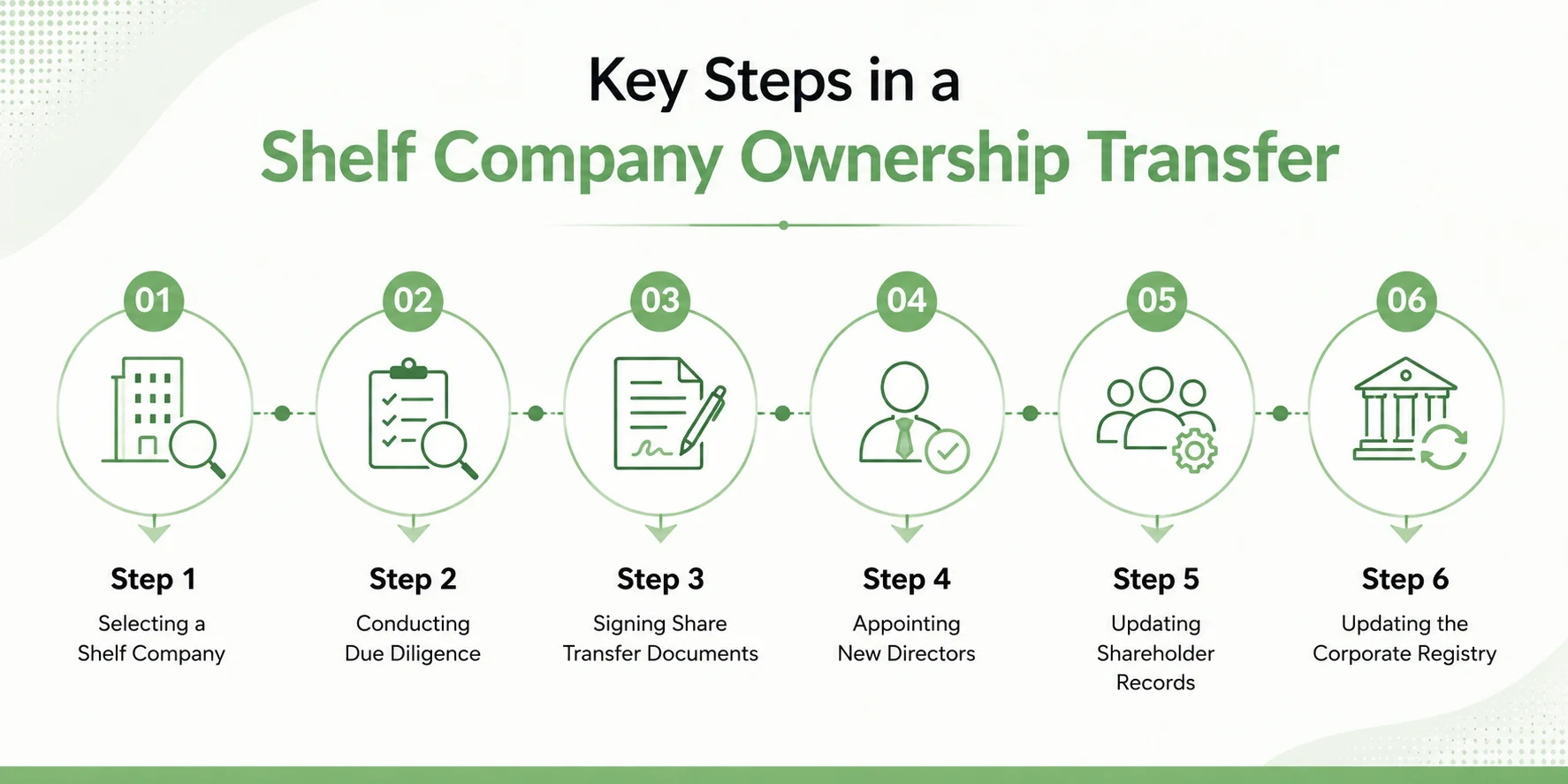
The transfer process follows a structured, sequential approach. Each stage builds on the previous one to ensure legal validity and compliance.
Step 1 – Selecting a Shelf Company
Selection should align with your specific business goals, industry, and operational needs.
Jurisdiction Considerations
- UK companies (incorporated with Companies House) are ideal for UK or European operations due to familiarity and straightforward compliance.
- Delaware companies suit US-focused operations or businesses seeking investor-friendly structures.
- Offshore jurisdictions (such as BVI, Cyprus, or Seychelles) may be chosen for international structures, tax planning, or privacy features.
Age Requirements
- Newly formed shelf companies (0-6 months old) work well for basic needs where speed is the priority.
- Aged companies (1-5+ years old) provide greater credibility for contract bidding, licensing, or building trust with partners.
Compliance Status Verification
Verify that the company has current filings with the registry, good standing certificates are available, and there are no outstanding penalties or strike-off risks. Pecunia Mlex notes that jurisdictional requirements vary significantly — UK transfers differ notably from those in Cyprus or the BVI.
Step 2 – Conducting Due Diligence
Never skip due diligence. This critical step protects you from purchasing a company with hidden problems that could surface later as costly liabilities.
Essential checks include
- Verify dormant status with zero transactions or trading activity.
- Review the complete filing history at Companies House or equivalent registry.
- Confirm no prior trading activity that might trigger tax obligations.
- Check for any outstanding debts, liabilities, or unpaid fees.
- Verify that nominee directors have resigned properly with no lingering issues.
- Ensure there are no legal proceedings, judgments, or disputes against the company.
Red flags to watch for
- Gaps in annual filings or confirmation statements.
- Previous director resignations without clear explanations.
- Registry warnings, compliance notices, or “active but non-compliant” status.
- Unclear or convoluted ownership history.
Reputable providers supply full company history documentation upfront. If anything appears incomplete or evasive, it is best to walk away and consider another option.
Step 3 – Signing Share Transfer Documents
This stage marks the legal moment when ownership changes hands. The share transfer process typically involves two key documents
- Share Transfer Form (Stock Transfer Form) – This lists the number of shares being transferred, states the purchase consideration (price paid), and must be signed by both the transferor (seller/provider) and transferee (buyer). Stamp duty may apply depending on the jurisdiction and value.
- Board Resolution approving the transfer – This authorizes updates to the share register and formally confirms acceptance of the new shareholder.
According to Corporates, this documentation creates a clear, auditable trail that proves ownership legitimacy — essential for banking, regulatory compliance, and future audits or sales.
Step 4 – Appointing New Directors
Every company needs directors to make legal decisions and represent the entity. The director appointment process usually follows these steps
- Previous nominee directors resign (if applicable).
- You appoint new directors through a Board Resolution.
- New directors formally accept the appointment in writing.
- The corporate registry receives official notification of the changes.
Once appointed, directors assume responsibilities such as signing authority for contracts and banking, ensuring ongoing compliance with company law, filing annual accounts and confirmations, and maintaining statutory registers. Most buyers appoint themselves or trusted associates as directors immediately after the purchase to gain full operational control.
Step 5 – Updating Shareholder Records
Internal company registers must accurately reflect the new ownership structure.
Required updates include
- Register of Members (Shareholders) – Remove previous shareholders, add new ones with exact share quantities, record the transfer date, and update beneficial ownership information.
- Register of Directors – Remove resigned directors and add newly appointed ones, including their addresses and appointment dates.
- Persons of Significant Control (PSC) Register (UK companies) – List any individuals owning more than 25% of shares or voting rights, record the nature of their control, and update within 14 days of the transfer.
These registers remain with the company and must be available for inspection by authorized parties.
Step 6 – Updating the Corporate Registry
Final ownership is not officially recognized until the relevant corporate registry is informed. For UK companies registered with Companies House, typical filings include
- Form CS01 or updates via confirmation statement for share capital changes.
- Form AP01 for appointment of directors.
- Form TM01 for the termination of directors.
- Form PSC01/04 for notifications regarding persons with significant control.
Filing deadlines are strict – director and PSC changes generally must be made within 14 days; share transfers are reported in the next confirmation statement. Professional providers usually handle these filings as part of the service to avoid errors or delays.
Non-compliance can lead to late filing penalties (£150–£1,500+), risk of the company being struck off the register, or even director disqualification proceedings.
Key Documents Involved in the Transfer
Understanding the required documentation ensures you receive everything needed for legitimate ownership and future operations.
Essential Transfer Documents
| Document | Purpose |
|---|---|
| Share Transfer Form | Legally transfers share ownership |
| Board Resolution (Share Transfer) | Approves ownership change |
| Board Resolution (Directors) | Appoints or removes directors |
| Register of Members Update | Internal shareholder record |
| Register of Directors Update | Internal director record |
| Certificate of Incorporation | Proves company legal existence |
| Articles of Association | Company constitutional rules |
| Good Standing Certificate | Confirms current compliance status |
Additional Documentation Often Included
- Memorandum of Association
- Share certificates issued to new shareholders
- Director consent to act forms
- PSC register updates
- Registry filing receipts and confirmations
Document Verification Checklist
- All documents were properly signed, dated, and witnessed where required
- The company registration number matches consistently across all papers
- Director and shareholder names are spelled consistently
- Share quantities and classes are accurate
- Registry stamps or seals appear where legally required
These documents provide legal proof of ownership. Store originals and certified copies securely — you will need them for banking, contracts, audits, and any future sale of the company.
How Long Does the Transfer Process Take
Speed remains one of the biggest advantages of buying shelf companies. Typical transfer timelines include
- Document preparation – 2-6 hours
- Share transfer execution – Same day
- Director appointments – Same day
- Registry filing – 1-3 business days
- Registry confirmation – 3-7 business days
In the fastest scenarios, core documentation can be completed in 24 hours, with full legal transfer (including registry updates) within 48-72 hours. Factors that speed up the process include electronic filing systems, simple single-shareholder structures, and experienced providers with ready templates. Slower cases often involve multiple shareholders, international buyers needing notarization, or registry backlogs during peak periods.
Compare this to new company formation timelines – UK (24 hours to 2 weeks), US Delaware (1-2 weeks), UAE (2-4 weeks), or Singapore (2-3 weeks). For time-sensitive opportunities such as contract bids, licensing applications, or urgent banking needs, shelf companies deliver immediate solutions that new formations simply cannot match.
Compliance and Regulatory Updates After Transfer
Ownership transfer is not truly complete until all regulatory records reflect the changes. Mandatory steps include filing director appointment or resignation notifications, share transfer confirmations, PSC change notifications, and updating the registered office address if necessary. Most jurisdictions require these filings within 14 days of the change.
For UK companies, the Persons of Significant Control (PSC) register is especially important. You must list individuals who own more than 25% of shares, hold more than 25% voting rights, can appoint or remove the majority of directors, or exercise significant influence or control. Updates to the PSC register and related forms (PSC01/04) must reach Companies House within 14 days.
Companies also file annual confirmation statements that verify the registered office, directors, shareholders, PSC details, and share capital. These are due within 14 days of the statement date (usually the anniversary of incorporation or previous filing).
Why does compliance matter? It maintains good standing for banking and contracts, avoids escalating penalties, prevents involuntary strike-off, and protects directors from personal liability. Late filing penalties start at £150 (up to 1 month late) and can reach £1,500 or more (over 6 months late), with repeated violations risking director disqualification. Recent Companies House reforms also emphasize identity verification for directors and PSCs, adding another layer of compliance to manage carefully.
Banking and Operational Setup After Transfer
Once the legal ownership transfer is complete, you can activate the company for real business activities.
Opening a Business Bank Account
Banks typically require the Certificate of Incorporation, Articles of Association, share certificates proving your ownership, proof of registered office, director identification (passport/ID), proof of address (utility bill), and a board resolution authorizing the account. Shelf companies sometimes undergo enhanced due diligence, but older entities can have an advantage with traditional banks. Prepare a clear business plan and explanation of ownership structure. Timeline – usually 1-4 weeks, depending on the bank and jurisdiction.
Tax Registration
In the UK, register for Corporation Tax within 3 months of starting trading, VAT if turnover exceeds the threshold, and PAYE if you will employ staff. In the US, apply for an EIN, handle state tax registrations, and obtain sales tax permits where applicable.
Accounting Systems Setup
Start bookkeeping immediately using reliable software such as QuickBooks, Xero, or FreeAgent. Set up your chart of accounts, invoice systems, and engage a bookkeeper or accountant for ongoing support.
Insurance and Licenses
Secure appropriate coverage, including professional indemnity, public liability, and any industry-specific permits. Register for data protection if you process personal information. The major advantage of a shelf company is that while banking and licensing still take time, you begin these processes with an already-incorporated entity, giving you a head start of several weeks compared to forming a new company from scratch.
Risks to Avoid During a Shelf Company Transfer
Not every transfer goes smoothly. Being aware of common pitfalls helps protect your investment.
Buying from Unreliable Providers
Warning signs include lack of a verifiable business address, reluctance to share documentation before payment, prices far below market rates, high-pressure sales tactics, and poor online reviews. Consequences can range from hidden liabilities to incomplete transfers. Protect yourself by researching the provider thoroughly, checking reviews, and requesting sample documents.
Incomplete Documentation
Missing paperwork leads to rejected bank applications, inability to prove ownership in disputes, and compliance gaps. Always request a complete list upfront and verify originals are provided.
Companies with Hidden Liabilities
Even “dormant” companies can carry unpaid fees, outstanding penalties, or prior registrations with lingering obligations. Conduct deep due diligence, including full registry history, tax clearance checks, and credit reports.
Outdated Registry Filings
Companies with lapsed filings create immediate compliance problems. Check confirmation statement dates, accounts status, and good standing before purchase.
Inadequate Transfer Documentation
Errors such as missing signatures, incorrect share quantities, or inconsistent dates can cause ownership disputes and banking rejections. Consider professional legal review before finalizing the purchase.
Why Choosing the Right Provider Matters
The shelf company provider significantly influences the success of the transfer and the long-term viability of the company. Reputable providers deliver verified dormant companies with genuine zero-trading history, transparent documentation, professionally executed transfers, and full compliance support.
Advantages include legal warranties against hidden liabilities, streamlined processes, post-purchase guidance, and ongoing services such as registered office provision and annual filing management. Evaluation criteria should include years in business (preferably 5+), clear pricing, responsive support, positive reviews, and money-back guarantees.
Key questions to ask before buying
- How long has the company been dormant?
- What full documentation will I receive?
- Are all registry filings completely up to date?
- What warranties and indemnities do you provide?
- Who handles the registry filings?
- What after-sales support is available?
- Are there any outstanding liabilities?
- Can I review the company history before committing?
Corporate law experts note that established providers can reduce transfer risks by a substantial margin compared to informal or unverified sellers.
How RMC Facilitates Shelf Company Ownership Transfers
RMC specializes in supplying fully compliant shelf companies backed by complete ownership transfer support. Services include verified dormant companies with zero trading history, current filings, and good standing; a transparent step-by-step transfer process (pre-purchase verification, professional documentation, coordinated execution, registry updates, and confirmation); comprehensive document packages; expert guidance on registry filings and ongoing compliance; and dedicated assistance with banking applications, including letters of good standing and ownership documentation.
RMC simplifies the experience for entrepreneurs (who can focus on business planning), investors (who gain quick, confident access to established entities), and international buyers (who receive expert help navigating cross-border requirements). The typical RMC timeline runs from same-day selection to complete transfer in 3-5 business days, with transparent pricing and no hidden fees.
Conclusion
Shelf company ownership transfer is a structured legal process that converts a dormant entity into your fully controlled, active business vehicle. Key elements include a clear multi-step sequence, essential documentation that establishes unambiguous ownership, mandatory registry filings, and careful post-transfer operational setup. When executed properly, shelf company transfers deliver speed (legal ownership often within 24-72 hours), transparency through clear documentation, full compliance with updated registry records, and legitimacy as an established entity ready for immediate use. Businesses looking for a ready-made UK entity can explore our UK shelf company services for available options.
The process becomes straightforward when you partner with professional providers who understand registry requirements and corporate law. Critical success factors are thorough due diligence, complete documentation, prompt filings, and working with reputable providers. Shelf companies particularly benefit entrepreneurs needing immediate ownership for time-sensitive contracts, licensing, banking relationships, or credibility through aged incorporation dates. The ownership transfer ultimately transforms a dormant legal shell into a powerful, active business tool under your complete control. If you need assistance selecting or transferring a suitable shelf company, contact us to discuss your requirements.