

Buying a shelf company, sometimes called a ready-made company or aged corporation, can dramatically speed up your international expansion. Instead of waiting weeks for a new registration, you get an entity with an established incorporation date, existing compliance filings, and the ability to open bank accounts faster. But here is the critical issue most buyers overlook: not all shelf companies are equal. The dormant status of the company before you buy it is arguably the single most important compliance factor in the entire purchase.
A shelf company that was not kept properly dormant, even one that recorded a single transaction, issued shares irregularly, or missed a filing, can carry hidden liabilities, banking red flags, and regulatory risks that follow the new owner from day one. This guide explains what dormant status means, why it matters for compliance, what risks emerge when dormancy is compromised, and how to verify a shelf company’s history before you buy.
What Is a Shelf Company? And What Does Dormant Actually Mean?
A shelf company is a legally incorporated business entity that has been registered with the relevant corporate authority but has conducted no business activity. It sits idle ‘on the shelf’ until sold to a buyer who wants immediate access to a registered entity
Dormant – The Legal Definition
In most jurisdictions, a company is considered dormant when it has had no significant accounting transactions during the financial year. In the UK, for example, Companies House defines a dormant company as one that has had no ‘significant accounting transactions’ since incorporation or since it was made dormant.
Significant accounting transactions include
- Sales or purchases of goods and services
- Receiving or paying interest
- Paying employees or directors
- Issuing or transferring shares (beyond initial subscriber shares)
- Opening or using a bank account for business purposes
Shelf Company vs Shell Company – A Key Distinction
These two terms are often confused, but they are legally and practically different
| Feature | Shelf Company | Shell Company |
| Purpose | Held dormant, sold to legitimate buyers | Often created to obscure ownership or move funds |
| Trading History | No transactions genuinely dormant | May have transactions, but no real operations |
| Compliance Intent | Maintained to regulatory standards | Often used to exploit regulatory gaps |
| Legitimate Use? | Yes, when properly verified | Varies frequently and is misused for illicit activity |
| Banking Risk | Low, if a clean history is verified | High triggers enhanced due diligence |
A shelf company becomes a shell company when it remains inactive after purchase or is used purely as a facade to hide transactions and ownership. This distinction is critical for compliance purposes.
Why Dormant Status Is the Foundation of Shelf Company Compliance
When you buy a shelf company, you are not just buying a name and a registration number. You are inheriting its entire history. Every filing, every transaction, every directorship change, all of it transfers to you as the new owner.
This is why dormant status is so fundamental. A perfectly dormant company gives you a blank, clean slate. Any break in dormancy, however minor, contaminates that slate.
What Dormant Status Protects You From
- Hidden tax liabilities from unreported transactions
- Unpaid creditors or contractual obligations
- Regulatory penalties for missed filings
- Banking rejections due to unexplained account activity
- AML (Anti-Money Laundering) scrutiny triggered by suspicious dormancy gaps
- Difficulty verifying beneficial ownership chain to regulators
Think of dormant status as a clean title on a property. Just as you would not buy a house with undisclosed mortgages or legal disputes, you should not buy a shelf company without verifying its entire compliance record.
The Compliance Risks of Poorly Maintained Shelf Companies
The shelf company market is not uniformly regulated. Some providers maintain their companies to the highest standard; others cut corners. Understanding the specific risks of poorly maintained companies helps you ask the right questions before purchasing.
Risk 1 – Hidden Liabilities
Even a single undisclosed transaction, a director’s expense reimbursement, a small vendor payment, can create a tax liability or creditor relationship that survives a company transfer. These obligations do not disappear when ownership changes; they pass to the new owner.
Risk 2 – Banking Rejection
Banks conduct thorough due diligence when opening accounts for newly acquired companies. A shelf company with unexplained historical activity, inconsistent filings, or nominee directors who cannot be verified is a red flag that often results in account rejection, sometimes across multiple financial institutions simultaneously.
Risk 3 – Regulatory Scrutiny and AML Flags
Global regulators, including the Financial Action Task Force (FATF), specifically identify shelf companies as vehicles for potential money laundering and beneficial ownership concealment. The infamous Panama Papers scandal exposed thousands of offshore shell entities used to hide assets and avoid tax authorities. Regulators have since tightened their scrutiny of any company with a gap between the incorporation date and actual operations.
Risk 4 – Incomplete Registry Filings
In many jurisdictions, companies must file annual confirmation statements or annual returns regardless of whether they traded. A shelf company that missed a single annual filing may be listed as ‘overdue’ or even ‘struck off’ in corporate registries, making it legally invalid and commercially unusable.
Risk 5 – Nominee Director Issues
Some shelf company providers use nominee directors, third-party individuals who appear on corporate records but have no real connection to the company. While this is not always illegal, it creates beneficial ownership opacity that triggers Enhanced Due Diligence (EDD) from banks and regulators. As noted by sanctions.io, frequent director changes or the use of corporate secretarial firms as directors may indicate a hidden beneficial owner.
What Proper Dormancy Maintenance Looks Like
A properly maintained shelf company follows a strict protocol throughout its dormant period. Here is what that looks like in practice and what you should verify before purchase
Annual Confirmation Statements or Annual Returns
In the UK, every company, including dormant ones, must file a confirmation statement with Companies House each year. This confirms that the registered details (directors, shareholders, registered address) are accurate and up to date. Gaps in these filings are a serious compliance red flag.
Dormant Company Accounts
Dormant companies must still file annual accounts with the corporate registry. These are simplified accounts that confirm no accounting transactions took place during the year. Look for a continuous, unbroken record of dormant accounts from the date of incorporation to the date of sale.
Registered Address Maintenance
The company must maintain a valid registered address throughout its dormant period. If the registered address changed without a proper filing or if the registered agent at that address cannot confirm the company’s history, this raises serious questions.
Share Capital Record
The initial share structure, subscriber shares, and any subsequent share transfers must be fully documented and consistent with the corporate registry records. Any undocumented share transfer is a significant compliance issue.
Director and Officer Records
All director appointments and resignations must be properly filed. The current directors at the time of sale should be clearly identified and verifiable, with no gaps or unexplained changes in the directorship record.
How Dormant Status Affects Banking Approval
One of the primary reasons entrepreneurs buy shelf companies is for a faster banking setup. An established incorporation date and a clean compliance record can simplify the bank’s due diligence process, but only if the dormant record is truly clean.
What Banks Look For
When a newly acquired shelf company applies to open a business bank account, the bank’s compliance team will review
- Corporate registry filings – are they complete and current?
- Beneficial ownership – Can the ultimate beneficial owner (UBO) be clearly identified?
- Transaction history – Was the company genuinely dormant, or was there financial activity?
- Director history – Were there any unusual changes in directors during the dormant period?
- Jurisdiction risk – Is the company registered in a jurisdiction flagged by FATF or local regulators?
Banks that identify any discrepancy in the dormant history may apply Enhanced Due Diligence (EDD), delay account opening, or outright reject the application. In severe cases, the bank may file a Suspicious Activity Report (SAR) with the relevant financial intelligence unit
The UBO Verification Requirement
Under the UK’s Money Laundering Regulations 2017 and equivalent rules across the EU and internationally, financial institutions must verify the Ultimate Beneficial Owner (UBO) of any company they onboard. For shelf companies with nominee directors or complex ownership chains, this can be particularly challenging. The UK Companies House now requires disclosure of Persons with Significant Control (PSC) for all registered companies, including dormant ones.
The Regulatory and Legal Framework Around Shelf Companies
The regulatory environment for shelf companies has tightened significantly in recent years. Entrepreneurs buying aged companies need to understand the legal framework that governs them
United Kingdom
- Proceeds of Crime Act 2002 (POCA) – Criminalises money laundering and handling criminal property. A shelf company with a hidden liability may implicate its new owner.
- Money Laundering Regulations 2017 – Requires customer due diligence (CDD) and beneficial ownership verification for all regulated entities.
- Economic Crime and Corporate Transparency Act 2023 – Introduced identity verification for company directors and enhanced powers for Companies House to query suspicious registrations.
European Union
- 5th and 6th AML Directives – Expanded the scope of AML obligations and introduced stricter beneficial ownership registers across EU member states.
International FATF Standards
The Financial Action Task Force (FATF) sets global AML standards. FATF Recommendation 24 specifically requires countries to ensure that corporate vehicles, including shelf companies, cannot be misused to hide beneficial ownership. Countries that fail to implement these standards are placed on the FATF grey or blacklist, which significantly increases scrutiny for companies registered in those jurisdictions.
Due Diligence Checklist – How to Verify a Shelf Company’s Dormant Status
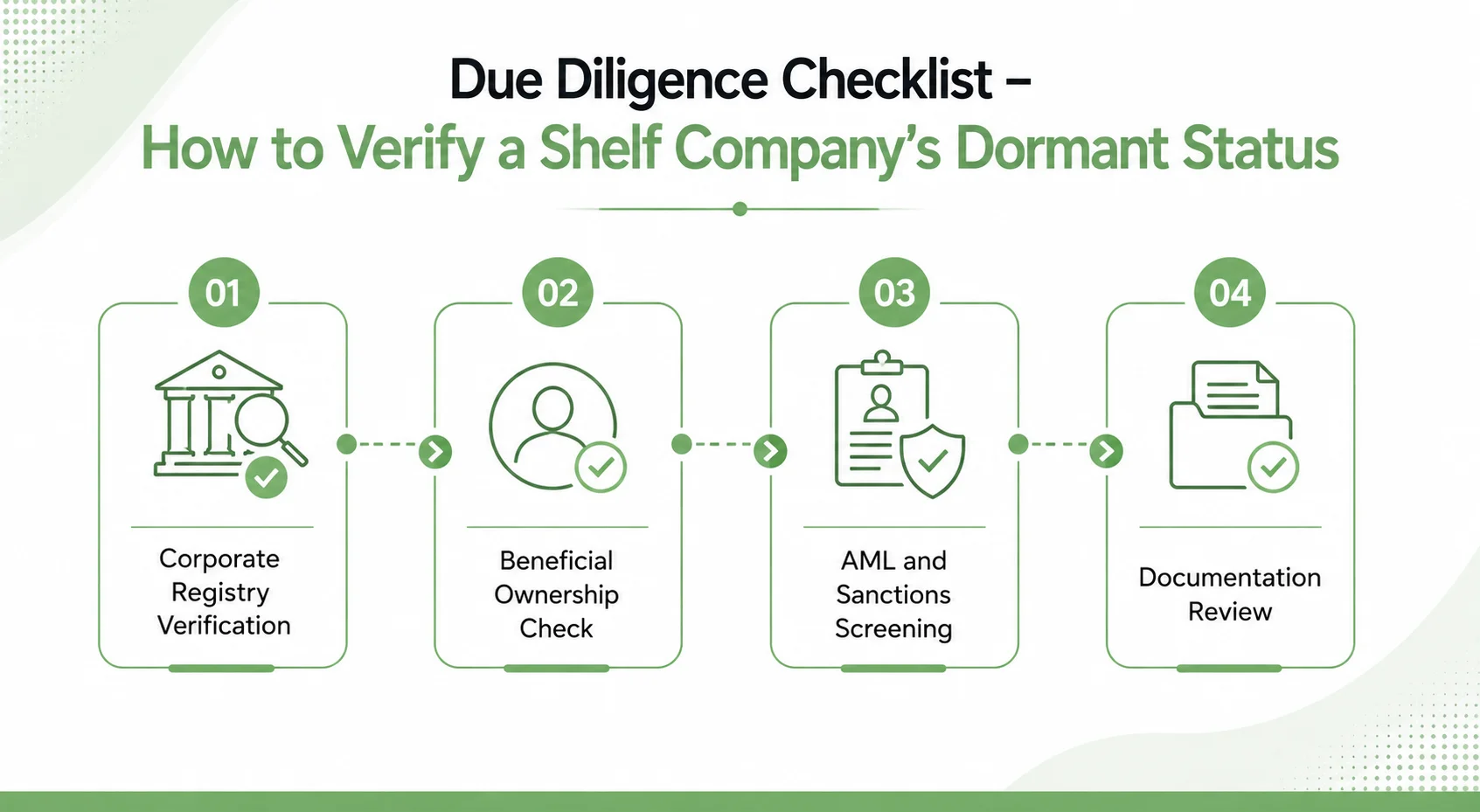
Before purchasing any shelf company, conduct a thorough due diligence review. The following checklist covers the essential verification steps
Corporate Registry Verification
- Pull the full filing history from the corporate registry (e.g., Companies House in the UK)
- Confirm all annual confirmation statements have been filed without gaps
- Verify dormant accounts have been filed each year
- Check for any overdue filings, penalties, or ‘struck off’ notices
- Review the full director and shareholder history
Beneficial Ownership Check
- Identify all Persons with Significant Control (PSC) in the registry
- Cross-reference with the provider’s documentation
- Verify that nominee arrangements (if any) are fully disclosed and legally compliant
- Confirm the UBO chain is clear and verifiable
AML and Sanctions Screening
- Screen all directors, shareholders, and UBOs against sanctions lists
- Check for adverse media coverage linking the company or its officers to financial crime
- Verify that the company is not incorporated in a FATF high-risk jurisdiction
Documentation Review
- Obtain certified copies of the Certificate of Incorporation
- Review the Memorandum and Articles of Association
- Check share certificates and the register of members
- Request the company’s full statutory books
- Obtain a Tax Clearance Certificate or equivalent from the relevant tax authority
When Shelf Companies Are the Right Choice for Global Expansion
Despite the compliance considerations, shelf companies remain a powerful tool for legitimate global expansion, particularly when time is a critical factor.
Ideal Use Cases
- Entering a new market before a competitor secures a position
- Meeting tender or government contract requirements that specify a minimum company age
- Preparing for a funding round where investors want to see an established corporate entity
- Building multi-jurisdiction corporate structures for international holding or operating companies
- Satisfying local bank or regulatory requirements for established businesses
Shelf Company vs Newly Incorporated Company – The Speed Comparison
| Factor | Shelf Company | New Incorporation |
| Time to legal entity | Immediate | Days to weeks |
| Incorporation date | Established (older) | New — today’s date |
| Banking readiness | Faster (clean history) | Standard timeline |
| Perceived credibility | Higher (aged entity) | Lower initially |
| Compliance risk | Low (if verified) | Very low (new entity) |
| Due diligence required | Extensive (buy) | Minimal (new) |
How RMC Supports Compliant Global Expansion
RMC (Ready Made Companies Worldwide) provides fully compliant dormant shelf companies to global entrepreneurs. Buyers looking to establish a presence in the UK can explore our UK shelf companies for ready-made options supported by the required corporate documentation and ownership transfer process.
- Continuous annual filings from the date of incorporation
- Dormant accounts filed each year have zero transactions recorded
- Full documentation package provided at the point of sale
- Transparent ownership transfer process with verified beneficial ownership
- Support for banking setup in multiple jurisdictions
- Ongoing compliance support post-purchase
Conclusion
The dormant status of a shelf company is not a technicality it is the core of its compliance value. A properly maintained, genuinely dormant shelf company gives you a clean, verified entity you can build a global business on. A poorly maintained one can expose you to hidden liabilities, banking rejections, regulatory scrutiny, and potential legal liability from day one.
If you are considering a shelf company and want help choosing an appropriately maintained entity for your business requirements, contact us to discuss available options and the ownership transfer process.