

You’ve spent weeks, sometimes months, waiting for your business registration to clear. Paperwork stalls at government offices. Banks won’t open accounts until you have an EIN. Clients ask, “How long have you been operating?” and your answer of “two weeks” costs you the deal. This is the reality most global entrepreneurs face when starting fresh. And it’s exactly why shelf companies, also known as aged companies or ready-made companies, have become one of the fastest-growing tools for international founders who need to move now.
A shelf company is a pre-registered, dormant legal entity that has been incorporated and “put on the shelf”, waiting to be purchased and activated. It has never traded, has no liabilities, and has an established incorporation date. The moment ownership transfers to you, you have a legal company with a history, without waiting weeks for the government to process your paperwork. This guide covers everything you need to know – what shelf companies are, why entrepreneurs choose them over traditional formation, how to buy one safely, and the real risks you need to watch out for.
What Is a Shelf Company? And How Does It Work?
Think of a shelf company like a book sitting on a library shelf, incorporated and registered, but never opened. It exists legally, but has never conducted any business activity.
These entities are created by legal service providers and corporate formation firms, then held in a dormant state until a buyer purchases them. Once the ownership transfer is complete, the new owner can activate the company, appoint directors, open bank accounts, and start trading, often within the same business day.
Shelf Company vs. Shell Company – Know the Difference
These two terms are often confused, but they are fundamentally different
- A shelf company is a legitimate, pre-registered entity with a clean history, dormant until sold to a buyer with real business intent.
- A shell company may have an active legal existence but is used to hold assets or structure transactions, sometimes legally, but sometimes associated with tax evasion or money laundering.
Using a legitimate shelf company from a reputable provider for real business purposes is completely legal in the US, UK, and most jurisdictions worldwide.
Why Traditional Business Registration Slows Global Expansion
Starting a business from scratch sounds simple. In practice, it involves multiple steps, multiple government agencies, and significant waiting time, especially for international founders.
The Standard US LLC Formation Process (7 Steps)
According to formation specialists and the US Small Business Administration (sba.gov), forming a new LLC involves
- Choose and verify your business name – must be unique and distinguishable in your chosen state
- Select your state/jurisdiction – Delaware, Wyoming, or your home state
- Appoint a registered agent – required in every state, must have a physical address in the filing state
- File Articles of Organization / Certificate of Formation – $90–$110 in Delaware, 10–15 business days standard
- Draft an Operating Agreement – not required in Delaware, but strongly recommended
- Obtain an EIN from the IRS – required for banking, hiring, and taxes (can take 2–4 weeks for international applicants via mail)
- Handle post-formation compliance – BOI reporting to FinCEN (within 30 days of formation), annual reports, licenses, and state tax registrations
The Real Timeline – It’s Longer Than You Think
Standard Delaware LLC formation takes 10–15 business days by mail and 2–5 business days online. But that’s just the certificate. The full process, including the EIN, operating agreement, bank account, and compliance filings, can take up to 9 weeks, according to formation guides at BizReport.com.
Expedited options exist – Delaware offers same-day processing for an additional $100–$200 fee, and 1-hour service for $1,000. But even with expediting, you still have an entity with zero history, which matters when applying for financing or enterprise contracts.
UK Formation – Fast Registration, But Not Instant Credibility
UK Companies House offers online registration in as little as 24 hours for £50. However, even with fast registration, the company is a brand-new lender, and government bodies and enterprise clients still view it as a startup with no track record.
The Global Entrepreneur’s Pain Points
- Delayed banking – Most banks require an EIN and a registered entity before opening business accounts
- Lost contracts – procurement officers at large companies often require 1–3 years of business history
- Financing gaps – SBA loans and business credit products favor companies with established histories
- Multi-state scaling – each new state requires a foreign LLC registration, adding weeks and cost
Top Reasons Global Entrepreneurs Choose Shelf Companies
1. Instant Operational Readiness – Start Trading Today
With a shelf company, you skip the entire registration queue. The company already exists legally. Once ownership transfers, often within the same business day, you can open bank accounts, sign contracts, issue invoices, and begin operations immediately.
There’s no waiting for government approval. No chasing registered agent confirmations. No 10-business-day processing window. For entrepreneurs operating in fast-moving markets, this speed advantage can mean the difference between winning and losing a contract.
2. Instant Credibility and Trust
An older incorporation date signals stability. According to a 2023 survey by the National Association of Educational Procurement (NAEP), 87% of procurement officers say they prioritize vendors with 3 or more years in business.
A shelf company gives your business that established appearance from day one, not after years of trading. This is particularly valuable when approaching enterprise clients, government tenders, or partnership negotiations where longevity signals trustworthiness.
3. Faster Banking, Financing, and Credit Access
One of the most practical advantages of shelf companies is accelerated access to financial products. Banks, lenders, and merchant processors assess risk partly based on business age.
- SBA loan approval rates reportedly jump from 27% to 63% for businesses over 2 years old
- Merchant processors often charge startups 1.5–3% higher transaction fees for the first 24 months
- Business lines of credit are significantly easier to access with an established entity history
A shelf company with a clean credit history can help you bypass early-stage financial bottlenecks that otherwise take years to overcome.
4. Faster Qualification for Contracts, Tenders, and Licenses
Many government contracts, corporate procurement processes, and industry licenses require a business to have been incorporated for a minimum period, typically 1–3 years. With a new company, you’re locked out entirely.
Shelf companies, especially those with 2+ years of clean history, immediately qualify for these opportunities. For global entrepreneurs targeting government work or enterprise contracts, this alone can justify the higher upfront cost.
5. Streamlined Global and Cross-Border Expansion
Delaware shelf companies are the gold standard for international entrepreneurs for several reasons –
- Delaware does not tax income earned outside the state, ideal for non-residents
- No requirement for owners or members to be US residents
- Delaware’s Court of Chancery is the world’s most respected business court; lenders and investors recognize this
- Easy multi-state qualification, a Delaware LLC can register as a foreign LLC in any other US state
- National registered agents simplify compliance across multiple states
As the State of Delaware officially notes, more than 1 million business entities are registered there, including many from international founders seeking flexible, business-friendly laws.
6. Asset Protection and Limited Liability Without the Wait
A shelf LLC carries the same liability protection as any newly formed LLC. Your personal assets are shielded from business debts and legal judgments from the moment you take ownership. The difference is that you get this protection immediately, not after weeks of registration, and with a company that already appears established to the outside world.
7. Tax Flexibility Preserved
A shelf LLC retains all the tax flexibility of a standard LLC. By default, single-member LLCs are taxed as disregarded entities (pass-through), while multi-member LLCs are taxed as partnerships. You can also elect S-Corp or C-Corp taxation status. This flexibility is fully available from the day you take ownership.
Shelf Companies vs. New LLC Formation – Side-by-Side Comparison
Here’s a direct comparison to help you decide which option fits your situation
| Factor | Shelf Company | New LLC (Standard) | New LLC (Expedited) | New UK Ltd |
| Time to Trade | Same day | 2–5 weeks | 1–3 days | 24–48 hrs |
| Perceived Age | Months/Years | Day 0 | Day 0 | Day 0 |
| Banking Speed | Faster approval | Slower | Slower | Slower |
| Contract Eligibility | Immediate | Delayed | Delayed | Delayed |
| Upfront Cost | Higher | Low ($110+) | Moderate | Low (£50) |
| Customization | Limited | Full | Full | Full |
| Hidden Liabilities | Possible | None | None | None |
| Compliance Required | Ongoing | Ongoing | Ongoing | Ongoing |
Bottom line – If speed, credibility, and immediate market access are priorities, especially for contract-heavy or financing-dependent businesses, a shelf company wins. If you need full customization, zero upfront premium, and have time to wait, new formation is the right call.
How to Acquire and Activate a Shelf Company (Step-by-Step)
The process is simpler than traditional formation, but it still requires careful steps to protect yourself.
Step 1 – Choose Your Jurisdiction and Entity Type
Delaware shelf companies are the most popular choice for global entrepreneurs. Wyoming offers stronger privacy protections. UK shelf Ltd companies are ideal if your primary market is Europe.
Consider – Where will you bank? Where are your clients? What tax obligations do you want to trigger?
Step 2 – Find a Reputable Provider and Verify History
This is the most critical step. Work only with established corporate formation services that provide –
- Full documentation of the company’s clean history
- Confirmation the entity has been in continuous good standing since formation
- Verification it has never been dissolved and reinstated (reinstated companies lose their age advantage with lenders)
- A certificate of good standing from the state
Cross-check the company’s status directly through the Delaware Division of Corporations or UK Companies House before purchasing.
Step 3 – Conduct Due Diligence
Even if a shelf company is advertised as “clean,” always verify
- No UCC filings or liens from previous lenders
- No pending litigation or unpaid tax obligations
- No dormant compliance penalties (late filing fees, etc.)
- All statutory records are up to date
Consider hiring a business attorney or accountant to review the documentation before purchase.
Step 4 – Transfer Ownership and Update Records
Once purchased, work with the provider to
- Transfer LLC membership interest or share ownership into your name
- Appoint yourself or your designees as members/directors
- Update the registered agent if needed (note – as of August 1, 2025, Delaware requires registered agents to maintain a physical office with regular hours)
- File updated operating agreement or articles of amendment if required
Step 5 – Handle Post-Activation Essentials
- Apply for an EIN from the IRS (instant online for US residents; 2–4 weeks by mail for non-residents)
- Open a business bank account (the established history should speed this up)
- File BOI report with FinCEN within 30 days of ownership change
- Register as a foreign LLC in any additional states where you’ll operate
- Note upcoming annual report and franchise tax deadlines ($300/year in Delaware)
Timeline – Ownership transfer and activation can often be completed the same business day. Compare this with 2–9 weeks for a new LLC formation from scratch.
Key Considerations and Potential Risks
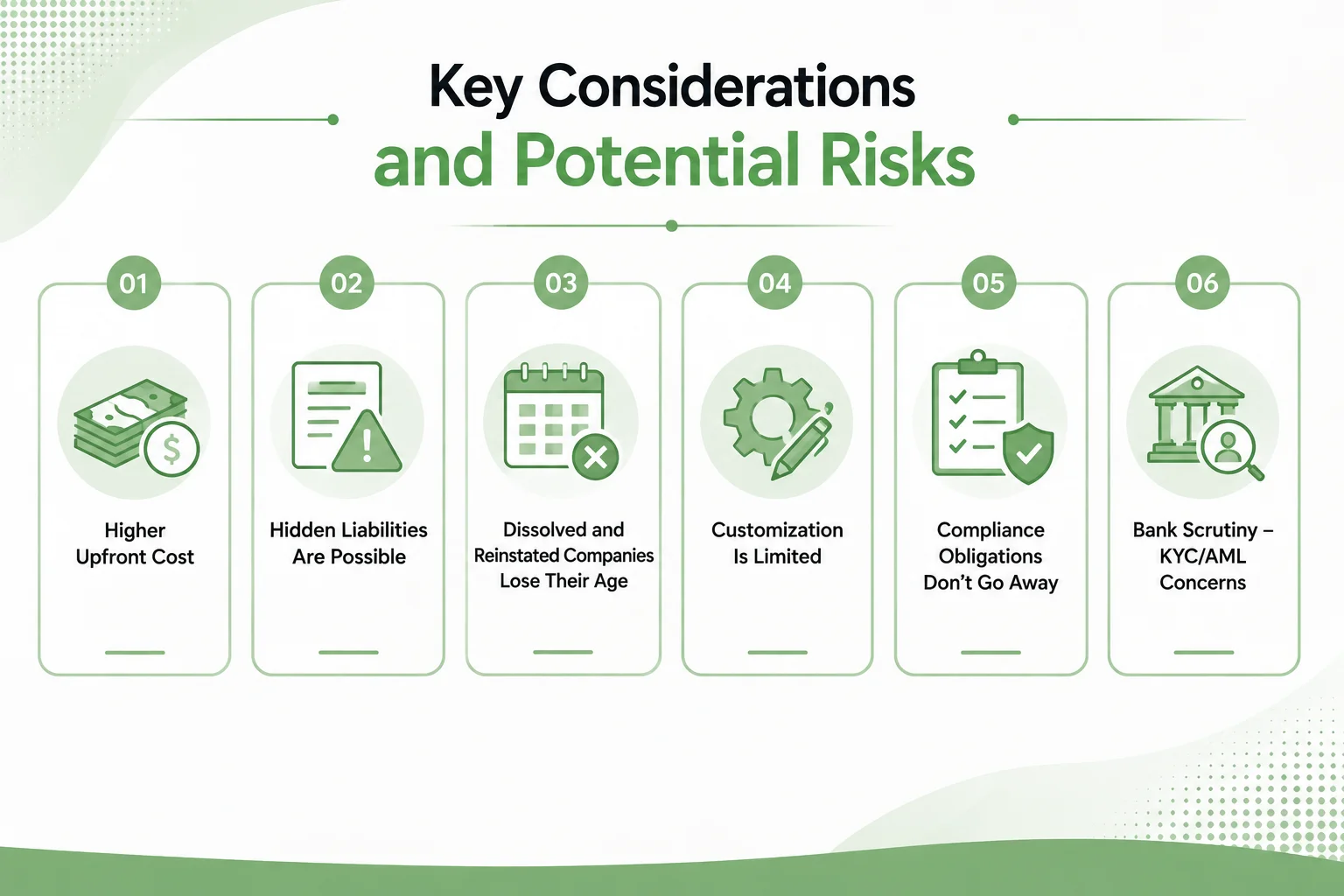
Shelf companies are powerful tools when used correctly, but they come with real risks that every buyer must understand.
1. Higher Upfront Cost
A brand-new Delaware LLC costs around $110–$200 in state fees. A shelf company can cost anywhere from a few hundred to several thousand dollars, depending on its age and history. Evaluate whether the time savings and credibility advantage justify the premium for your specific situation.
2. Hidden Liabilities Are Possible
Even dormant companies can accumulate penalties for missed filings, unresolved UCC liens, or outstanding tax obligations. The new owner inherits these. This is why due diligence isn’t optional; it’s essential.
According to PastPaperHero’s legal analysis, buyers are responsible for any outstanding penalties or liabilities of the company, even those that arose before purchase.
3. Dissolved and Reinstated Companies Lose Their Age
This is a critical and often overlooked risk. If a shelf company were ever dissolved and later reinstated, financial institutions would typically treat it as a new company, regardless of its original formation date. Always verify continuous good standing since the original incorporation.
4. Customization Is Limited
Unlike a new LLC, a shelf company comes with a pre-existing name that may not align with your brand. Most providers allow you to register a DBA (“Doing Business As”) name to trade under a different name, but the legal entity name is fixed at formation.
5. Compliance Obligations Don’t Go Away
Buying a shelf company doesn’t mean buying a compliance-free entity. You inherit all ongoing obligations – annual reports, franchise taxes, registered agent fees, and BOI reporting. These are identical to what you’d owe on a newly formed LLC.
6. Bank Scrutiny – KYC/AML Concerns
Some financial institutions flag shelf company purchases for enhanced due diligence under Know Your Customer (KYC) protocols. Castellum.AI’s compliance analysis notes that because shelf companies are sometimes misused, banks may apply closer scrutiny. Be prepared to document your legitimate business purpose clearly when opening accounts.
Conclusion – Is a Shelf Company Right for You?
Shelf companies aren’t a shortcut around compliance; they’re a shortcut around the registration queue. When used correctly, they give you the foundation to build a credible, scalable business from day one. If you are considering purchasing a ready-made company and need help identifying the right jurisdiction or entity, contact us to discuss your requirements.