
Readymade companies have long provided entrepreneurs and international businesses with a faster route to acquiring an already incorporated legal entity. However, the European regulatory environment is changing. Stronger anti-money laundering controls, beneficial ownership requirements and more consistent customer due diligence are placing greater emphasis on who owns a company, where funds originate and how an acquired entity will be used. These developments do not automatically remove the commercial value of a readymade company. Businesses considering a shelf company therefore need to assess both the benefits of an existing entity and the compliance responsibilities that accompany the purchase.
What Has Changed Under the EU Regulatory Framework?
The EU has introduced a substantial new anti-money laundering and counter-terrorist financing framework. One of its central components is Regulation (EU) 2024/1624 – commonly referred to as the AML Regulation or AMLR.
The Regulation is scheduled to apply generally from 10 July 2027. It creates directly applicable AML requirements across the EU and is intended to provide greater consistency between Member States.
The accompanying Directive (EU) 2024/1640 also strengthens the framework surrounding national AML systems and beneficial ownership registers. Among other measures, it requires central registers to retain information concerning changes in beneficial ownership following the initial recording of that information.
For companies and their owners, several areas are particularly relevant:
- Beneficial ownership identification and verification
- Customer due diligence
- Ownership information held in central registers
- Greater consistency in AML supervision
- Monitoring of business relationships
- More effective identification of discrepancies and suspicious activity
The important distinction is that these measures target financial crime and opaque corporate structures. They do not establish a general EU prohibition on purchasing an already incorporated company.
Businesses considering international expansion can review the available options through Ready Made Companies Worldwide.
Why AML and KYC Matter More for Readymade Company Buyers
A shelf company changes ownership when it is acquired. That makes transparency surrounding the new shareholders, directors and ultimate beneficial owners particularly important.
Banks, corporate service providers and other regulated organisations may need to understand who ultimately controls the company, the purpose of the relationship and the nature of the intended business activity.
AMLA has also been developing technical standards dealing with customer due diligence under the new AML Regulation. These standards are intended to provide greater detail concerning the information and documentation that regulated organisations should collect.
Also read – How to Buy a Shelf Company
Are Readymade Companies Still Legal in the EU?
There is no general EU rule in the new AML framework that bans the acquisition of an existing company simply because it was incorporated in advance and remained dormant.
What matters is whether the company and its new owners comply with the corporate, tax, AML, beneficial ownership and sector-specific requirements applicable in the relevant Member State.
Why Beneficial Ownership Is Becoming More Important
Beneficial ownership transparency is a major element of the EU’s evolving AML framework.
Under Directive (EU) 2024/1640, Member States must maintain central registers containing beneficial ownership information. The Directive also provides mechanisms for regulated entities and competent authorities to access information required for AML purposes.
For readymade company buyers, this makes prompt and accurate ownership updates especially important after a transfer.
A buyer should therefore be prepared to identify the natural person or persons who ultimately own or control the company rather than relying solely on the names appearing at an intermediate corporate level.
Where ownership involves several companies or jurisdictions, supporting documents may also be required to demonstrate the complete ownership chain.
Do Readymade Companies Still Offer Commercial Benefits?
Yes – depending on the buyer’s circumstances.
The regulatory environment has changed, but the fundamental characteristics of an existing incorporated company have not.
Faster Access to an Existing Legal Entity
A shelf company has already completed its initial incorporation. A buyer therefore acquires an existing legal entity instead of beginning the incorporation process from the first filing.
This can be useful where a company needs an entity for a time-sensitive commercial transaction or international expansion.
Existing Incorporation Date
An aged shelf company can have an earlier incorporation date than a newly formed company.
However, buyers should distinguish between company age and trading history. An older dormant company does not automatically have customers, revenue, credit history, contracts or commercial experience.
International Expansion
Companies entering another European jurisdiction may use an existing entity as part of their expansion structure, provided the company is suitable for the proposed activities and all ownership and regulatory changes are completed.
Corporate Structuring
An existing company may also be considered for a subsidiary, holding structure or another legitimate commercial purpose, subject to local tax, legal and regulatory advice.
What Has Become More Difficult?
The main change is not the ability to purchase a readymade company. It is the level of transparency expected around the transaction.
Banks and other regulated organisations can conduct detailed checks before establishing a relationship with the new owners.
This means buyers should not assume that acquiring an older company automatically provides:
- A bank account
- Credit facilities
- Financing
- VAT registration
- Payment processing
- Regulatory licences
- Tender eligibility
- A trading history
Each of these may involve separate eligibility requirements and approval processes.
The new EU framework is also moving towards more consistent enforcement. In July 2026, AMLA announced standards intended to establish a more harmonised approach to assessing AML/CFT breaches across EU supervision.
Readymade Company vs New Incorporation
Whether an existing entity or a newly incorporated company is more suitable depends on the intended use.
| Factor | Readymade Company | New Company |
|---|---|---|
| Incorporation | Already completed | New registration required |
| Company age | Existing incorporation date | Starts from incorporation |
| Corporate history | Must be verified | Begins fresh |
| Due diligence | Particularly important | Still required |
| AML and KYC | Required where applicable | Required where applicable |
A readymade company may suit a buyer who has a genuine reason for requiring an existing entity. A new company may be more appropriate where company age provides little practical benefit or where a completely new corporate structure is preferred.
Why Clean Corporate History Matters More Than Age
The incorporation date alone should never determine whether a shelf company is suitable.
A two-year-old company with incomplete filings, unexplained transactions or unresolved liabilities may create considerably more work than a younger company with properly maintained records.
Before purchasing, buyers should establish whether the company has genuinely remained dormant and whether its corporate filings support the representations made by the seller.
How to Assess a Readymade Company Before Purchase
A structured due diligence process is increasingly important under tighter EU compliance requirements.
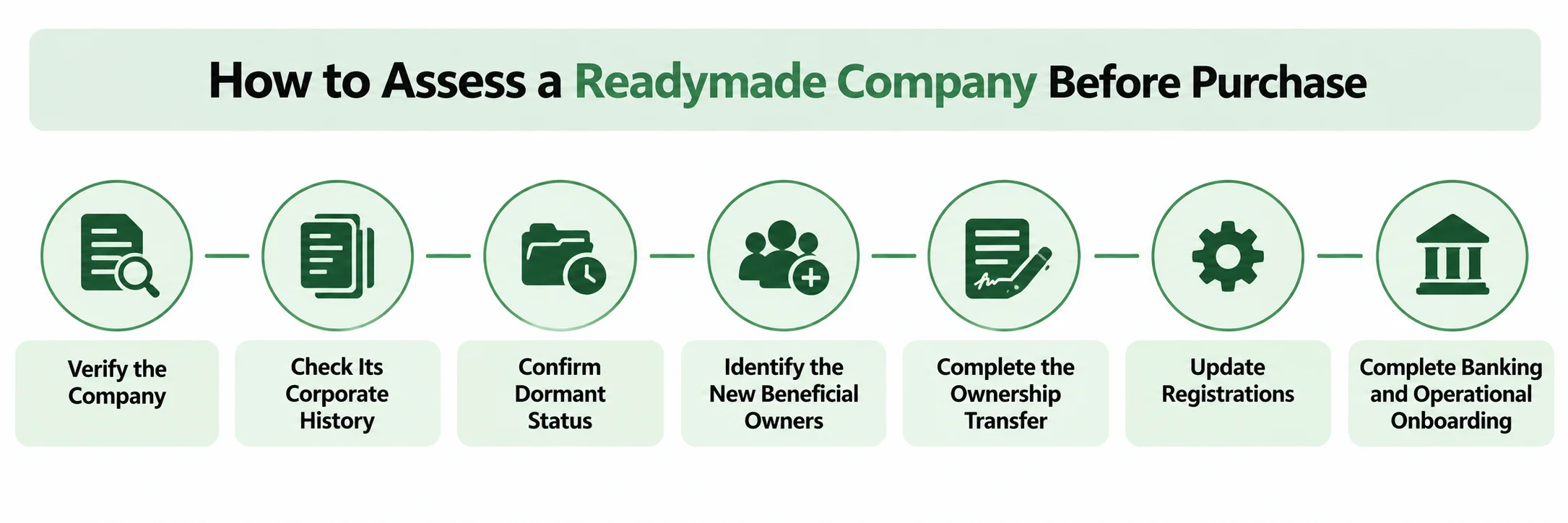
1. Verify the Company
Confirm that the company exists on the relevant official corporate register and remains in good standing where that concept applies.
2. Check Its Corporate History
Review previous filings, accounts, shareholders, directors and other available registry information.
3. Confirm Dormant Status
Do not rely solely on a description such as “clean” or “unused”. Supporting corporate and financial records should be examined where appropriate.
4. Identify the New Beneficial Owners
Prepare the ownership information and supporting documentation that will be required after the acquisition.
5. Complete the Ownership Transfer
Shares, directors and other corporate information should be transferred according to the law of the jurisdiction concerned.
6. Update Registrations
Beneficial ownership, tax, VAT and other registrations may need to be updated after the acquisition.
7. Complete Banking and Operational Onboarding
Banking, payment processing and regulated activities should be treated as separate processes rather than assumed to transfer automatically with the company.
What Documents Should Buyers Request?
Documentation can vary considerably between jurisdictions, but buyers should generally expect access to the principal records needed to establish the company’s identity, ownership and history. These can include incorporation certificates, constitutional documents, corporate registers, previous accounts, confirmation of current directors and shareholders and evidence supporting the company’s dormant status.
Where appropriate, buyers should also investigate tax filings, VAT status and other registrations. The objective is simple – the company being purchased should match what has been represented by the provider.
How AMLA Is Changing EU Supervision
Another important development is the establishment of the EU Authority for Anti-Money Laundering and Countering the Financing of Terrorism – AMLA. On 1 January 2026, AML/CFT mandates and functions previously held by the European Banking Authority were transferred to AMLA. Existing EBA AML/CFT guidelines remain effective until they are replaced by AMLA measures.
AMLA has since been developing technical standards and guidelines concerning areas such as customer due diligence, ongoing monitoring and the identification of business relationships.
For international businesses, this points towards a more harmonised European compliance environment.
When Can a Readymade Company Still Make Sense?
The strongest reason to acquire a shelf company is usually a genuine commercial requirement for an existing legal entity.
Examples can include:
- Entering a European market quickly
- Establishing a subsidiary
- Meeting a commercial deadline
- Implementing an international corporate structure
- Acquiring an entity with an earlier incorporation date
However, the company must still be appropriate for its intended purpose.
Buyers should therefore consider the jurisdiction, tax system, ownership structure, banking requirements, regulatory obligations and expected business activities before proceeding.
The Role of Professional Due Diligence
Tighter regulations make due diligence more valuable rather than making legitimate readymade companies obsolete.
The purchase should establish exactly what the buyer is acquiring and whether the company carries historical liabilities or compliance problems.
Professional assistance can also help ensure that ownership transfers, beneficial ownership updates and corporate filings are completed correctly.
For international buyers, this becomes especially important where the purchaser, beneficial owners and company are located in different jurisdictions.
Are Readymade Companies Still Worth Considering?
EU regulatory developments have changed the environment surrounding corporate transparency, but they have not eliminated the legitimate commercial use of existing companies.
The stronger regulatory framework means buyers need to focus less on simply acquiring the oldest available company and more on obtaining an entity with transparent ownership, reliable records and a verifiable corporate history.
A compliant readymade company can still provide an efficient route to acquiring an existing European corporate entity. However, its suitability depends on the buyer’s business objectives, the jurisdiction and the quality of the company’s history.
The most important principle is that a shelf company should provide speed of acquisition – not a shortcut around compliance.
Conclusion
The EU’s evolving AML framework is raising standards for transparency, customer due diligence and beneficial ownership reporting, but it does not remove the legitimate role of readymade companies. Businesses that carry out appropriate due diligence, maintain accurate ownership information and meet the requirements of the relevant jurisdiction can still consider an existing company for market entry, international expansion or corporate structuring.
If you are considering purchasing a readymade company and need support with company selection, ownership transfer or compliance requirements, Contact Us to discuss the most suitable option for your business.