

Speed is often the deciding factor in business. Whether you are chasing a contract, launching in a new market, or completing an acquisition, waiting weeks for a company registration can cost you real money. That is where a shelf company, also called a ready-made or pre-registered company, steps in.
A shelf company is a legal entity that has been incorporated but never traded. It sits on a ‘shelf’, maintained in good standing, until a buyer takes ownership. The appeal is obvious you get an active company with an established incorporation date, often within days.
But buying a shelf company is not without its complexities. Hidden liabilities, regulatory scrutiny, and the premium price tag are all factors worth weighing carefully. This guide walks you through everything the advantages, the risks, the due diligence process, and when it makes sense for your business.
What Is a Shelf Company?
A shelf company, sometimes called a ready-made company, aged company, or pre-registered company, is a business entity that has been legally formed but has never conducted any commercial activity. It has no employees, no trading history, no assets, and (in a clean purchase) no liabilities.
These companies are created by formation agents, law firms, or specialist providers who register them in bulk, pay any required annual fees, and maintain them in good standing. The company then ‘ages’ on the shelf until a buyer purchases it.
The key distinction from a shell company is intent. A shell company may hold assets or be used as part of a broader corporate structure. A true shelf company is kept completely dormant with the sole purpose of being sold later as a clean, aged entity.
How Does Buying a Shelf Company Work?
- A provider incorporates a company in a chosen jurisdiction.
- The company is kept dormant, and in good standing, annual returns are filed, and fees are paid.
- A buyer purchases the company’s shares and becomes the new legal owner.
- The buyer updates the directors, registered address, and company name as required.
- The company retains its original incorporation date, giving the appearance of an established business.
For a detailed overview of how company registration works in the UK, see the
Shelf Company vs New Company – At a Glance
| Factor | Shelf / Ready-Made Company | New Incorporation |
| Time to trade | Immediate hours to days | 1–4+ weeks depending on jurisdiction |
| Perceived age | Established incorporation date (months/years) | Brand new, no history |
| Cost | Higher upfront (premium for age) | Lower setup fees |
| Hidden liabilities | Possible due diligence required | No clean slate |
| Credibility | Appears established to clients & lenders | May face new company scepticism |
| Licensing | May meet age requirements instantly | Must wait and reapply |
| Flexibility | Limited by the existing structure | Full freedom from the start |
Shelf Company Advantages – Why Buyers Choose Them
The benefits of buying a shelf company go beyond simple convenience. For the right buyer in the right situation, they can be transformative.
| Advantage | Why It Matters |
| Instant operational status | Skip weeks of registration paperwork |
| Established incorporation date | Builds credibility with banks, clients, and partners |
| Faster credit & banking access | Some lenders favour older entities |
| Meets age-based licence criteria | Regulated sectors often require a minimum company age |
| Accelerates M&A transactions | Useful vehicle for acquisitions, SPVs, and holding structures |
| Immediate contract signing | Can bid and tender from day one |
1. Immediate Operational Status
Incorporating a new company from scratch takes time, often one to four weeks or longer in heavily regulated jurisdictions. With a shelf company, you can be operational within hours of completing the purchase. Directors are appointed, the name is changed, and you can start trading the same day.
This matters most when you are bidding on a contract, need to sign a lease, or want to respond quickly to a market opportunity.
2. Established Incorporation Date
One of the most cited advantages is the company’s age. An entity incorporated several years ago carries an implicit signal of stability even if it has never traded. Clients, suppliers, and lenders often perceive an older company as more credible than a freshly formed one.
As noted by legal experts, shelf companies can help create a perception of an established business, which may be valuable when approaching suppliers and business partners.
3. Faster Banking and Credit Access
Some banks and financial institutions are more comfortable opening business accounts for companies with a trading history, or at least an established incorporation date. While this benefit is increasingly scrutinised by modern lenders (who look at actual financials rather than just age), it can still smooth the process of opening your first business account.
Similarly, certain trade credit facilities, payment processors, and leasing agreements favour companies with a longer track record.
4. Meeting Age-Based Licence Requirements
Some regulated industries require a company to be a minimum age before it can apply for certain licences or permits. This is particularly relevant in financial services, property, and some public sector tendering frameworks.
Buying a shelf company that already meets the age threshold can save months of waiting and the cost of missing a business opportunity in the interim.
5. Useful Vehicle in M&A and Corporate Structuring
In mergers and acquisitions, shelf companies can serve as clean acquisition vehicles. As OffDeal notes, buyers sometimes use a shelf corporation to merge with a target business, simplifying the transactional structure and preserving certain liability boundaries.
They are also used to establish special purpose vehicles (SPVs), holding companies, and subsidiaries as part of larger group structures.
6. Name and Brand Flexibility
When you purchase a shelf company, you can change its name after acquisition (subject to availability and filing requirements). This means you get the benefit of an established entity while still launching under your own brand.
Shelf Company Risks – What You Need to Watch Out For
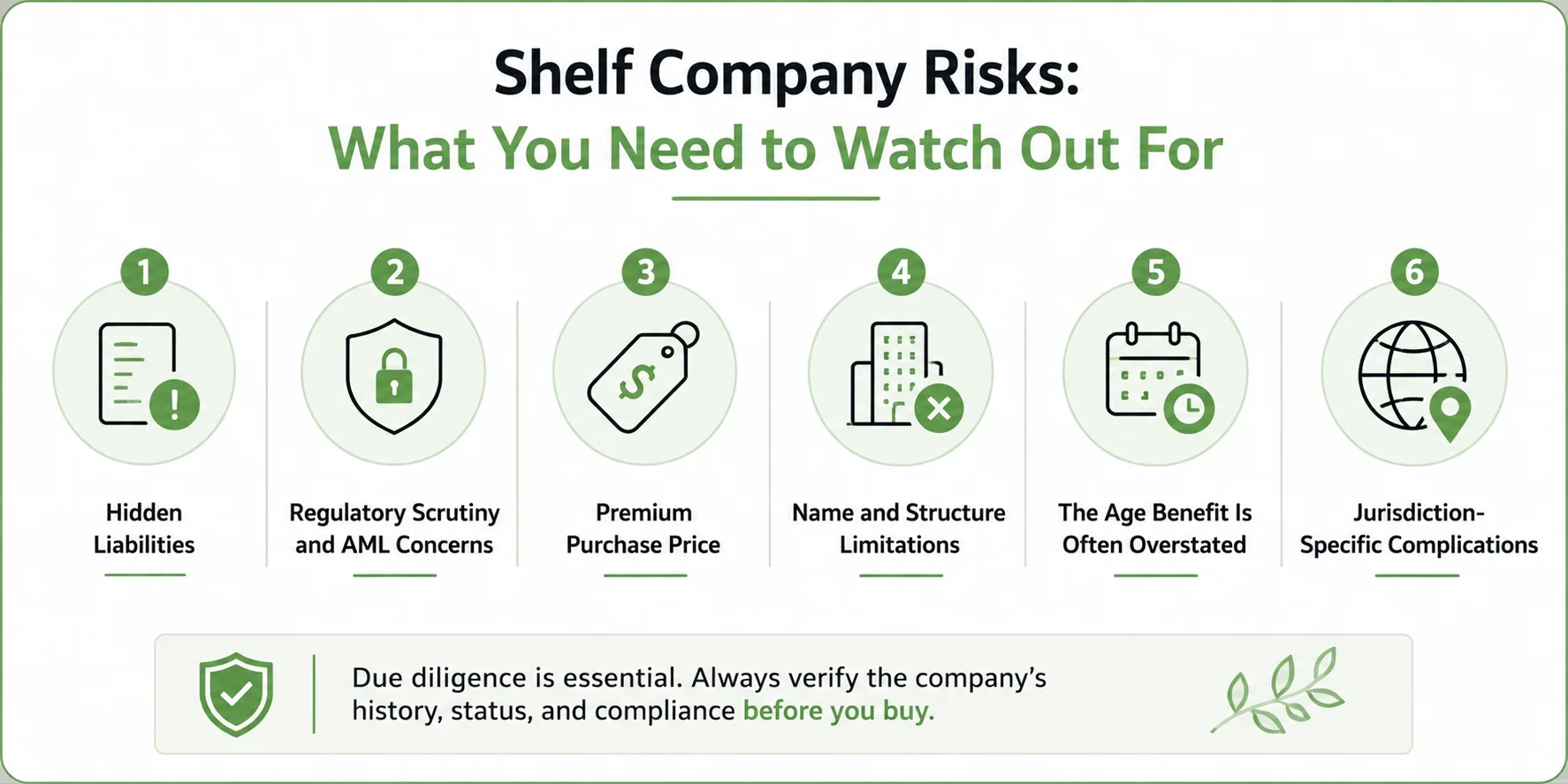
The advantages are real, but so are the risks. Failing to account for them can turn a quick solution into an expensive problem.
1. Hidden Liabilities
The most serious risk is acquiring undisclosed liabilities. Even if a company appears to have been dormant, there may be outstanding debts, tax arrears, unresolved legal claims, or registered charges against its assets.
This is not hypothetical. A seller may not always disclose every historic issue. Without thorough due diligence, you can inadvertently become responsible for debts and disputes that predate your ownership.
2. Regulatory Scrutiny and AML Concerns
Shelf companies have historically been misused in money laundering and tax avoidance schemes. As a result, regulators in many jurisdictions, including the UK’s Financial Conduct Authority and HMRC, pay particular attention to newly reactivated entities.
Banks and financial institutions apply enhanced Know Your Customer (KYC) checks to shelf company purchases. The Financial Action Task Force (FATF) has specifically flagged shell and shelf entities as higher-risk vehicles. Expect more documentation requests and longer onboarding times at banks as a result.
3. Premium Purchase Price
Aged companies for sale command a higher price than registering a company from scratch. The older the company, the more expensive it tends to be. In some jurisdictions, a well-aged shelf company can cost several times more than a fresh incorporation.
For many buyers, particularly those in the early stages of a venture, this premium is not justified, especially since many of the perceived benefits (instant credibility, banking access) are increasingly challenged by sophisticated lenders and partners.
4. Name and Structure Limitations
You inherit the shelf company as it was set up by its original incorporator. That means you may need to change the company name, update the articles of association, restructure the share capital, and appoint new directors — all of which take time and cost money. Some structural elements may not be easy to change.
5. The Age Benefit Is Often Overstated
Modern banks, lenders, and sophisticated business partners conduct their own due diligence. The incorporation date alone rarely carries significant weight if the company has no trading history, no filed accounts, and no track record. The credibility advantage, while real in some contexts, should not be the sole justification for buying a shelf company.
6. Jurisdiction-Specific Complications
Rules vary significantly by country. In Germany, for example, Clevver notes that buying a shelf company (Vorratsgesellschaft) involves specific notarial requirements and the process is more involved than in the UK or the US.
In Brazil, the registry process for shelf companies adds another layer of complexity and verification. Always seek local legal advice before buying in an unfamiliar jurisdiction.
Due Diligence Shelf Company Checklist
Due diligence is the single most important step in any shelf company purchase. Skipping or rushing it is the most common mistake buyers make. Here is what you must verify before completing the transaction.
| Check Area | What to Verify |
| Corporate status | Active & in good standing with Companies House or local registry |
| Financial records | No outstanding debts, judgments, or tax arrears |
| Ownership history | Full chain of ownership; no undisclosed prior directors |
| Legal disputes | No pending litigation, claims, or regulatory sanctions |
| Tax filings | All annual returns filed; no missed deadlines |
| Bank accounts | Confirm no undisclosed accounts or credit facilities |
| Dormancy confirmation | Written certification that no trading activity occurred |
| Registered charges | Search for any charges registered against the company |
Always instruct an independent solicitor or qualified M&A advisor to conduct due diligence. The cost is minimal compared to the potential exposure of acquiring undisclosed liabilities.
When Buying a Shelf Company Makes Sense and When It Doesn’t
Good Reasons to Buy a Shelf Company
- You need to sign a contract, submit a tender, or open a bank account within days.
- You operate in a regulated sector where a minimum company age is required for licensing.
- You are executing an M&A strategy and need a clean acquisition vehicle.
- Your business model benefits from the perceived credibility of an established entity.
- You are expanding internationally and need a local entity quickly.
When You Should Incorporate Fresh Instead
- You have sufficient time to go through the standard incorporation process.
- Your budget is tight, and the premium cost of an aged company is hard to justify.
- You want full control over your company’s structure from day one.
- Your clients and partners are unlikely to be influenced by the incorporation date.
- You are in an early-stage startup, and credibility is built through your product, not your company’s age.
How to Buy a Shelf Company – Step-by-Step
- Define your requirement jurisdiction, company type, minimum age, and budget.
- Source providers use reputable company formation agents or legal firms. Avoid unregulated marketplaces.
- Review available options, check the incorporation date, company name, jurisdiction, and any prior filing history.
- Commission due diligence instructs a solicitor to verify the company’s status, filings, and clean history.
- Complete the transfer sign, share transfer documents, file director changes, and update Companies House (or the relevant registry).
- Update the company, change the name if required, update articles, and establish a business bank account.
- Begin trading once all registrations are updated and the company is ready for use.
Shelf Companies by Jurisdiction – Key Differences
The shelf company market varies considerably by country. Here is a brief overview of common jurisdictions.
United Kingdom
The UK has one of the most accessible shelf company markets. Companies House maintains a public register, making due diligence straightforward. The process is fast and relatively low-cost. However, UK banks apply rigorous KYC checks on reactivated entities, so expect scrutiny when opening accounts.
United States (Delaware, Nevada, Wyoming)
US shelf corporations, particularly in Delaware and Nevada, are widely marketed. They are popular for M&A vehicles and corporate structuring. However, lenders and partners increasingly look past incorporation dates to assess real operational history. Ensure full compliance with state and federal tax obligations post-purchase.
Germany
Germany’s Vorratsgesellschaft (shelf GmbH) is a recognised legal concept. The purchase requires notarial involvement and is more regulated than in common law jurisdictions. The process is reliable but slower and more expensive.
Europe (Broader)
Across the EU, shelf company availability varies. In countries such as Bulgaria, the Czech Republic, and Estonia popular for their business-friendly environments, ready-made companies are available through specialist providers.
Final Thoughts
Buying a shelf company can be a smart, strategic move or an expensive mistake. The difference comes down to preparation.
If speed is critical, if you need to meet age-based regulatory requirements, or if you are executing a complex M&A deal, a shelf company offers genuine advantages that a fresh incorporation simply cannot match. The established incorporation date, immediate operational status, and clean legal structure are real benefits in the right hands.
But the risks are equally real. Hidden liabilities, regulatory scrutiny, and a premium purchase price mean that a shelf company is not always the right answer. For many businesses, particularly early-stage startups without time pressure, incorporating fresh offers offers more flexibility, lower cost, and a cleaner starting point.
Whatever you decide, thorough due diligence is non-negotiable. Engage a qualified solicitor, verify every filing, and treat the company’s history as your own because once you complete the purchase, it is.