
For a start-up, intellectual property is often one of the most valuable assets the business owns. Your brand name, logo, website content, software, product design, inventions, photographs, marketing materials, databases, and confidential know-how can all carry commercial value. Yet IP protection is frequently postponed while founders focus on funding, sales, product development, and daily operations.
That delay can become expensive. A business may discover that another company already owns a similar trade mark, a contractor owns rights to work the start-up paid for, or an invention has been disclosed publicly before patent protection was considered. Building an IP strategy early helps a start-up establish ownership, reduce legal risk, strengthen its position with investors, and protect the assets that differentiate it from competitors.
What Is Intellectual Property?
Intellectual property – commonly called IP – covers creations of the mind that can have legal and commercial value. Depending on what your start-up creates, protection may apply to your brand, technology, software, designs, written content, and confidential business information. Entrepreneurs building a new business should consider these assets alongside their wider company structure, particularly when using a ready-made company to accelerate their business launch.
For founders, IP is broader than inventions. It can include your company name, product names, logos, software code, website copy, photographs, product appearance, technical innovations, proprietary processes, and confidential business information.
If you are still developing your wider business structure, professional business consultancy services can also help you consider how intellectual property fits into your broader commercial plans.
Why Intellectual Property Matters for Start-Ups
A start-up’s competitive advantage often comes from something intangible – technology, branding, content, data, design, specialist knowledge, or a distinctive method of delivering a service. Protecting these assets can strengthen the business as it grows and help founders establish a clearer commercial foundation. Start-ups that also need to establish their corporate structure quickly
Also read – Shelf Companies for Startups – Fast Business Setup Guide
Effective IP management can help a start-up
- Establish ownership of important business assets
- Prevent or challenge unauthorised copying
- Build a recognisable and defensible brand
- Reduce disputes between founders, employees, and contractors
- Improve confidence during investor due diligence
- Create licensing and commercialisation opportunities
- Support international expansion
- Increase the overall commercial value of the business
The UK Intellectual Property Office also recommends integrating IP strategy into business planning, noting that investors may want to understand how a company’s IP is protected and connected to future income.
What Types of IP Could Your Start-Up Own?
Trade Marks
Trade marks protect the distinctive signs customers use to identify your products or services. This may include your company or product name, logo, and other distinctive branding.
Registering a company name does not necessarily provide the same protection as registering a trade mark. Start-ups should therefore search existing trade marks before committing significant money to branding, domains, packaging, or advertising.
UK trade mark protection is divided into classes of goods and services, making the selection of appropriate classes an important part of the application process.
For businesses ready to secure their brand identity, professional trade mark registration services can help with the registration process.
Copyright
For technology start-ups, software code, proprietary systems, databases, and technical processes can represent a substantial proportion of the company’s value. Ownership should therefore be clearly documented from the beginning, particularly when developers, freelancers, or external agencies contribute to the product. SaaS founders should
Also read – Shelf Company for a SaaS Business – Is It Worth It?
for additional considerations around intellectual property, company structure, funding, and customer data. Ownership still needs attention. If freelancers, agencies, developers, or designers create materials for your company, contracts should clearly address who owns the resulting IP.
Patents
Patents are designed to protect qualifying inventions and technical innovations. They concern how an invention works, what it does, or how it achieves its result. Patent applications can be complex, and not every idea or innovation qualifies.
Timing is particularly important. Founders developing potentially patentable technology should consider protection before publicly disclosing technical details. UK government guidance recommends keeping relevant IP secret until registration and using a non-disclosure agreement when disclosure is necessary.
Design Rights
Design protection concerns the visual appearance of a product rather than how it technically functions. Depending on the circumstances, features such as shape, configuration, pattern, or decoration may qualify for protection.
This can be particularly important for start-ups developing consumer products, packaging, furniture, accessories, hardware, or other products where appearance creates commercial differentiation.
Trade Secrets and Confidential Information
Some valuable information is better kept confidential rather than publicly registered. Examples may include formulas, internal processes, algorithms, supplier arrangements, pricing methods, customer intelligence, or commercially sensitive know-how.
Confidentiality agreements and NDAs can therefore form an important part of an IP strategy. UK IPO guidance specifically identifies confidentiality and trade secrets as areas businesses should consider alongside registered IP rights.
How to Identify Intellectual Property in Your Start-Up
Many founders own more IP than they realise. An IP audit provides a structured way to identify it.
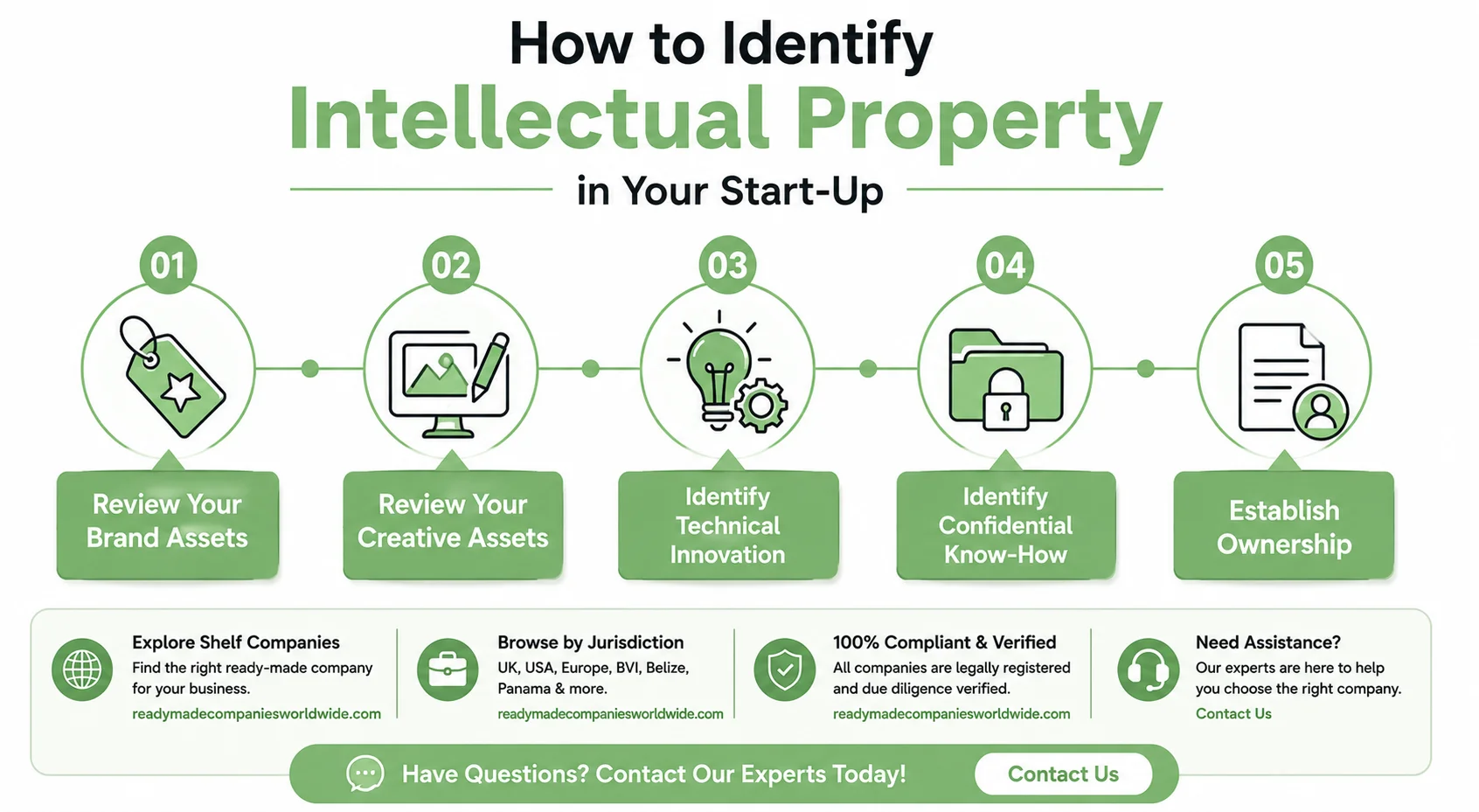
Step 1 – Review Your Brand Assets
List your business name, product names, logos, slogans, domains, packaging, and other distinctive brand elements. Determine which assets are commercially important and whether appropriate trade mark protection exists.
Step 2 – Review Your Creative Assets
Identify website content, photographs, videos, software, graphics, manuals, presentations, reports, marketing materials, and databases created for the company. Record who created each asset and whether ownership is documented.
Step 3 – Identify Technical Innovation
Review products, manufacturing methods, software architecture, technical processes, and research. If something is genuinely innovative, obtain professional advice before publishing technical information.
Step 4 – Identify Confidential Know-How
Document the information that would harm your competitive position if it reached competitors. Then review who has access to it and whether confidentiality protections are adequate.
Step 5 – Establish Ownership
Create an IP register recording the asset, creator, owner, relevant agreements, registration details, renewal dates, and countries where protection exists.
This step is especially important when founders, employees, freelancers, agencies, or external developers have contributed to the business.
How to Protect Your Start-Up’s Intellectual Property
Register Important Rights Early
Not every right requires registration, but trade marks, patents, and registered designs generally require an application for formal registered protection. Copyright, by contrast, can arise automatically for qualifying works.
Prioritise protection based on commercial importance rather than trying to register everything immediately.
Put IP Ownership in Writing
Founder agreements, employment contracts, freelancer agreements, development contracts, and agency agreements should clearly address intellectual property.
Do not assume paying someone to create something automatically resolves every ownership question. Written assignments and appropriate contractual clauses can prevent uncertainty later.
Use NDAs Where Appropriate
If confidential information must be shared with potential investors, developers, manufacturers, consultants, or commercial partners, consider whether an NDA is appropriate before disclosure.
An NDA does not replace patents, trade marks, or other formal protection, but it can help preserve confidentiality around commercially sensitive information.
Search Before You Register
Before applying for a trade mark, patent, or registered design, search for existing rights that could create conflicts. UK government guidance specifically recommends checking whether similar registered IP already exists before submitting an application.
Early searches can prevent wasted branding costs and reduce the risk of infringement disputes.
Common IP Mistakes Start-Ups Should Avoid
One of the biggest mistakes is waiting until the business becomes successful before thinking about IP. By that point, rebranding or resolving an ownership dispute may be significantly more expensive.
Other common mistakes include –
- Assuming company registration automatically protects a brand
- Using a logo without checking existing trade marks
- Publishing an invention before considering patent protection
- Failing to document IP created by contractors
- Sharing confidential information without appropriate safeguards
- Registering rights only domestically despite plans for international expansion
- Forgetting renewal and filing deadlines
- Failing to monitor competitors for potential infringement
IP protection should therefore be an ongoing business process rather than a one-time registration exercise.
Protecting IP When Expanding Internationally
Intellectual property rights are territorial. A UK trade mark, for example, does not automatically provide equivalent protection everywhere your start-up may eventually trade. Business.gov.uk specifically notes that UK-registered trade marks protect the owner in the UK, meaning businesses planning exports should consider protection in other countries.
Before entering another market, review which IP assets matter there and determine whether additional registrations are required. International expansion planning should consider trade marks, patents, designs, licensing arrangements, local enforcement, and ownership structures.
Intellectual property protection becomes increasingly important when a start-up enters international markets. Businesses should review where their trade marks, technology, designs, and other valuable assets require protection while also considering the appropriate corporate structure for each market. For businesses planning cross-border growth,
Also read – Using Shelf Companies to Speed Up International Expansion.
What Should You Do If Someone Infringes Your IP?
Discovering unauthorised use does not automatically mean litigation should be the first response. Start by documenting the suspected infringement and obtaining professional advice on whether your rights are enforceable.
Depending on the circumstances, options may include contacting the other party, negotiating a licence or settlement, using mediation or another dispute-resolution process, or pursuing legal proceedings. UK government guidance identifies these as potential routes for defending intellectual property rights.
Professional legal and compliance support can also be valuable when IP questions overlap with contracts, company ownership, or wider regulatory obligations.
Conclusion
Intellectual property should be treated as a core business asset from the earliest stages of a start-up. Identifying your brand assets, creative works, technology, designs, and confidential know-how allows you to determine which assets require protection and where potential risks exist. A practical IP strategy should combine appropriate registrations with clear ownership agreements, confidentiality measures, regular IP reviews, and professional advice where necessary. Protecting these assets early can reduce future disputes, support investor confidence, and preserve the competitive advantages your start-up is working to create. If you are considering using an established company as part of your start-up or international business strategy, contact us to discuss available ready-made company options.