
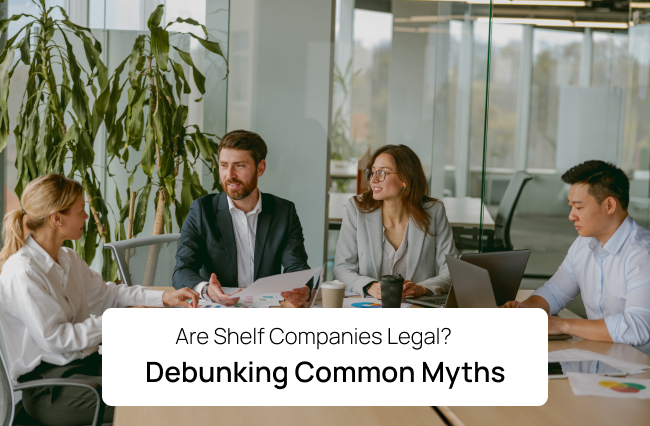
Shelf companies are often surrounded by misconceptions. Some entrepreneurs see them as a fast and practical way to acquire an established legal entity, while others associate them with hidden debts, suspicious transactions, or regulatory problems. This confusion can make it difficult for legitimate buyers to understand where shelf companies actually stand from a legal perspective.
The simple answer is that shelf companies can be legally formed, sold, and transferred in many jurisdictions. What matters is how the company has been maintained, how ownership is transferred, whether the buyer completes the required compliance procedures, and how the company is subsequently used. In the UK, official HMRC guidance expressly recognises the sale of “off-the-shelf” firms as an activity carried out by company formation agents and other trust or company service providers.
This guide separates common shelf company myths from reality and explains what buyers should check before acquiring one.
What Is a Shelf Company?
A shelf company is a company that has already been incorporated but has generally been kept inactive until a buyer acquires it. Instead of creating a completely new entity, the buyer takes ownership of an existing registered company and updates its corporate information as required.
A properly maintained shelf company should have clear incorporation documents, an identifiable ownership history, appropriate statutory filings, and no undisclosed liabilities or problematic trading activity. Buyers interested in understanding the concept in greater detail can be Ready Made Companies Worldwide and the available ready-made company options.
Are Shelf Companies Legal?
Yes – the concept of forming companies in advance and later transferring them to buyers is legitimate in jurisdictions where local company law permits it. UK government guidance recognises company formation agents as legitimate service providers, while HMRC guidance specifically discusses agents selling off-the-shelf firms.
However, the legality of the company itself should not be confused with the legality of everything someone might do with it. A legitimate shelf company could still be misused for fraud, false representations, money laundering, tax evasion, or other unlawful activities. Buyers therefore need to comply with ownership disclosure, identity verification, tax, AML, banking, and other requirements relevant to their jurisdiction and activities.
Myth 1 – Shelf Companies Are Illegal
This is perhaps the biggest misconception.
A shelf company does not become illegal simply because it was incorporated before its current owner acquired it. Companies can change shareholders, directors, registered offices, and other corporate information throughout their existence.
The important issue is whether the acquisition and subsequent operation comply with applicable laws. Proper ownership transfer, accurate registry information, identity verification, tax compliance, and transparent business activity are essential.
Myth 2 – Shelf Companies Are the Same as Shell Companies
The terms are sometimes used interchangeably, but they should not automatically be treated as identical.
A shelf company is generally created in advance and kept inactive until acquisition. A shell company is a broader description often applied to an entity with little or no active business operations. Depending on the context and jurisdiction, shell companies can have legitimate purposes, but the term has also become associated with financial crime and opaque corporate structures.
Buyers should focus on the actual history and status of the entity rather than relying solely on labels.
Myth 3 – Every Shelf Company Has Hidden Debts
A properly maintained dormant shelf company should not automatically come with commercial debts simply because it has existed for several years. However, buyers should never accept a seller’s statement of “clean history” without verification.
Before completing a purchase, check
- Statutory filing history
- Tax status
- Outstanding charges or liabilities
- Previous directors and shareholders
- Evidence of previous trading
- Court judgments or litigation where relevant
- Company accounts and annual filings
- Good-standing status where applicable
Due diligence is what separates a well-maintained ready-made company from an unnecessary acquisition risk.
Also read – Shelf Company Due Diligence.
Myth 4 – Buying an Older Company Automatically Gives You Business Credibility
An older incorporation date can demonstrate that the legal entity has existed for a longer period, but that does not mean the company has been actively trading throughout that time.
Banks, lenders, investors, suppliers, and procurement departments may distinguish between company age and trading history. A company incorporated five years ago but dormant throughout those five years does not have five years of operating revenue, customers, audited trading results, or commercial performance.
Buyers should therefore never represent an incorporation date as evidence of trading activity that did not occur.
Myth 5 – A Shelf Company Guarantees Bank Account Approval
No company structure can guarantee bank account approval.
Banks conduct their own KYC, AML, source-of-funds, ownership, business activity, and risk assessments. An older incorporation date may be relevant to some institutions, but it does not override their onboarding requirements.
The new owner should be prepared to provide identification, beneficial ownership information, business plans, expected transaction details, source-of-funds evidence, and other documents requested by the bank.
Myth 6 – A Shelf Company Automatically Gives You Access to Credit
Company age alone does not create a strong credit profile.
Lenders can consider the company’s financial performance, revenue, ownership, directors, business model, repayment capacity, security, credit history, and other risk factors. A dormant company that has never borrowed or traded does not suddenly acquire years of positive credit history simply because its incorporation date is older.
Buyers should be particularly cautious of sellers promising guaranteed loans, instant credit limits, or financing solely because a company is aged.
Myth 7 – Shelf Companies Guarantee Tender Eligibility
An established incorporation date may help where a tender genuinely requires the bidder to have existed for a minimum period. However, many procurement exercises evaluate much more than incorporation age.
Tender requirements may include previous contracts, audited accounts, turnover thresholds, insurance, licences, staff qualifications, references, technical capability, and proven operating experience.
Never assume that acquiring a three-year-old shelf company gives you three years of trading experience. Review the tender conditions before buying a company specifically for procurement purposes.
Myth 8 – Ownership Can Be Transferred Without Compliance Checks
Modern company regulation is moving in the opposite direction.
In the UK, compulsory Companies House identity verification for directors and people with significant control came into effect on 18 November 2025. Companies House guidance states that people setting up, running, owning, or controlling UK companies can be subject to identity verification requirements.
Corporate service providers also face tighter requirements. Companies House requires agents carrying out relevant activities to register as Authorised Corporate Service Providers where applicable, with AML supervision forming part of the framework.
A legitimate shelf company transaction should therefore involve transparent identification and ownership procedures rather than attempts to avoid them.
Myth 9 – You Cannot Change a Shelf Company’s Details
Buying a shelf company does not necessarily mean keeping its original corporate details permanently.
Depending on the jurisdiction and applicable rules, buyers may be able or required to update information such as
- Directors
- Shareholders
- Persons with significant control
- Registered office
- Company name
- Business activities
- Accounting information
- Tax registrations
The important point is that changes must be made correctly and reported to the relevant authorities within applicable deadlines.
Myth 10 – Shelf Companies Are Only Used for Suspicious Purposes
Shelf companies can have legitimate commercial uses. A buyer might need an existing legal entity for faster market entry, a particular incorporation date, an international expansion project, or another genuine business requirement.
Regulators focus heavily on transparency because corporate entities can also be abused. Companies House reforms have expanded identity verification and strengthened the integrity of the UK company register specifically to make fraudulent use more difficult.
The appropriate question is therefore not simply whether a company is a shelf company. Buyers should ask who owns it, where it came from, whether it has been maintained correctly, why it is being purchased, and whether the transaction complies with applicable law.
How to Buy a Shelf Company Legally and Safely
A legitimate acquisition should be transparent from enquiry through to ownership transfer. Buyers should first identify why they need a shelf company and select an appropriate jurisdiction and entity rather than simply choosing the oldest company available.
A sensible process generally involves
- Select a reputable shelf company provider.
- Review the company’s incorporation and filing history.
- Confirm that it has no undisclosed liabilities or problematic activity.
- Complete required KYC and identity verification.
- Review the ownership transfer documentation.
- Update directors, shareholders and beneficial ownership information.
- Complete relevant registry filings.
- Address banking, tax, licensing and ongoing compliance requirements.
Businesses considering a UK entity can explore available UK shelf companies and compare suitable options based on their commercial requirements.
Red Flags Buyers Should Never Ignore
The legality of shelf companies does not mean every seller or every company on the market is trustworthy. A buyer should be cautious if a provider refuses to disclose company records, guarantees bank financing, promises an established trading history for a dormant entity, or encourages inaccurate representations about the company’s past.
Other warning signs include unexplained previous transactions, missing statutory documents, overdue filings, undisclosed directors or shareholders, unusually complex ownership structures, and pressure to complete the transaction before independent checks can be performed.
Legal Compliance After You Buy
Due diligence does not end when ownership transfers.
The new owner becomes responsible for keeping the company compliant. Depending on the jurisdiction and business activity, this can include annual accounts, confirmation statements or annual returns, tax registrations, beneficial ownership information, licences, registered office requirements, and regulatory filings.
For UK companies, identity verification is now a particularly important consideration. Directors need to comply with Companies House identity verification requirements, and Companies House states that directors must provide their personal code in connection with relevant company filings.
Shelf Company Myths – Quick Reality Check
| Myth | Reality |
|---|---|
| Shelf companies are illegal | They can be legitimately formed, sold and acquired |
| They always contain hidden debts | A properly maintained entity may be clean, but verification is essential |
| Company age equals trading history | Incorporation age and actual trading history are different |
| Banking is guaranteed | Banks conduct independent KYC and risk assessments |
| Credit is automatically available | Financing depends on broader credit and commercial factors |
| An aged company guarantees contracts | Tender eligibility depends on the specific procurement criteria |
| Buyers can remain anonymous | Ownership and identity disclosure rules may apply |
| No compliance is required after purchase | Ongoing corporate, tax and regulatory obligations remain |
Conclusion
Shelf companies are not inherently illegal or suspicious – they can provide a legitimate route to acquiring an existing corporate entity when there is a genuine commercial reason to do so. The key is transparency – buyers should verify the company’s history, distinguish incorporation age from actual trading experience, complete all required KYC and ownership procedures, and maintain ongoing corporate and tax compliance after acquisition. A reputable provider should be willing to disclose the company’s documentation and explain the transfer process rather than making unrealistic promises about banking, credit, or contracts. If you are considering purchasing a properly maintained shelf company and want help identifying an appropriate option, contact us to discuss your requirements.