
When exploring ready-made businesses in the United States, entrepreneurs often encounter the terms US shelf corporation and shelf company. Although these expressions are frequently used interchangeably, they do not always describe the same legal structure. A shelf company is a broad term for an existing business entity formed and generally kept inactive until purchased, while a shelf corporation specifically refers to an incorporated entity with a corporate legal structure. Understanding this distinction is important because ownership arrangements, taxation, compliance requirements and future investment opportunities can differ considerably. Before acquiring an existing US business, buyers should understand exactly what type of entity they are purchasing and whether it supports their commercial objectives.
What Is a US Shelf Company?
A US shelf company is an existing legal entity that was previously registered and generally kept inactive until a buyer acquires it. Instead of creating a new entity, an entrepreneur purchases an already incorporated or organised business.
The term shelf company describes the entity’s commercial availability and history rather than a specific legal structure.
A US shelf company may therefore be
- A corporation
- A limited liability company (LLC)
- Another eligible legal entity, depending on the jurisdiction
The company may have an earlier incorporation date and existing registration documents, but buyers should verify whether it has genuinely remained dormant.
At Ready Made Companies Worldwide, entrepreneurs can explore established companies in different jurisdictions and identify structures that match their business requirements.
What Is a US Shelf Corporation?
A US shelf corporation is a corporation that has already been incorporated under state law and is being held for future sale. Unlike the broader term shelf company, a shelf corporation specifically has a corporate legal structure.
Corporations generally have shareholders, directors and officers, with governance requirements established through state legislation and corporate documents.A shelf corporation may have been formed several years before being acquired. However, its incorporation age should not be confused with active trading experience.
Main Characteristics of a Shelf Corporation
A typical US shelf corporation may have
- An existing certificate of incorporation
- A registered corporate name
- An earlier incorporation date
- Shareholder and corporate governance records
- Applicable annual filing obligations
Its exact requirements depend on the state where it was incorporated.
Also read – Buying a Shelf Company – 11 Critical Questions You Must Ask
US Shelf Corporation vs Shelf Company – Key Differences
The main distinction is that a shelf corporation describes a particular legal entity type, while a shelf company is a general commercial term.
| Factor | US Shelf Corporation | US Shelf Company |
|---|---|---|
| Meaning | An existing incorporated corporation | An existing entity offered for acquisition |
| Legal Structure | Corporation | Corporation, LLC or another eligible entity |
| Ownership | Shareholders | Depends on the entity type |
| Management | Generally directors and officers | Depends on the legal structure |
| Tax Treatment | Generally corporate taxation, subject to applicable elections | Depends on entity classification |
| Compliance | Corporate filings and governance requirements | Depends on entity type and state |
Important distinction – Every shelf corporation can be described as a shelf company, but not every shelf company is legally a corporation.
How Does a Shelf Corporation Differ From a Shelf LLC?
When purchasing a US shelf company, one of the most important decisions is whether to acquire a corporation or an LLC.
Ownership Structure
Corporations generally issue shares to shareholders.
LLCs, by comparison, have members whose ownership interests are governed by applicable state law and operating agreements.
Both structures can provide limited liability protection, although that protection is subject to legal exceptions.
Management Requirements
Corporations generally operate through directors and officers, with formal governance procedures.
LLCs often provide greater flexibility in management arrangements.
Depending on the state and operating agreement, an LLC may be managed by its members or appointed managers.
Federal Tax Treatment
A domestic C corporation is generally subject to federal corporate income tax.
An LLC’s federal tax treatment depends on its ownership and any applicable tax elections.
According to the IRS, a single-member LLC is generally treated as a disregarded entity for federal income tax purposes unless it elects corporate treatment. A multi-member LLC is generally treated as a partnership unless it makes an appropriate election.
An LLC may also elect to be taxed as a corporation without changing its underlying state-law entity type.
These differences make it important to select the appropriate structure before purchasing.
Why Do Entrepreneurs Buy US Shelf Companies?
Existing companies can appeal to entrepreneurs who prefer acquiring a registered entity rather than forming a new one.
Earlier Incorporation Date
A shelf company may have been registered several years before its acquisition.
This provides an earlier legal formation date, although it does not establish genuine trading experience.
Existing Legal Registration
The entity has already been created under applicable state law.
This may reduce the need to complete the initial incorporation process, although ownership transfer and post-acquisition requirements still apply.
Choice of Business Structures
Buyers may be able to select between existing corporations and LLCs, depending on availability.
This allows entrepreneurs to consider the structure that best supports their intended activities.
International Business Opportunities
Foreign entrepreneurs may consider US entities for international trading, consultancy, investment or other eligible commercial activities.
However, acquiring a US company does not automatically provide immigration rights, banking approval or permission to undertake regulated activities.
Which US States Are Popular for Shelf Companies?
Delaware, Wyoming and Nevada are commonly considered when evaluating US company structures.
Delaware
Delaware is recognised for its established corporate-law framework and extensive body of business case law.
It may be particularly relevant to corporations planning sophisticated ownership arrangements or external investment.
Wyoming
Wyoming is frequently considered for LLC structures because of its comparatively modest minimum annual state maintenance costs.
It may appeal to privately held businesses seeking a straightforward legal structure.
Nevada
Nevada offers an established corporate framework and a distinctive state tax environment.
However, buyers should evaluate its annual filing and business licence expenses before selecting the jurisdiction.
The best state depends on where the company will operate, its legal structure, tax obligations and future commercial requirements.
Does a Shelf Corporation Offer Better Business Credit?
Not automatically. One common misconception is that an older shelf corporation immediately provides stronger business credit than a newly registered company. In reality, incorporation age and creditworthiness are different considerations. A corporation established several years ago may never have traded, obtained financing or maintained a business bank account.
Banks and lenders may assess
- Current beneficial owners
- Financial performance
- Existing credit obligations
- Business activities
- Source of funds
- Supporting documentation
Neither a shelf corporation nor a shelf LLC guarantees credit approval. Buyers should be cautious of sellers promising automatic financing based solely on incorporation age.
How to Choose Between a Shelf Corporation and Shelf LLC
Choosing the appropriate entity requires evaluating both legal structure and commercial objectives.
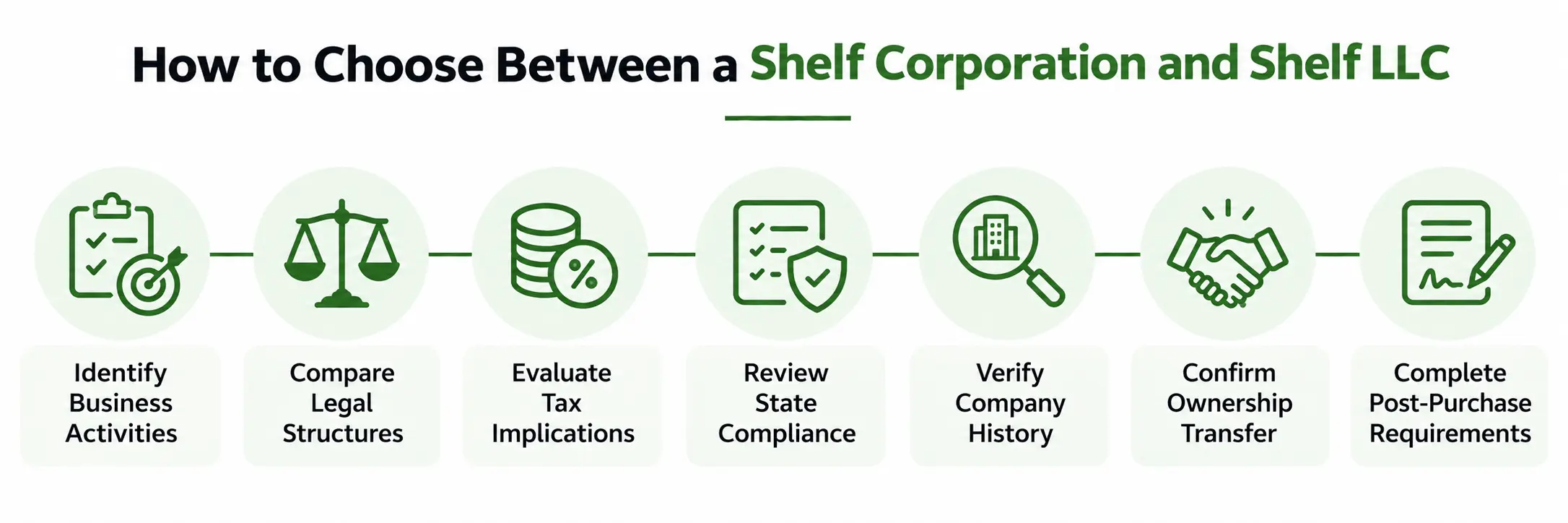
Step 1 – Identify Your Business Activities
Determine what the company will do and whether its intended activities require specific licences or approvals.
Step 2 – Compare Legal Structures
Assess whether a corporation or LLC better supports your ownership arrangements and management requirements.
Step 3 – Evaluate Tax Implications
Consider federal taxation, state obligations and the owners’ tax residence.
Step 4 – Review State Compliance Requirements
Check annual reports, franchise taxes, registered-agent requirements and other recurring obligations.
Step 5 – Verify Company History
Review incorporation records, financial statements, previous activities and any outstanding liabilities.
Step 6 – Confirm Ownership Transfer
Ensure the seller has legal authority to transfer the entity and that the appropriate documents are completed.
Step 7 – Complete Post-Purchase Requirements
Address applicable tax registrations, banking applications, licences and statutory updates before commencing operations.
Entrepreneurs interested in acquiring an existing US entity can review available US Shelf Companies and compare suitable structures.
Important Compliance Requirements for US Shelf Companies
Purchasing an existing company does not eliminate its legal or tax responsibilities.
Both corporations and LLCs may need to maintain registered agents, submit state filings and satisfy applicable tax obligations.
Foreign-owned entities may also face additional federal reporting requirements depending on their classification and transactions.
Beneficial Ownership Reporting
Under FinCEN’s final rule effective August 14, 2026, companies created in the United States are exempt from federal Beneficial Ownership Information reporting under the Corporate Transparency Act.
Certain foreign entities registered to do business in the United States remain subject to the revised reporting framework.
This exemption does not eliminate tax reporting, banking verification or other applicable regulatory obligations.
Conclusion
A US shelf corporation and shelf company are closely related terms, but they are not always identical. A shelf corporation specifically refers to an existing incorporated corporation, while a shelf company is a broader term that can include corporations, LLCs and other eligible business entities.
The most suitable option depends on ownership requirements, tax treatment, management preferences and future business plans. Before purchasing, verify the company’s legal standing, historical records and ongoing obligations rather than relying solely on its age.
For assistance with selecting an appropriate ready-made US business, Contact Us to discuss your requirements.