
Starting a business in the United States involves several important decisions, including whether to purchase an existing shelf company or establish a new Limited Liability Company (LLC). Both options provide a legal business structure, but they differ in acquisition costs, incorporation timelines, administrative requirements, and long-term flexibility. A US shelf company offers an existing incorporation date and a ready-made legal entity, while forming a new LLC allows entrepreneurs to establish a business with a fresh corporate history. Understanding these differences can help business owners, foreign investors, and startups choose the most practical and cost-effective route into the US market.
What Is a US Shelf Company?
A US shelf company is a business entity that has already been legally registered but has generally remained inactive. These companies are established in advance and maintained until an entrepreneur or investor purchases them. Unlike a newly formed business, a shelf company already has an incorporation or formation date, state registration records, and an existing legal identity.
For example, an LLC registered in Delaware several years ago may be available for purchase today. Once ownership is transferred, the buyer can use the existing entity for legitimate business activities, subject to completing the necessary compliance requirements.
Businesses considering this option can review available services through Ready Made Companies Worldwide.
However, purchasing an existing entity does not mean acquiring an established customer base, operational history, or guaranteed financial credibility.
What Does Forming a New LLC Involve?
Forming a new LLC means establishing a completely new legal entity under the laws of a chosen US state. The owner selects a business name, appoints a registered agent, submits the required formation documents, and completes applicable tax and administrative registrations. Popular formation states include Delaware, Wyoming, and Nevada, although the most suitable state depends on where the business will operate.
A newly formed LLC generally provides
- A fresh corporate history without inherited business liabilities.
- Flexibility to select a preferred company name.
- Control over ownership and management arrangements.
- Lower initial costs in many cases.
- A straightforward structure for small businesses and startups.
However, the business must establish its own commercial relationships, financial records, and operating history.
US Shelf Company vs New LLC – Cost Comparison
Cost is often the first consideration when choosing between purchasing an existing company and forming a new LLC.
Cost of Buying a US Shelf Company
The price of a shelf company depends on its age, state of registration, corporate records, and the services included in the acquisition.
Illustrative market price ranges include
- Recently registered companies – $500–$1,000
- Companies aged 1–2 years – $1,000–$2,000
- Companies aged 3–5 years – $2,000–$5,000
- Older companies – $5,000 or more
These figures are indicative rather than guaranteed quotations. Actual prices depend on the provider and the specific company.
Additional expenses may include legal review, ownership-transfer documentation, registered agent services, and state filing charges.
Buyers should request a complete breakdown before purchasing.
Cost of Forming a New LLC
Forming a new LLC generally involves lower upfront expenses.
For example, Wyoming charges a $100 LLC formation fee, while Delaware’s standard LLC formation filing fee is $110.
Additional expenses can include registered agent services, professional assistance, business licences, and ongoing state compliance.
Some entrepreneurs complete the filing themselves, while others use a formation service.
Cost Comparison Table
| Cost Factor | US Shelf Company | New LLC |
|---|---|---|
| Initial cost | Often $500–$5,000+ | State filing fee plus services |
| State registration | Already completed | Required |
| Registered agent | Ongoing expense | Ongoing expense |
| Legal documentation | Transfer-related costs | Formation-related costs |
| Due diligence | Extensive checks recommended | Generally simpler |
Important – The purchase price is only part of the total cost. Both options may involve recurring state fees, registered agent charges, tax preparation, and licensing expenses.
US Shelf Company vs New LLC – Timeline Comparison
The timeline can be just as important as the purchase price, particularly for entrepreneurs planning a time-sensitive market entry.
How Long Does Buying a Shelf Company Take?
Because the company already exists, buyers do not need to wait for a new incorporation filing. However, the acquisition still involves several activities. These may include selecting a suitable company, verifying its history, completing due diligence, preparing transfer documents, and updating relevant corporate records.
A straightforward transfer may take a few business days once documentation is ready, while a transaction requiring more extensive checks can take longer. Banking and tax arrangements may extend the overall operational timeline.
How Long Does New LLC Formation Take?
New LLC formation timelines vary significantly by state.
Wyoming allows eligible online business registrations to become active immediately after successful filing.
Delaware offers expedited filing services, including same-day processing for an additional charge, subject to applicable submission requirements.
Standard processing times depend on state workloads and filing methods.
Consequently, purchasing a shelf company is not always faster than forming a new LLC.
Which Option Is Faster?
For entrepreneurs who simply need a newly registered business entity, online LLC formation may be the quickest solution.
A shelf company may be more suitable when the buyer specifically needs an existing incorporation date.
The relevant comparison is not simply how quickly the company can be acquired or registered, but how long it takes to become fully operational.
Benefits of Buying a US Shelf Company
Existing Incorporation Date
A shelf company retains its original formation date after ownership changes.
This may be useful where a legitimate commercial requirement concerns the age of the legal entity.
However, company age should never be represented as evidence of trading activity that did not occur.
Existing Corporate Structure
The company already has a legal identity and registration records.
This can eliminate the need to establish an entirely new entity, although ownership records and administrative arrangements may require updating.
Potential Market Entry Advantages
Businesses expanding internationally may prefer acquiring an existing entity when its incorporation date or corporate structure supports a particular transaction.
Entrepreneurs interested in available options can review US shelf companies to assess whether a ready-made entity matches their requirements.
Benefits of Forming a New LLC
Lower Initial Investment
A new LLC is often the more economical choice, particularly for startups with limited budgets.
Owners avoid paying a premium for an older incorporation date that may not provide any practical advantage.
Clean Corporate History
A newly established LLC begins without the previous filing history or potential undisclosed obligations associated with acquiring another entity.
This reduces historical due-diligence concerns, although ongoing compliance remains essential.
Greater Flexibility
Entrepreneurs can choose their preferred company name, ownership structure, registered agent, and management arrangements from the beginning.
This is particularly useful for businesses developing a new brand or operating model.
Risks and Legal Considerations
Both approaches require proper legal and regulatory compliance.
Hidden Liabilities
A shelf company may have unpaid fees, outstanding obligations, incomplete filings, or other issues that are not immediately obvious.
Buyers should investigate these matters before completing a purchase.
Banking Requirements
Neither option guarantees a US business bank account.
Banks generally review ownership information, identification documents, business activities, and financial risk.
An older company without genuine trading history should not be assumed to qualify more easily for financing.
Tax Compliance
Both new and acquired LLCs may have federal and state tax obligations.
These depend on factors including ownership, tax classification, business activities, and the states involved.
Foreign-owned single-member LLCs may also have specific IRS reporting requirements, including Form 5472 with a pro forma Form 1120 when applicable.
Beneficial Ownership Reporting
Under FinCEN’s final rule effective August 14, 2026, entities created in the United States are exempt from federal Corporate Transparency Act beneficial ownership information reporting.
This exemption does not eliminate applicable state-level requirements, bank verification procedures, or other regulatory obligations.
For a more detailed explanation of acquisition checks,
Also read – How to Buy a Shelf Company – Step-by-Step Guide.
How to Choose Between a US Shelf Company and a New LLC
Choosing the right option requires comparing business objectives, financial resources, and operational requirements.
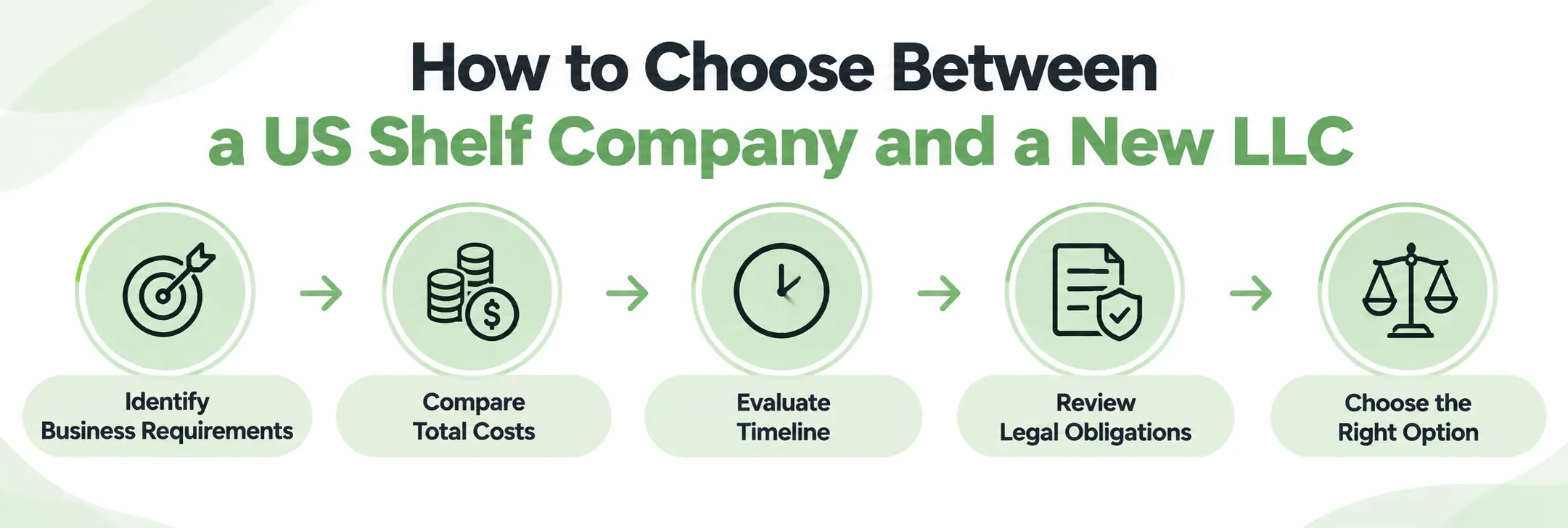
Step 1 – Identify Your Business Requirements
Determine whether an existing incorporation date provides a genuine commercial benefit.
If company age is irrelevant, new LLC formation may be more practical.
Step 2 – Compare Total Costs
Calculate the complete cost of purchasing or forming the company, including legal assistance, registered agent fees, state charges, and ongoing compliance.
Step 3 – Evaluate the Timeline
Compare the expected acquisition or formation date with the time required for banking, tax registration, and operational readiness.
Step 4 – Review Legal and Tax Obligations
Consider the state of registration, ownership structure, tax classification, and reporting requirements.
For shelf companies, investigate historical compliance and potential liabilities.
Step 5 – Select the Most Suitable Option
Choose a shelf company when an existing entity provides a specific commercial advantage.
Choose new LLC formation when lower costs, flexibility, and a fresh corporate history are more important.
Conclusion
A shelf company can provide an established legal entity, but buyers must consider acquisition costs, historical liabilities, and ownership-transfer requirements. A newly formed LLC generally offers lower initial costs, greater flexibility, and a clean corporate history.
Neither option automatically guarantees faster banking, improved creditworthiness, or immediate operational readiness.
For entrepreneurs evaluating available US ready-made companies, Contact Us to discuss suitable options and understand the requirements involved in acquiring an existing business entity.