
Choosing between a Delaware, Wyoming and Nevada shelf company can significantly influence your business’s ongoing costs, legal structure and future growth opportunities. All three states offer established company formation frameworks, but their advantages differ depending on your commercial objectives. Delaware is widely recognised for its sophisticated corporate laws and investor familiarity, Wyoming attracts entrepreneurs seeking affordable LLC maintenance, and Nevada appeals to businesses interested in its corporate protections and state tax environment. Understanding the differences in annual fees, ownership requirements, compliance obligations and business suitability is essential before purchasing an existing US company.
What Is a US Shelf Company?
A shelf company is a previously incorporated business entity that has generally remained inactive until a buyer acquires it. Unlike establishing a completely new company, purchasing a shelf company involves transferring ownership of an existing legal entity.
These companies may already possess incorporation documents, registration numbers and an earlier incorporation date.
However, an older company does not automatically have established credit, trading experience or banking relationships.
At Ready Made Companies Worldwide, entrepreneurs can explore existing companies across different jurisdictions and assess suitable acquisition options.
Delaware Shelf Companies – Corporate Flexibility and Investor Appeal
Delaware is among the most established corporate jurisdictions in the United States.
Its corporate legal system, particularly the Delaware Court of Chancery, provides a specialised framework for resolving business disputes.
This makes Delaware especially relevant to companies anticipating sophisticated ownership arrangements, investment rounds or future restructuring.
Why Choose Delaware?
Delaware offers several potential advantages
- Established corporate legislation and extensive legal precedents
- Familiarity among institutional investors
- Flexible corporate governance arrangements
- Suitable structures for corporations and LLCs
However, Delaware is not automatically the most economical choice.
Under current Delaware Division of Corporations guidance, LLCs must pay a $400 annual tax, while corporations face separate franchise tax and annual reporting requirements.
Wyoming Shelf Companies – Lower Costs and LLC Flexibility
Wyoming is frequently considered by entrepreneurs seeking a straightforward business structure with comparatively modest annual state fees.
Its LLC framework is particularly attractive to privately held businesses, consultants and smaller international enterprises.
Why Choose Wyoming?
Key considerations include
- Minimum annual licence tax of $60
- No individual or corporate state income tax
- Established LLC legislation
- Relatively straightforward annual reporting
- Potential suitability for owner-managed businesses
Wyoming’s annual licence tax for relevant entities is $60 or 0.0002 of assets located and employed in the state, whichever is greater.
Annual reports are generally due on the first day of the anniversary month of incorporation.
These features make Wyoming worth considering when keeping recurring state-level expenses manageable is a priority.
Nevada Shelf Companies – Business Protections and Tax Considerations
Nevada is another established jurisdiction for incorporating businesses in the United States.
The state attracts attention because of its corporate laws, absence of individual and corporate state income taxes, and established business environment.
However, Nevada’s annual maintenance expenses are generally higher than Wyoming’s minimum charges.
Why Choose Nevada?
Potential advantages include
- No state individual income tax
- No traditional state corporate income tax
- Established corporate and LLC legislation
- Legal protections for qualifying business owners
- Suitable structures for certain privately held businesses
Nevada businesses may still face other state taxes, including the Commerce Tax where applicable.
For LLCs, the annual state business licence renewal fee is generally $200, while the annual list filing fee is generally $150.
This produces a typical combined annual state filing and licence cost of approximately $350 for an LLC, excluding registered-agent and other expenses.
Delaware vs Wyoming vs Nevada Shelf Company – Comparison
The following table highlights important differences between these jurisdictions.
| Factor | Delaware | Wyoming | Nevada |
|---|---|---|---|
| Main Advantage | Corporate law and investor familiarity | Lower annual costs | Corporate protections and tax environment |
| Typical Business Suitability | Investment-focused companies | Small businesses and LLCs | Privately held companies |
| Minimum Annual LLC State Cost | $400 | $60 | Approximately $350 |
| Annual LLC Filing | Annual tax; no annual report | Annual report and licence tax | Annual list and business licence |
| State Income Tax | Depends on entity and activities | No individual or corporate income tax | No individual or corporate income tax |
The figures represent typical state-level LLC obligations, not complete operating costs. Additional taxes, registered-agent fees and professional expenses may apply.
Which State Offers Better Business Privacy?
Privacy is frequently discussed when comparing Delaware, Wyoming and Nevada shelf companies.
However, privacy should not be confused with anonymity.
Delaware
Delaware LLCs generally do not need to identify their members publicly in their initial formation documents.
Nevertheless, registered-agent requirements and other legal obligations still apply.
Wyoming
Wyoming offers a relatively straightforward LLC registration framework, and member information is not necessarily included in public formation filings.
However, certain company information remains publicly accessible.
Nevada
Nevada requires LLCs to file lists identifying managers or managing members, making certain management information publicly available.
In all three states, banks and other regulated institutions may require beneficial ownership information during customer verification.
Therefore, entrepreneurs should assess actual disclosure requirements rather than relying on general claims about corporate privacy.
Which State Is Better for Business Banking?
A Delaware, Wyoming or Nevada shelf company may be eligible to apply for US business banking services.
However, the state of incorporation does not guarantee approval.
Financial institutions typically assess:
- Beneficial ownership and identification
- Intended business activities
- Source of funds
- Supporting corporate documents
- Business location and operational requirements
An aged shelf company may have an earlier incorporation date without possessing any genuine trading or credit history.
For additional information about selecting a suitable US company
Also read – Delaware vs Wyoming Shelf Company
Which State Is Best for Different Business Requirements?
Startups Seeking Investment
Delaware may be particularly suitable for startups planning institutional fundraising or sophisticated equity arrangements.
Its established corporate framework is familiar to many investors and professional advisers.
Small Online Businesses
Wyoming may appeal to owner-managed e-commerce businesses, consultants and online service providers seeking relatively low annual state maintenance costs.
Privately Held Companies
Nevada may be considered by businesses interested in its corporate legislation and tax environment.
However, its higher recurring state fees should be weighed against any practical advantages.
International Entrepreneurs
Foreign investors can consider all three jurisdictions, subject to applicable ownership, tax and regulatory requirements.
The appropriate choice depends on the company’s activities, owners’ tax residence and where business operations will take place.
How to Choose Between Delaware, Wyoming and Nevada
Selecting a shelf company should involve more than comparing incorporation dates or advertised prices.
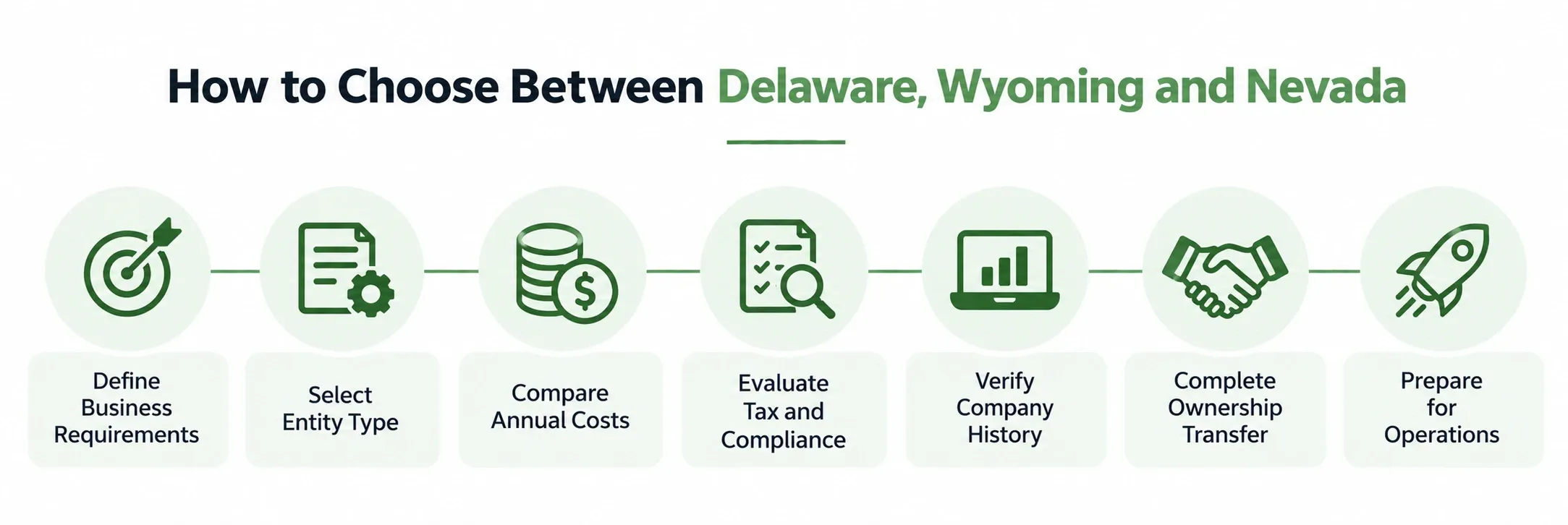
Step 1 – Define Your Business Requirements
Identify your intended activities, target market, ownership structure and long-term commercial objectives.
Step 2 – Select the Appropriate Entity Type
Determine whether an LLC or corporation better supports your intended tax treatment, management structure and investment plans.
Step 3 – Compare Annual State Costs
Review franchise taxes, annual reports, business licence fees and registered-agent expenses.
Step 4 – Evaluate Tax and Compliance Requirements
Consider federal taxes, state obligations and potential registration requirements in other states where the company will operate.
Step 5 – Verify the Company’s History
Check incorporation records, previous filings, financial history and any outstanding liabilities.
Step 6 – Complete Ownership Transfer
Arrange the required ownership documents, corporate resolutions and statutory updates.
Step 7 – Prepare for Business Operations
Complete applicable tax registrations, banking applications, licences and other requirements before trading.
Entrepreneurs exploring US business ownership can review available US Shelf Companies to identify suitable options.
Important Compliance Considerations
Purchasing an existing company does not eliminate regulatory responsibilities.
Each state requires businesses to maintain their legal status and complete applicable filings.
Federal tax obligations may also apply, particularly where foreign ownership is involved.
Under FinCEN’s current Corporate Transparency Act rules, entities created in the United States are exempt from federal Beneficial Ownership Information reporting. Certain foreign entities registered to conduct business in the US remain subject to the revised requirements.
This exemption does not remove tax, licensing or banking verification obligations.
Businesses operating outside their incorporation state may also need foreign qualification in the state where they conduct business.
Conclusion
The Delaware vs Wyoming vs Nevada shelf company comparison demonstrates that each jurisdiction offers different advantages.
Delaware is often suitable for investment-oriented companies requiring an established corporate-law environment, while Wyoming can provide lower recurring state costs for smaller LLCs. Nevada offers an alternative corporate framework but generally involves higher annual LLC maintenance expenses than Wyoming.
Before purchasing, entrepreneurs should evaluate the company’s legal history, tax obligations, ownership structure and intended operations rather than relying solely on incorporation age.
For assistance with selecting an appropriate ready-made US company, Contact Us to discuss your requirements.