

Buying a shelf company in the USA as a non-resident can be a practical way to establish a business presence in the American market without forming a completely new entity. A shelf company is a legally registered business that has already been incorporated and is available for purchase. International entrepreneurs may consider this option to acquire an existing corporate registration, simplify certain administrative steps, and begin their US business journey. However, understanding the legal requirements, ownership transfer procedures, taxation, and compliance obligations is essential before purchasing a US shelf company.
What Is a Shelf Company in the USA?
A shelf company, sometimes called a ready-made company or aged corporation, is a business entity registered in the United States and maintained for future sale.
These companies are typically created without conducting significant commercial activities. They remain registered until an entrepreneur or investor purchases them.
A US shelf company may offer several features
- An existing company registration date.
- A registered business name.
- An established legal entity.
- Existing incorporation documents.
- A registered agent, depending on the package.
- A potentially faster starting point than incorporating a new entity.
However, a shelf company’s age does not automatically provide business credit, banking approval, or financial credibility. These depend on its actual history and the requirements of financial institutions.
For international entrepreneurs interested in acquiring an established business entity, Ready Made Companies Worldwide provides information about shelf company options across different jurisdictions.
Can a Non-Resident Buy a Shelf Company in the USA?
Yes. Non-US residents can generally purchase and own American limited liability companies (LLCs) and corporations without holding US citizenship or permanent residency.
The United States allows foreign entrepreneurs to own many types of businesses, although certain regulated industries and transactions may have additional restrictions.
Non-resident buyers should consider the following requirements
- A valid passport or other acceptable identification.
- Proof of residential address.
- Identification of the ultimate beneficial owner.
- A registered agent in the company’s state of registration.
- Appropriate ownership transfer documents.
- Compliance with applicable federal and state tax requirements.
Depending on the company’s structure and the buyer’s circumstances, additional documentation may be necessary.
Importantly, purchasing a US shelf company does not automatically provide a US visa, immigration status, or permission to work in the United States.
Also read: How to Verify the Legitimacy of a Shelf Company Before Buying
Benefits of Buying a US Shelf Company as a Non-Resident
Purchasing a ready-made company can offer several advantages for international business owners.
1. Existing Company Registration
A shelf company has already completed its initial incorporation process. Buyers acquire an existing legal entity rather than submitting a new formation application.
This can reduce some administrative work, although ownership changes and regulatory updates may still take time.
2. Established Incorporation Date
An aged shelf company has a registration date that predates its purchase.
This may be useful when demonstrating how long the legal entity has existed. However, incorporation age should not be confused with an established trading history.
3. Access to the US Business Market
Owning a US company can provide a legal structure for entering the American market, entering commercial agreements, and conducting permitted business activities.
Non-resident entrepreneurs may use the entity for international consulting, e-commerce, technology services, or other lawful commercial operations.
4. Flexible Ownership Options
Many US LLCs and corporations allow foreign ownership, making them suitable for international entrepreneurs.
The appropriate structure depends on ownership arrangements, tax considerations, financing plans, and long-term business objectives.
How to Buy a Shelf Company in the USA as a Non-Resident – Step-by-Step Process
Buying a US shelf company requires careful planning and verification. Following a structured process helps reduce legal, financial, and operational risks.
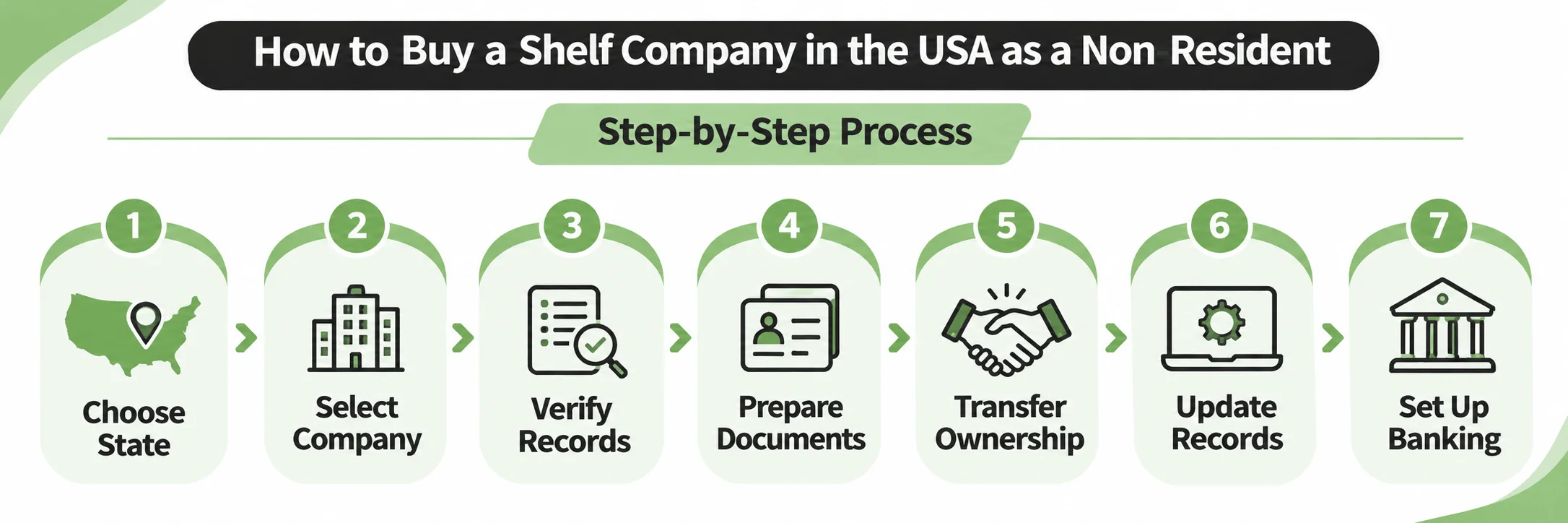
Step 1 – Choose the Right US State
The first step is selecting the state where the shelf company is registered.
Delaware, Wyoming, and Nevada are commonly considered because of their business entity laws and corporate administration frameworks.
However, the best state depends on where the business will operate, its legal structure, and its tax obligations.
Step 2 – Select a Suitable Shelf Company
Choose a company based on its registration date, entity type, legal status, and documented history.
Before making a decision, request the incorporation documents, ownership information, and available compliance records.
Avoid selecting a company solely because it is older.
Step 3 – Conduct Legal and Financial Due Diligence
Verify that the company is legally registered and in good standing with the relevant state authority.
Review its tax history, debts, contracts, litigation records, and previous ownership.
Where appropriate, obtain confirmation that the company has never traded or incurred liabilities.
Step 4 – Prepare Identification and KYC Documents
Non-resident buyers generally need to provide identity verification documents to the seller or service provider.
These may include a passport, proof of address, and information about the source of funds.
Additional documents may be requested depending on the transaction and applicable anti-money laundering requirements.
Step 5 – Complete the Ownership Transfer
Once verification is complete, the buyer and seller execute the appropriate transfer documents.
For an LLC, this may involve transferring membership interests and updating the operating agreement.
For a corporation, the process may involve transferring shares, updating the stock ledger, and making necessary director or officer changes.
Step 6 – Update Company Records and Tax Information
After the transfer, update the company’s internal records, registered agent information, and relevant state filings.
Review whether the IRS requires a new Employer Identification Number (EIN) or an update to the responsible party information.
An existing EIN does not necessarily remain appropriate after every ownership or structural change.
Step 7 – Apply for Business Banking and Begin Operations
With the ownership transfer completed, the new owner can approach suitable financial institutions to apply for a business account.
Banks may request ownership documents, identification, company records, and information about the proposed business activities.
Bank account approval is not guaranteed, particularly for non-resident owners.
Once the necessary registrations, banking arrangements, and compliance requirements are satisfied, the company can begin operating.
Best US States for Buying a Shelf Company
Different states offer different legal and administrative advantages. Delaware, Wyoming, and Nevada are frequently considered by international entrepreneurs.
| State | Main Advantage | Important Consideration |
|---|---|---|
| Delaware | Established corporate legal framework | Franchise taxes and annual requirements |
| Wyoming | Relatively straightforward LLC administration | Annual reports and registered agent requirements |
| Nevada | Business-oriented corporate laws | State filing fees and recurring compliance costs |
Which state should you choose?
Delaware may suit businesses seeking investment or a familiar corporate legal framework. Wyoming is often considered for smaller LLC operations, while Nevada may appeal to entrepreneurs evaluating alternative corporate structures.
However, incorporating or purchasing a company in one state does not necessarily eliminate registration or tax obligations in another state where the business operates.
Documents Required to Buy a US Shelf Company
Non-resident buyers should prepare the necessary documents before starting the purchase.
Common requirements include:
- Valid passport or government-issued identification.
- Proof of residential address.
- Beneficial ownership information.
- Completed KYC documentation.
- Signed purchase and ownership transfer agreement.
- Company formation and registration documents.
- Relevant tax and compliance records.
How Much Does a US Shelf Company Cost?
The cost of purchasing a US shelf company depends on its age, state of incorporation, legal structure, and included services.
An older company may command a higher price, but age alone should not determine its value.
Buyers should evaluate the total acquisition cost, including:
- Shelf company purchase price.
- Ownership transfer and documentation fees.
- Registered agent charges.
- State annual report and franchise tax obligations.
- Legal and accounting services.
- Any outstanding liabilities or compliance expenses.
Legal and Tax Considerations for Non-Resident Owners
Buying an existing American company creates ongoing legal and tax responsibilities.
Federal and State Tax Obligations
Tax requirements depend on the entity’s classification, ownership, activities, and applicable federal and state laws.
For example, a foreign-owned single-member LLC treated as a disregarded entity may need to submit IRS Form 5472 with a pro forma Form 1120 when it has reportable transactions.
Other entities may have different filing obligations.
Foreign ownership does not automatically eliminate US tax reporting requirements.
Beneficial Ownership Reporting
As of November 2026, US-created entities are exempt from federal beneficial ownership information reporting to FinCEN under the Corporate Transparency Act.
However, banks and other regulated institutions may still require beneficial ownership information during their verification procedures.
State-level disclosure requirements may also apply. Buyers should confirm the current rules before completing a transaction.
Registered Agent Requirements
US LLCs and corporations generally must maintain a registered agent in their state of formation.
The registered agent receives official legal notices and other documents on behalf of the company.
Failure to maintain a registered agent can affect the company’s compliance status.
Annual Reports and Renewals
Depending on the state and entity type, businesses may need to submit annual reports, pay franchise taxes, or maintain other registrations.
Non-resident owners should understand these obligations before purchasing a shelf company.
Conclusion
Buying a shelf company in the USA as a non-resident can provide an alternative to forming a new business entity. With an existing registration, flexible ownership possibilities, and access to the American business environment, shelf companies may appeal to international entrepreneurs seeking a practical starting point.
However, selecting a legitimate company, reviewing its history, completing ownership transfers, and meeting tax obligations are essential to a successful acquisition.
If you are considering purchasing a US shelf company, contact Ready Made Companies Worldwide to discuss your requirements and explore suitable options.