

An off-the-shelf company, also known as a shelf company, ready-made company, or aged company, is a company that has already been legally incorporated but has generally remained inactive and unused until it is purchased. The company already has an incorporation date and registration number, although it may have no trading history, revenue, assets, or customer base.
Buying an off-the-shelf company can therefore give entrepreneurs access to an existing corporate structure without having to complete the entire incorporation process themselves. However, the benefits depend heavily on the company’s jurisdiction, compliance status, history, and the quality of the provider.
In this guide, we explore the key benefits of buying an off-the-shelf company for your business, the potential risks, and the factors you should consider before making a purchase.
What Is an Off-the-Shelf Company?
An off-the-shelf company is a previously incorporated legal entity that has been kept inactive or dormant and is later made available for purchase.
Unlike an operating business, a genuine shelf company normally does not have an established customer base, revenue stream, employees, trading contracts, or operational history. Its primary value comes from the fact that the legal entity has already been created and has an existing incorporation date and registration number.
Once purchased, ownership and management details can generally be updated according to the rules of the relevant jurisdiction. Depending on local regulations, this may include changing the directors, shareholders, registered office, company name, and business activities.
This makes an off-the-shelf company particularly attractive to entrepreneurs who want a faster route to establishing a corporate presence.
Faster Business Setup
One of the biggest benefits of buying an off-the-shelf company is speed.
When you incorporate a new company, you may need to select a company name, prepare incorporation documents, submit applications, wait for registration, and complete additional administrative procedures.
With an off-the-shelf company, the basic legal entity has already been incorporated. Instead of beginning the registration process from zero, you acquire an existing entity and complete the ownership and management transfer process.
This can be particularly useful when you have a business opportunity that requires you to establish a company quickly.
For example, an entrepreneur preparing to enter a new market may prefer to acquire a ready-made company rather than wait for a new incorporation application to be completed.
However, faster incorporation does not necessarily mean that the company is immediately ready for every business activity. Bank accounts, licences, tax registrations, VAT registrations, sector-specific approvals, and other compliance requirements may still need to be completed.
Access to an Existing Incorporation Date
Another important benefit is that an off-the-shelf company already has an existing incorporation date.
A newly incorporated company starts its corporate age from the day it is registered. An aged shelf company, by contrast, may have been incorporated months or years earlier.
This can be useful in situations where counterparties, suppliers, investors, or commercial partners consider company age as one of several indicators when assessing a potential business relationship.
Some commercial opportunities may also have requirements relating to the minimum age of a company. In such cases, an existing incorporation date may be useful, provided the relevant organisation actually accepts an acquired shelf company for that purpose.
It is important, however, not to confuse company age with business experience.
A company incorporated five years ago but kept dormant for five years does not automatically have five years of trading experience, revenue, customer relationships, or financial performance.
Avoid Starting the Incorporation Process From Scratch
Traditional company formation can involve several administrative tasks.
These may include
- Selecting an available company name
- Preparing incorporation documents
- Registering the company
- Appointing directors
- Recording shareholders
- Establishing a registered office
- Completing statutory filings
- Applying for relevant registrations
An off-the-shelf company can reduce some of these initial formation steps because the legal entity already exists.
Instead, the buyer can focus on transferring the company into their ownership and preparing it for its intended business activities.
For entrepreneurs who value convenience, this can make the process considerably more straightforward.
A Practical Solution for Time-Sensitive Business Opportunities
Business opportunities do not always arrive according to your preferred timeline.
You may need a company quickly because you are negotiating a contract, preparing to enter a market, setting up a new subsidiary, or responding to a commercial opportunity.
In such circumstances, waiting for a traditional incorporation process may create unnecessary delays.
An off-the-shelf company can provide a ready-made corporate structure that may allow you to move through the initial setup stage more quickly.
This is one reason shelf companies are often considered by entrepreneurs, international investors, consultants, contractors, and businesses expanding into new markets.
Greater Flexibility in Structuring Your Business
Many shelf companies are established with relatively standard corporate structures.
After acquisition, subject to local laws and the terms of the transaction, the company can often be adapted to the buyer’s requirements.
This may include changing
- Company name
- Directors
- Shareholders
- Registered office
- Business activities
- Corporate structure
The exact options depend on the jurisdiction and the company’s legal framework.
This flexibility allows buyers to acquire an existing company and then tailor its structure around their business strategy instead of building the corporate entity from the beginning.
Potentially Useful for International Expansion
Off-the-shelf companies can also be considered by businesses expanding internationally.
Suppose an established business wants to create a corporate presence in another jurisdiction. Forming a new subsidiary may require additional registration and administrative work.
An appropriate ready-made company may provide a faster starting point for establishing that presence.
For multinational businesses, this can be especially useful when several corporate entities need to be established as part of a broader expansion strategy.
However, international company ownership involves additional considerations, including tax residency, beneficial ownership reporting, banking requirements, local substance rules, licensing, and cross-border tax obligations.
A shelf company should therefore be viewed as a corporate setup tool rather than a way to bypass regulatory requirements.
A More Convenient Alternative for Entrepreneurs
Entrepreneurs often have limited time and resources.
Instead of spending significant time dealing with administrative formation procedures, purchasing a ready-made company allows them to concentrate on areas such as
- Business planning
- Sales and marketing
- Product development
- Customer acquisition
- Recruitment
- Market expansion
- Strategic partnerships
The convenience factor can be particularly valuable for entrepreneurs who already understand their target market and simply need an appropriate legal structure.
Can Help Meet Certain Company-Age Requirements
Company age can sometimes be relevant in commercial situations.
Certain tenders, supplier arrangements, contracts, or business relationships may require a company to have existed for a specified period. Where the rules permit it, an appropriately aged shelf company can potentially satisfy an age-based requirement sooner than a newly incorporated company.
However, buyers should always verify the specific requirement directly with the organisation involved.
An older incorporation date does not guarantee eligibility, particularly where the requirement is based on actual trading history, financial performance, industry experience, or previous contracts.
Opportunity to Start With a Clean Corporate History
A genuine shelf company is generally established with the intention of remaining unused until it is sold.
This means a properly maintained shelf company can offer a corporate entity without the complicated trading history associated with purchasing an operating business.
A clean shelf company should ideally have
- No trading activity
- No outstanding debts
- No undisclosed liabilities
- No employees
- No ongoing contracts
- No litigation
- No unexplained financial transactions
- Up-to-date statutory filings
This is one of the most important reasons buyers should conduct due diligence before purchasing.
A seller’s statement that a company is “clean” should never replace independent verification.
Easier Separation Between Personal and Business Activities
Using a properly established company can help entrepreneurs maintain a clear distinction between their personal affairs and their business activities.
Once the company is properly transferred and operationalised, the business can maintain its own corporate records, contracts, invoices, accounting records, and banking arrangements.
The exact legal protection offered by a company depends on the jurisdiction and how the company is managed. Directors and shareholders must still comply with applicable laws and cannot assume that incorporation automatically protects them from every personal liability.
What Should You Check Before Buying an Off-the-Shelf Company?
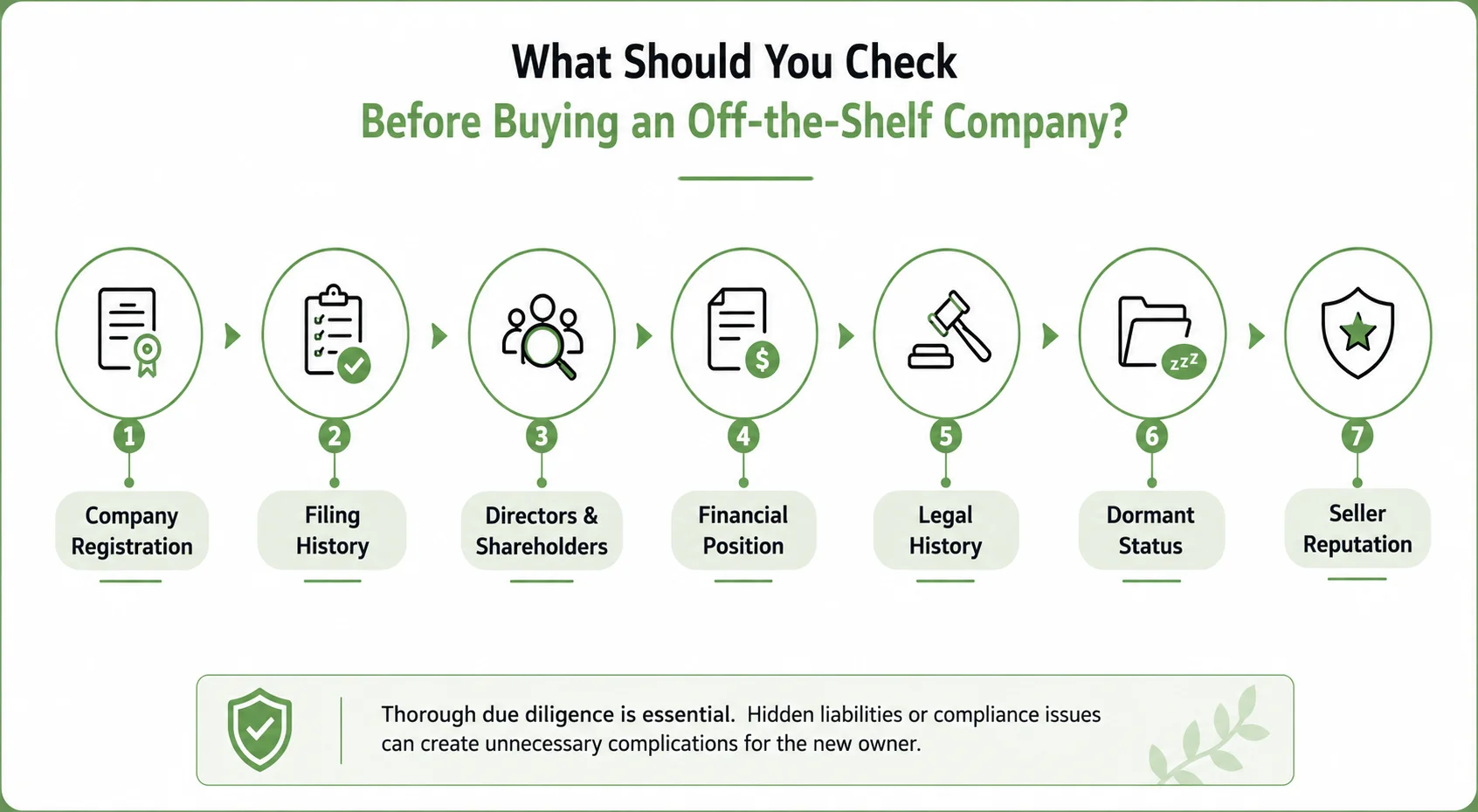
Although buying a shelf company offers several advantages, due diligence is essential.
Before completing a purchase, check the company’s official registration records and confirm its status.
You should ideally verify
Company Registration
Confirm the company’s registration number, incorporation date, legal status, and registered office.
Filing History
Review whether the company’s required annual filings and other statutory obligations have been properly maintained.
Directors and Shareholders
Check the existing directors, shareholders, persons with significant control where applicable, and any previous changes.
Financial Position
Confirm that the company has no undisclosed debts, tax liabilities, loans, or financial obligations.
Legal History
Where possible, check for litigation, charges, insolvency proceedings, or other legal issues.
Dormant Status
If the company is advertised as dormant or unused, verify that its records are consistent with that description.
Seller Reputation
Work with a reputable provider that can demonstrate ownership of the company and provide appropriate documentation.
Thorough due diligence is particularly important because acquiring a company means acquiring the legal entity itself. Hidden liabilities or compliance problems can create unnecessary complications for the new owner.
Off-the-Shelf Company vs. New Company Formation
The right option depends on your priorities.
| Factor | Off-the-Shelf Company | New Company |
|---|---|---|
| Existing incorporation date | Yes | No |
| Registration process | Already completed | Required |
| Setup speed | Usually faster | Depends on jurisdiction |
| Trading history | Usually none | None initially |
| Company age | May be older | Newly incorporated |
| Customisation | Usually possible after purchase | Available during formation |
| Due diligence | Essential | Usually simpler |
| Cost | Purchase price + transfer costs | Formation costs |
| Best for | Speed and existing corporate age | Businesses starting from zero |
If speed and an existing incorporation date are important, an off-the-shelf company may be worth considering.
If you want complete control from day one and do not need an existing company age, forming a new company may be more appropriate.
Is Buying an Off-the-Shelf Company Right for Your Business?
An off-the-shelf company may be suitable if you
- Need a company quickly
- Want an existing incorporation date
- Are expanding into another jurisdiction
- Need a ready-made corporate structure
- Want to avoid starting the incorporation process from scratch
- Have a time-sensitive commercial opportunity
- Prefer a company with a clean, unused history
On the other hand, it may not be appropriate if your business specifically needs an established trading record, proven revenue, existing contracts, or a substantial financial history.
Remember that a shelf company is not the same as buying an existing operating business. You are generally acquiring a previously incorporated legal entity, not an established company with customers and proven revenue.
Final Thoughts
Buying an off-the-shelf company can be a practical solution for entrepreneurs who want to establish a corporate structure quickly and benefit from an existing incorporation date.
The main advantages include faster setup, convenience, corporate age, flexibility, and potential suitability for time-sensitive business opportunities.
However, company age should never be mistaken for trading experience or financial strength. A dormant company does not automatically have a strong reputation, credit history, banking relationship, or commercial track record.
The key to a successful purchase is due diligence.
Before buying, verify the company’s registration status, filing history, directors, shareholders, financial position, legal history, and dormant status. Work with a reputable provider and make sure all ownership and compliance requirements are properly completed.
When carefully selected and correctly transferred, an off-the-shelf company can provide a convenient starting point for entrepreneurs who want to move forward without building their corporate entity from the ground up.